

The question your clients actually type
Owners who test their own firm report two surprises: ChatGPT names them, then drops them when asked to answer as it would for a stranger, because the first answer leaned on their earlier question; and three private windows give three different lists. One screenshot proves little; what counts is being named, consistently, to someone who has never heard of you.
That person rarely asks for “a good accountant”; the situation they describe is the filter. Four shapes dominate: industry plus place (“accountant in Columbus who works with restaurants”), entity or tax situation (“CPA for an S corp with employees in two states”), urgency (“accountant for back taxes and IRS letters near me”) and software or fee (“QuickBooks bookkeeper, fixed fee”). Each carries a constraint the answer must satisfy, so measure the questions your best clients typed before finding you, not the broad one you would like to win.
How the assistants answer, and from what
With web search on, the assistants do not consult a ranking. They run a few searches derived from the question, read a few pages and list whoever those pages describe plainly. For accounting the usual sources are the Google Business Profile and Maps, Yelp, software directories such as QuickBooks ProAdvisor and Xero’s advisor directory, state CPA society directories, licence lookups such as CPA Verify in the US or the ICAEW directory in the UK, Reddit small-business threads, local press and the firms’ own service pages.
Only the last is fully yours, and it carries the constraint. “Tax and advisory for individuals and businesses” matches every question weakly; “Restaurant accounting in Columbus”, listing POS reconciliation, tip reporting and Ohio sales tax, matches the restaurant question and hands the model the sentence it needs to justify naming you. Licence lookups and reviews confirm rather than list. The four differ because they search different indexes, and runs differ because wording and searches are sampled, so read trends, not single runs. Fame is not the criterion: a national brand that never wrote about restaurant payroll in Columbus is not named for it.
The most common mistake: the page written for everyone
The typical accounting site is organised by service for an undefined audience: Tax, Bookkeeping and Payroll pages, each written for “individuals and businesses of all sizes”. Partners fear naming an industry will put off other clients, fee ranges feel risky, and the copy often came from a template vendor. Asking an AI to “optimise” the site yields more of the same, and owners who tried report no result.
When the question carries a constraint, the generic page loses to any page that states it, including those of online services with national content teams. A firm with forty restaurant clients stays absent because the evidence sits in its client list, not on the web. Keep the general pages, but add pages for the two or three segments where you have real depth, with what only practitioners know: filings, deadlines, software, ratios, fees.
A worked example, step by step
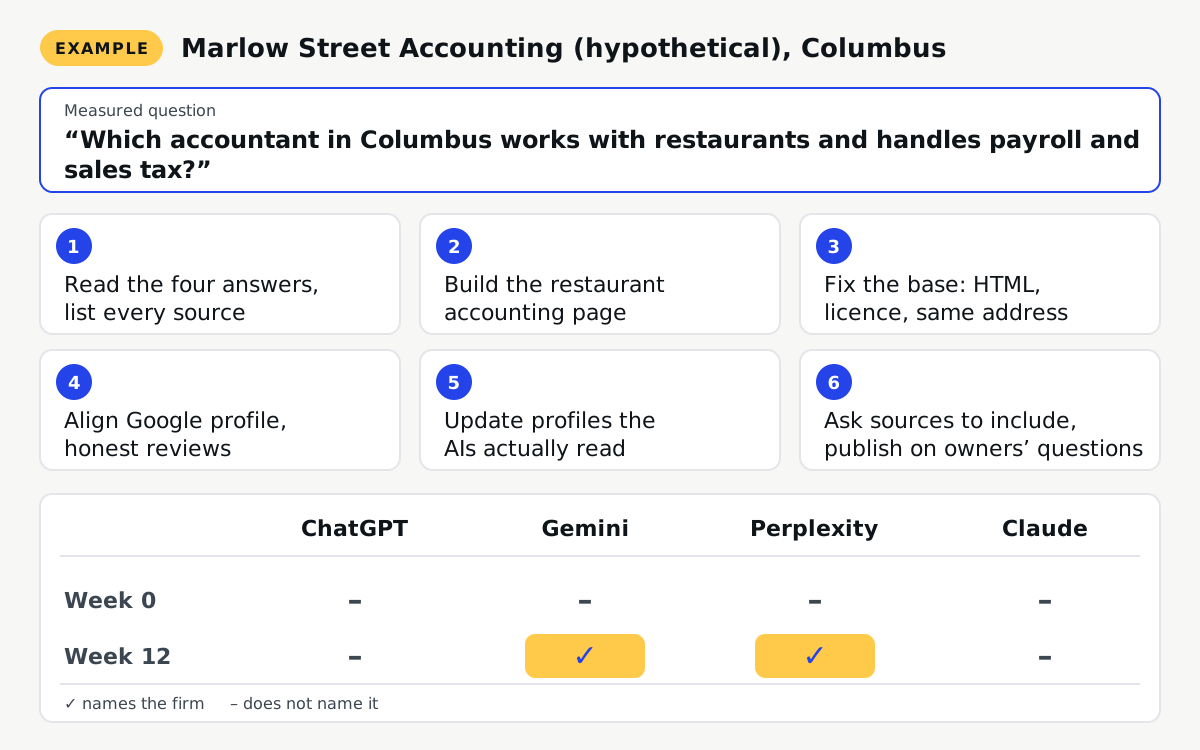
Example: a hypothetical firm, Marlow Street Accounting, in Columbus, Ohio. Two CPAs and four staff, eleven years old, about 140 business clients, 40 of them independent restaurants. Bookkeeping-and-payroll packages run from $450 to $1,200 a month, and the Google profile has 61 reviews averaging 4.8.
The measured question: “Which accountant in Columbus works with restaurants and handles payroll and sales tax?” Week 0: named by 0 of 4. ChatGPT named two online services and a regional firm; Perplexity drew on a Yelp list; Gemini listed downtown Maps results; Claude gave criteria and no names.
- Listed every firm and source in the four answers: competitors’ industry pages and one directory, nothing from Marlow Street, so a content gap rather than a reputation problem.
- Built “Restaurant accounting in Columbus”: who it serves (one to four locations, 10 to 80 staff), what is included (daily POS reconciliation, tip reporting, Ohio sales tax, a monthly P&L with food and labour cost percentages), the fee range and the first month.
- Fixed the base: services moved from a PDF and a script-loaded accordion crawlers could not read into plain HTML; each partner got a page linking to the public licence lookup; name, address and phone became identical everywhere.
- Aligned the Google Business Profile with the page and invited restaurant clients to review in their own words, with no script or incentive.
- Updated the profiles the assistants had read: Yelp, the ProAdvisor entry (industry: restaurants) and the state CPA society directory.
- Asked the QuickBooks ProAdvisor directory and the state CPA society to list the firm’s restaurant work, and published a page for each of the owners’ real questions: sales tax on delivery-app orders, the tip credit in payroll, expected labour cost.
Weeks 1 to 4 showed nothing. In week 6 Perplexity named the firm, citing the restaurant page; in week 9 Gemini listed it among three, apparently combining Maps and the page. At week 12 ChatGPT still named the online services and Claude still answered with criteria: 2 of 4.
What failed: a “best accountant in Columbus” page changed nothing and strained the board’s rules on unverifiable claims, so it came down; AI-rewritten service pages were fluent but empty. Results vary; this is a plausible path, not a forecast.
What to publish so an assistant can cite you
Titles that would serve this firm: “Restaurant accounting in Columbus: what is included and what it costs”, “Ohio sales tax for restaurants on delivery apps”, “Switching accountants mid-year”. A sample excerpt: “We work with independent restaurants in central Ohio, from single cafés to four-location groups. Every week we reconcile POS sales to bank deposits, run payroll with tip reporting and file Ohio sales tax on schedule. Monthly fees typically run $450 to $1,200, fixed after we review your books.”
A citable accounting page states who it serves and where, the situations, software and filings involved, a fee range or its basis, the process and timing, and verifiable credentials. Claims like “the best” or “guaranteed savings” add no evidence and may breach your board’s advertising rules.
When this is not worth doing
It does not pay for a firm already turning work away in filing season; more enquiries only lengthen the queue. It rarely pays where clients arrive through referrals that never touch a search box, from wealth managers, bankers and lawyers, or for audits of larger companies, awarded by tender.
Nor does it pay if the partners will not name a segment or publish specifics, because the citable page cannot be written. Then a referral arrangement, a well-kept Google profile for local individual clients or a fee review pays better. The free test shows cheaply which side you are on.
How the work runs, within your board’s rules
The free test asks one question to the four assistants and saves the full answers as your starting point. The service measures up to 10 questions weekly in the four, fixes the site’s base, finds out where the AI gets each answer and asks for the firm’s inclusion wherever there is a path: QuickBooks ProAdvisor and Xero’s advisor directory, the state CPA society directory, local press. Some of those are editorial or paid, so we promise the request, not the listing; you see what was asked and what got in. We also publish content that answers the measured questions. We publish on a subdomain via your DNS or deliver for you to publish; onboarding is online. It costs $299/month with no lock-in, plus a one-time $599 bonus charged only when an assistant starts naming the firm for a measured question, checked by a person on our team, or Google Analytics shows a visit from an AI. Nothing is guaranteed.
Accountancy is regulated. Our content is informative, follows the advertising rules of your state board of accountancy or professional body, promises no outcomes or savings, uses no testimonials where forbidden and does not solicit. You approve what speaks for the firm; professional claims remain the licensed accountant’s responsibility.
Questions
Do my Google reviews matter more than my website?
Reviews confirm that a firm is real and well regarded. The page stating your segment, services and fees is what matches you to a specific question.
Can I pay to be listed in AI answers?
No one sells a place in the answer. A paid directory listing can complete a profile the assistant may read, but it does not decide what is written.
Does my accountancy board allow this?
Informative content about services, process and fees is generally permitted, and that is all we write. Rules on testimonials, comparisons and claims of specialisation vary by state and country, so each page follows yours and you approve it.
How long until anything changes?
Base fixes are read within weeks. Answers change slowly and unevenly, often one assistant months before another, and some questions never move.
What if an assistant says something wrong about my firm?
Usually an outdated fee or address copied from an old directory. We trace the answer to its sources, correct your pages and the profiles you control, and measure whether the error disappears.