
The question your clients actually ask
Owners find the problem by accident. One sees her clinic named by ChatGPT, asks it to answer as it would for a stranger, and the name disappears: it came from the earlier conversation. One answer is an anecdote; the measure is the same question, asked the same way, every week.
Clients rarely ask for “a good aesthetic clinic”. They name a treatment, a place and a worry, and the worry decides the answer: safety (“tear-trough filler in [city] with a doctor on site if something goes wrong”), credentials (“which clinic in [city] is run by a dermatologist”), skin type (“melasma laser safe for dark skin”) or restraint (“natural-looking lip filler”). Each draws on different sources, so a clinic named for one can be missing from the next.
Where the AI’s answer about aesthetic clinics comes from
With web search on, the assistants summarize what the pages they find agree on; in aesthetics, those are: the Google Business Profile and the words in its reviews; RealSelf and Yelp; state medical and nursing board license lookups; local “best of” lists; Reddit threads comparing injectors; and the clinic’s own treatment pages.
Aesthetics is medicine: asked whom to see, the assistants often name nobody and give criteria instead, such as a board-certified dermatologist, hyaluronidase on hand and an assessment before treatment. That generic answer is your checklist: a clinic gets named when its own pages state, verifiably, that it meets those criteria, and independent sources agree. Fame is not the criterion: the med spa with 2,000 reviews wins “Botox in [city]”, but the safety question goes to whoever documents who injects and what happens in a complication. The four assistants search different indexes and vary between runs, so we count weeks.
The most common mistake: a treatment menu built for Instagram
The typical aesthetic site is a menu: toxin and filler brand names, a lip filler special and a before-and-after gallery, while the useful information lives in Instagram highlights. But assistants read text on pages they can index; most of Instagram sits behind a login, and a photo has no sentence to quote. Nowhere does the site say who holds the syringe, under whose supervision, or what happens if filler blocks a blood vessel.
So the clinic misses the safety questions of its most valuable clients, and promotions make it worse: “20% off filler” and “flawless results” are what medical boards scrutinize, and several jurisdictions restrict before-and-after images for these procedures. Replace each claim with a checkable fact: the injector’s name, profession and license number, who supervises, who is turned away and the complication protocol.
A worked example, step by step
Example: a hypothetical clinic, not a sayurname client. Imagine Hyde Park Aesthetic Clinic in Austin, Texas: a board-certified dermatologist as medical director, two registered nurse injectors and an aesthetician, nine years open, 318 Google reviews averaging 4.9. A filler syringe cost $780 to $880. The site was a treatment menu with a monthly specials banner.
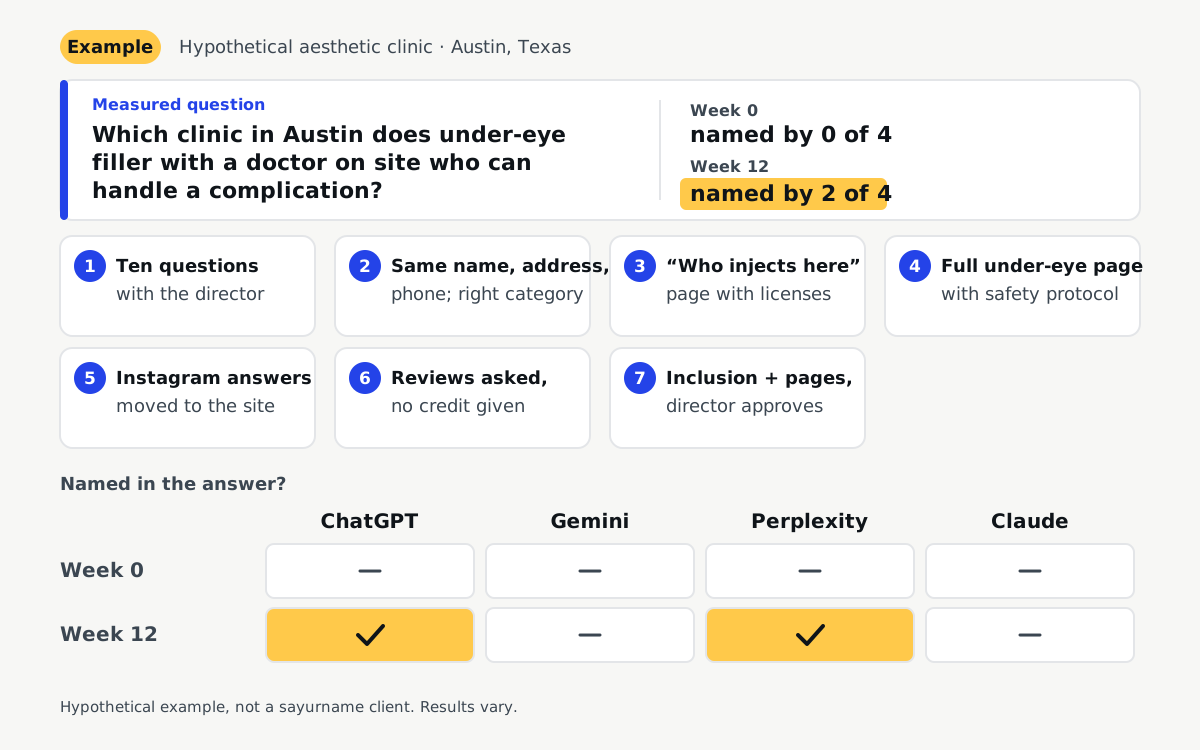
The measured question was “Which clinic in Austin does under-eye filler with a doctor on site who can handle a complication?”. At week 0 it was named by 0 of 4 assistants: ChatGPT named two plastic surgery practices and a med spa chain, Gemini the most-reviewed med spas, Perplexity a magazine’s “best injectors” list, and Claude nobody.
- Chose ten questions with the medical director, from under-eye filler to masseter Botox and melasma lasers.
- Fixed the base: one name, address and phone across the site, Google, Yelp and RealSelf, and the Google category changed from “Day spa” to “Medical spa”.
- Published a “Who injects here” page: each person’s profession, Texas license number and years injecting, who supervises the nurses, and that the aesthetician does not inject, all checkable on the state board lookups.
- Replaced the under-eye promotion with a full page: who is not a candidate, the dermatologist’s assessment first, hyaluronic acid only, hyaluronidase in the room, the complication protocol and the price range.
- Moved the answers in Instagram highlights onto the site as text; removed the specials banner and “flawless results”.
- Asked for reviews after the two-week follow-up and ended the $25 credit the clinic had been giving for them.
- Asked a local “best of” list to include the clinic, and published one page per measured question, each approved by the medical director.
Perplexity named the clinic in week 7, citing the under-eye page; ChatGPT followed in week 11, after a Reddit thread mentioned the dermatologist’s assessment. At week 12 Gemini still listed the most-reviewed med spas, and Claude still gave criteria without names, now matching the clinic’s page almost line for line.
What did not work: a “safest injectors in Austin” headline moved nothing and came down; a paid directory profile brought consultations, not answers; “cheapest Botox in Austin” never moved, because deal sites answer it. Results vary by city, question and competition; another clinic could see none of this in twelve weeks.
What to publish
A citable page answers one client question with facts others can check. Titles that work: “Under-eye filler in Austin: who is a candidate, who injects and what happens if something goes wrong”; “Who injects at Hyde Park Aesthetic Clinic: licenses, training and supervision”; “Melasma on darker skin: the lasers we use, the ones we avoid and why”.
An excerpt from the first: “Dr. Laura Mendes, a board-certified dermatologist, assesses every under-eye patient first; about one in three is advised against filler, usually because the shadow is pigment, not hollowness. We use only hyaluronic acid, which can be dissolved, and keep hyaluronidase in the treatment room. Most patients need one syringe, $780 to $880.” What makes it citable: a named practitioner a board lookup confirms, who is turned away and why, the safety facts the assistants ask for, a price range where allowed, one treatment per page.
When it is not worth it
If your injectors are booked six weeks out, more demand adds nothing; spend on capacity. If your clients come almost entirely from Instagram and influencers, run the free test before paying anything: they may not ask an AI at all.
Nor does it pay when the clinic cannot publish what the questions require. Who may inject varies: in many US states nurses inject under a physician’s supervision, while in much of Europe injectables are reserved to doctors. If someone injects in a role your jurisdiction does not clearly allow, documenting it exposes the problem, so fix that first. Where your board forbids the content needed, just correct the Google profile and directories.
How the work runs, within your medical board’s rules
It starts with the free test: one client question, four AIs, the full answers saved as the starting point. Subscribed, we measure up to 10 questions every week in the four assistants, fix the site’s base so the AI can read it, find out where the AI gets the answer to each question and ask for the clinic’s inclusion wherever there is a path: RealSelf, Yelp, local “best of” lists. Some of those are editorial or paid, so we promise the request, not the listing; you see what was asked and what got in. We also publish content that answers the measured questions. It goes on a subdomain via DNS, or we deliver and you publish.
It costs $299/month, with no lock-in. A one-time $599 bonus is charged only when an AI starts naming the clinic for a measured question, checked by a person, or Google Analytics shows a visit from an AI. Nobody controls AI answers; there is no guarantee of a recommendation. The content is informative and follows your state medical board’s advertising rules: no promised results, no before-and-after images or testimonials where forbidden, no solicitation, no client information, and the medical director approves every piece.
Questions
Do reviews and Instagram matter more than my website?
Reviews tell the AI the clinic is real and liked; Instagram barely reaches it, since most of it needs a login. In the example, 318 reviews were not enough until a page said who injects.
Can I pay a directory or a product’s provider locator to be listed?
A premium profile can bring consultations from that site; it does not buy a place in an AI’s answer, which is written from what several independent sources say.
Is this allowed by my medical board?
Informative content about treatments, credentials and risks is generally permitted; the rules restrict promised results, misleading titles, inducements and often before-and-after images. The medical director approves each piece, within your board’s rules.
How long until anything changes?
In the example, the first assistant named the clinic in week 7, and two still had not by week 12. Narrow questions tend to move sooner; some take months, some never move.
What if the AI says something wrong about my clinic?
It happens: a former injector still listed, a treatment you dropped, an old promotional price. The AI repeats what it read, so correct the source, usually a directory or old page, and state the right fact on your site.