

The question a homeowner actually types
The complaint we hear most from architects: their practice came up when they asked ChatGPT, then vanished when they asked again from a private window as a stranger; the assistant had named them only because the earlier conversation had. A check from your own account means nothing; what counts is what a stranger gets, asked the same way, repeatedly.
Clients rarely ask for “an architect”. They describe a project, a place and a constraint: “architect who designs detached ADUs in Portland”, “architect for a historic house who knows the landmarks review”, “architect for design and permit drawings only, no construction”. The first shape rewards a page that states the specialty and the jurisdiction; the second, a page that explains with numbers how you handle that review and how long it takes; the third, a plain statement of what you do and do not provide. A homepage promising “thoughtful design for modern living” answers none of them.
What the assistants read when they answer
The four assistants answer local recommendation questions with a web search, and in this sector it lands on the same sources: Google Business Profile and Maps, Houzz, the AIA’s architect finder, local press, Reddit threads, and the practices’ own service and project pages. The state board’s license lookup confirms rather than recommends, but your license number on your site plus the same name on the board’s register gives two agreeing sources, which is what an assistant wants before naming anyone.
That agreement, not fame, is the mechanism. A large firm with a celebrated museum often loses the ADU question to a three-person practice that has a page about ADUs in that city, with sizes and permit times, while the large firm shows galleries without text. Answers differ between assistants because each uses a different search index, and between runs because generation is probabilistic. In our measurements Perplexity picks up fresh pages first, while ChatGPT and Claude lean on facts repeated across sources; one screenshot proves nothing.
The most common mistake: a portfolio with no words
Architects build their sites like a jury presentation: large photographs, a project name, a year. That serves a human who can see the quality and gives an assistant nothing to cite: no scope, location or process. Practices then ask the AI itself to “optimize the site”, get generic keyword advice, and see no change; the missing ingredient was facts, not phrasing.
The cost is concrete: fifteen strong residential projects can be invisible for the exact question your best clients ask, while a competitor with four descriptive project pages gets named. Keep the images and write under them: the client’s need, neighborhood, floor area, review path, permit duration, cost range where the client agrees, and your exact role. Two hundred honest words per project change what an assistant can say about you.
A worked example, step by step
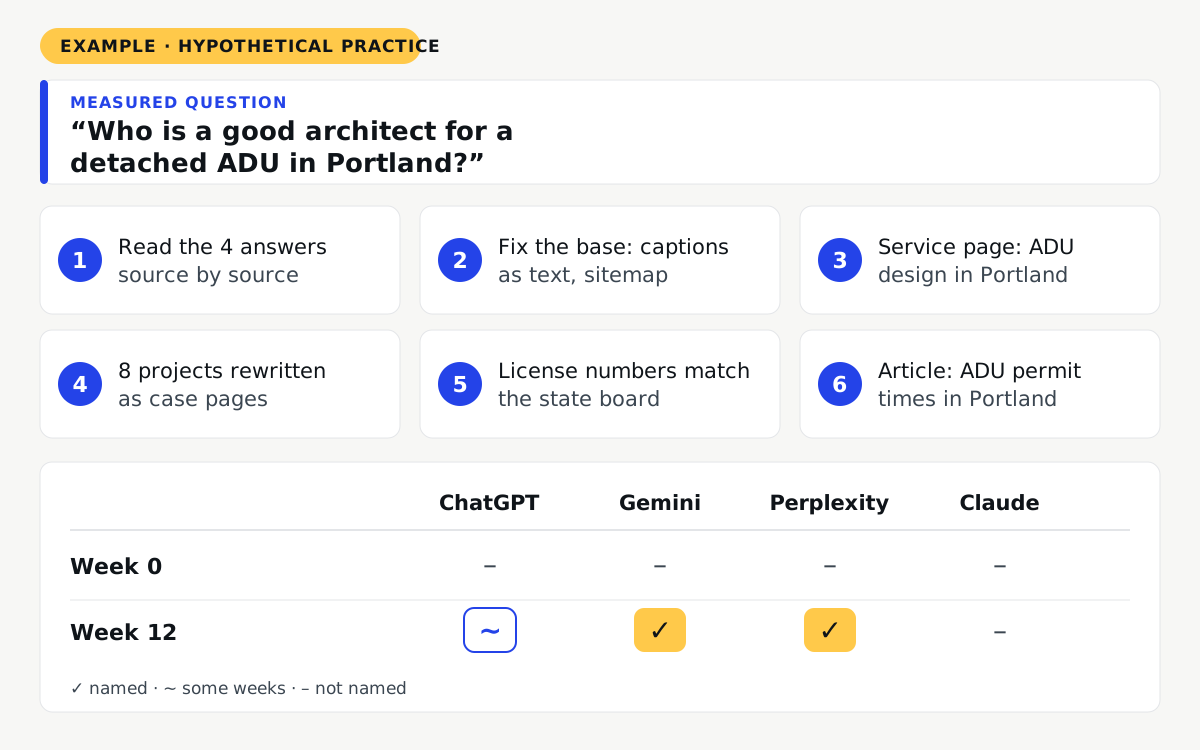
Example: a hypothetical practice, Alder Line Architects in Portland, Oregon. Two licensed architects and a designer, twelve years in practice, mostly detached ADUs. Design fees for an ADU run $18,000 to $28,000; 23 Google reviews and 9 on Houzz. The site had 31 projects with captions only and a 120-word services page.
The measured question: “Who is a good architect for a detached ADU in Portland?”. In week 0 none of the four assistants named the practice (0 of 4); three named the same two design-build companies, and Perplexity cited a Houzz list and a Reddit thread.
- We read the week-0 answers source by source and listed what the named firms had that Alder Line lacked: an ADU page for Portland, size rules in plain text, project pages with numbers.
- We fixed the base: the gallery loaded captions through a script crawlers did not run, so we rendered them as text, gave each project a title and neighborhood, and submitted the sitemap.
- We wrote one service page, “Detached ADU design in Portland”: size limits, typical permit time in recent projects, what the fee includes, and what the practice does not do (it does not build).
- We rewrote 8 of the 31 projects as case pages of 250 to 400 words: neighborhood, floor area, main constraint, permit duration and each party’s role.
- We added both license numbers to the about page, matching the state board’s register, and aligned name and address across the site, Google Business Profile and Houzz.
- We published an article on a point the week-0 answers got wrong, how long an ADU permit takes in Portland, naming the source of each statement.
Nothing changed until week 5, when Perplexity named Alder Line, citing the new service page. Gemini followed in week 9. By week 12 ChatGPT named the practice only in some weeks, and Claude never had: 2 of 4, ChatGPT intermittent.
Two things did not work: a paid press release for the tenth anniversary changed nothing, and a page aimed at “best architects in Portland” was wasted, since that broad question goes to firms with decades of press. This is one hypothetical path; with more competing specialists or fewer real projects to describe, results would come more slowly or not at all.
What to publish
Titles that get cited name the project type, the place and the constraint: “Detached ADU design in Portland: size limits, permits and fees”; “Case: a 640 sq ft garage conversion in Sellwood, from survey to permit in 11 weeks”. Sample excerpt for the first: “We design detached ADUs in Portland, most between 500 and 800 square feet. In our recent projects permits took eight to fourteen weeks, depending on the review path. Our fee covers design, permit drawings and plan-review responses; we do not build.”
A page is citable when its facts are checkable: who signs the drawings and under which license, where you work, project types and sizes, real timelines, fee ranges where your board allows it, and what you do not do. “Award-winning team” gives an assistant nothing to repeat.
When it is not worth it
If two developers keep you booked eighteen months ahead, this work brings clients you cannot serve. The same goes for practices living on competitions and public tenders, where the client is a jury. In a small town where few people ask AI for an architect, the measurement stays flat for months.
It also pays poorly when the target question is too broad: “best architect in New York” is out of reach for a two-person practice, where referrals or a current Google Business Profile serve better. Run the free test on your real question first; if the answers already name you, or nobody asks it, you know before spending.
How the work runs, within your board’s rules
It starts with the free test: one question, four assistants, full answers saved as your starting point. Onboarding is online, with no call: you confirm your profile, choose up to 10 questions, and publish on a subdomain we connect through DNS or receive the content to publish yourself. Every week we measure those questions in ChatGPT, Gemini, Perplexity and Claude. We fix the site’s base, find out where the AI gets each answer, and ask for the practice’s inclusion wherever there is a path: Houzz, the AIA’s architect finder, local press. Some of those are editorial or paid, so we promise the request, not the listing; you see what was asked and what got in. We also publish content that answers the measured questions.
The price is $299/month with no lock-in, plus a one-time $599 bonus charged only when an AI starts naming your practice for a measured question (a person checks it) or Google Analytics shows a visit from an AI. Nobody controls these answers, so there is no guarantee of a recommendation. Architecture is regulated: our content is informative, follows your state architecture board’s advertising rules, avoids testimonials where restricted, promises no results and solicits no one. You review everything before it goes out.
Questions
Do my Houzz and Google reviews matter more than my site?
Reviews tell an assistant you exist and clients were satisfied, rarely what you specialize in. For a specialty question, the cited page is usually a service or project page.
Can I pay to be listed in the AI’s answer?
No. There is no paid placement in these answers. A paid directory listing is at most one more source; an assistant names what it can justify.
Is this allowed by my architecture board?
Informative content about services, process and completed projects is what boards generally accept; restrictions vary by state, usually covering misleading claims, some testimonials and comparisons. You approve what is published.
How long until anything changes?
In the example the first change came in week 5 and was still partial in week 12; plausible, not a promise. Perplexity often reacts first; the others can take months or not change.
What if an assistant says something wrong about my practice?
It happens: an old address, a former partner, a service you dropped. We find the source, correct it on your site and profiles, and publish a clear page with the right fact.