
The question drivers actually ask
One owner opened three private browser windows, asked the same question and got three different lists, his shop in only one. Another heard a customer say she found him through Perplexity, while Google Analytics logged direct traffic. What helps is the same question asked weekly in all four, and why a competitor was named instead.
Drivers rarely type “mechanic near me”. They type a car, a symptom and a worry, and the worry decides who is named. “Subaru head gasket repair in [city], not the dealer” goes to the shop that says it does Subaru engines in volume. “Honest mechanic in [neighborhood] for a second opinion on a $3,200 brake quote” is decided by reviews that mention estimates. “Who services Toyota hybrid batteries besides the dealer” turns on stated training. “Will an independent shop void my warranty?” gets the Magnuson-Moss Warranty Act, then a shop that explains it.
Where the AI’s answer about mechanics comes from
With web search on, each assistant searches and summarizes what the pages agree on. For auto repair the sources are predictable: Google Business Profile and Maps (categories, hours, review wording), Yelp, RepairPal, the AAA Approved Auto Repair and ASE Blue Seal locators, Better Business Bureau complaints, Reddit and owner forums, the state regulator’s lookup where shops register, such as California’s Bureau of Automotive Repair, and the shop’s own service pages.
Three features set this sector apart. Questions are model-specific, and the assistant needs a sentence linking make, job and shop; it will not infer hybrid skill from a photo of a Prius on the lift. Trust is read from review text: “written estimate, called before adding anything” is evidence, bare stars are not. And the dealer wins by default whenever no independent source is specific enough. Answers vary between assistants and runs, so one private-window test misleads. Nor is fame the criterion: the chain with 2,000 reviews wins “auto repair in [city]”, not “Subaru head gasket”.
The most common mistake: “all makes and models”
Nearly every independent shop’s homepage says “we service all makes and models” above a strip of manufacturer logos. A driver reads flexibility. An AI looking for evidence about head gaskets or hybrid batteries reads nothing, because every competitor says the same and none of it can be checked; the logos may even suggest a manufacturer certification the shop does not hold.
The cost falls on the high-ticket repairs where owners most want an alternative to the dealer; those answers go to the dealer by default. Replace the claim with evidence: the makes you see in volume and how many a year, the jobs you do on them, the training and tools behind them (named technicians and their ASE tests, factory scan software), and what you send out, such as transmission rebuilds. A shop that says what it does not do is believed about what it does.
A worked example, step by step
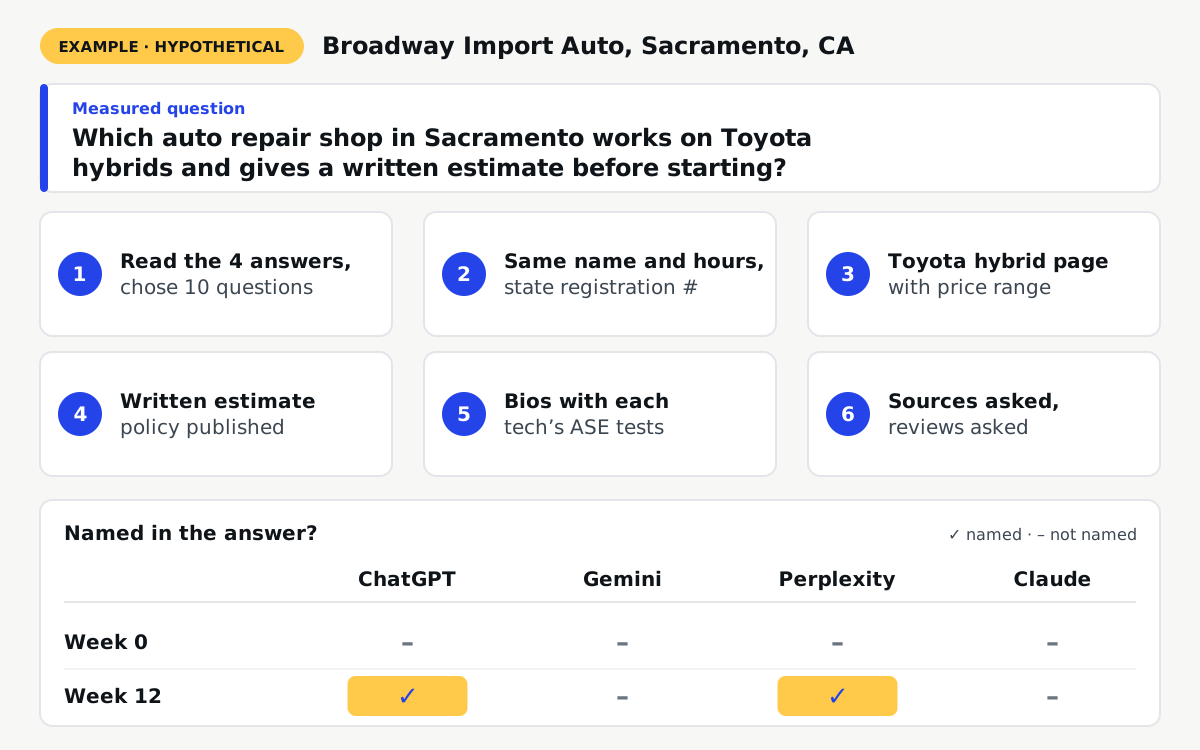
Example: a hypothetical shop, not a sayurname client. Imagine Broadway Import Auto in Sacramento, California: five technicians, three ASE-certified, one with the L3 hybrid test, 18 years open, 410 Google reviews averaging 4.8. It replaces about 25 hybrid batteries a year at $2,800 to $4,200 installed. The homepage said “all makes and models” over twelve logos; hybrids appeared nowhere.
The measured question was “Which auto repair shop in Sacramento works on Toyota hybrids and gives a written estimate before starting?”. At week 0 the shop was named by 0 of 4: ChatGPT gave two Toyota dealers and a chain, Gemini the most-reviewed shops, Perplexity a Reddit thread, Claude no one.
- Read the four answers and their sources with the owner, and chose ten questions, from hybrid batteries to second opinions.
- Fixed the base: identical name, address, phone and hours on the site, Google, Yelp and RepairPal, a “Hybrid service” category, the state registration number in the footer.
- Replaced the logo strip with a Toyota hybrid page: models, about 25 batteries a year, the module test before any replacement, new versus reconditioned, prices, what goes to the dealer.
- Published the estimate policy: written estimate signed before work, a call and new authorization before anything is added, old parts returned on request, as California requires.
- Rewrote the technician bios with each person’s ASE tests and years on hybrids, instead of “ASE certified shop”.
- Asked AAA Approved Auto Repair and the recommended-shop lists of Toyota owner forums to include the shop, published a page for each measured question, each checked by the lead technician, and asked hybrid customers for unprompted reviews.
The estimate question moved first: by week 3 Perplexity cited the estimate page for a shop that “won’t add work without asking”. In week 6 Perplexity named the shop for the hybrid question, citing the new page; in week 9 ChatGPT followed, after a forum thread and four reviews mentioned battery jobs. At week 12 Gemini still listed the dealers; Claude named the shop in one run of four, which does not count.
What did not work: a “Sacramento’s hybrid experts” banner moved nothing and came down, since the shop has one specialist; a paid directory listing changed no answer; the Tesla suspension question never moved. Results vary by city, make and competition; another shop might see none of this in twelve weeks.
What to publish
A citable page answers one driver’s question with checkable facts. Titles that work: “Toyota hybrid batteries in Sacramento: diagnosis, new or reconditioned, and cost”; “How our estimates work: what you sign, when we call”; “Can an independent shop service my car under warranty?”.
From the first: “About one car in three sent to us for a failing hybrid battery needs something else, usually a cooling fan or one module, so we test every module before quoting. A new Toyota pack costs $2,800 to $4,200 installed, depending on generation; a reconditioned one costs less, with a shorter warranty.” Citable means make and generation, job volume, the diagnostic step, a price range and what moves it, written warranty terms, and certifications per named technician.
When it is not worth it
If the bays are booked two weeks out, more demand lengthens the queue and loses the regulars who wrote your reviews; hire first. A collision shop living on insurers’ direct repair programs gets work from the insurer, a fleet shop from contracts, and the only shop within thirty miles already has the town.
Nor does it pay when head office controls a franchise location’s pages, or when nobody will commit to specifics such as makes, prices or an estimate policy. Start smaller: fix the Google profile and hours, answer existing reviews, and return with something concrete to publish.
How the work runs, within your state’s repair rules
It starts with the free test: one driver’s question sent to the four AIs, full answers saved as the starting point. Subscribed, we measure up to 10 questions weekly in the four assistants, fix the site’s base, find out where the AI gets the answer to each question and ask for the shop’s inclusion wherever there is a path: Yelp, RepairPal, the AAA Approved Auto Repair locator, owner forums. Some of those sources are editorial or have their own criteria, so we promise the request, not the listing; you see what was asked and what got in. We also publish content that answers the measured questions.
It costs $299/month, with no lock-in. A one-time $599 bonus is charged only when an AI starts naming the shop for a measured question, checked by a person, or Google Analytics shows a visit from an AI. Nobody controls AI answers, so there is no guarantee. Few states license mechanics, but several register shops and all regulate consumer dealings: content follows your state’s rules on estimates and advertised prices, states certifications exactly as held, promises no outcome or warranty the shop does not honor in writing, and is checked by the shop first.
Questions
Do reviews matter more than my website?
Reviews show the shop is real and how it treats people; the service page says which cars and jobs it handles. In the example, 410 reviews were not enough for hybrids until the hybrid page existed.
Can I pay to be listed by the AI?
No assistant sells places in its answers. A paid directory listing can bring calls from that directory, but the answer comes from several independent sources; in the example it changed nothing.
Should I call us an ASE certified shop?
Say exactly which technicians hold which ASE tests, and since when. A blanket claim resting on one person’s test is easy to check, and helps the AI less than a specific one.
How long until anything changes?
In the example, one assistant named the shop in week 6, a second in week 9, two not by week 12. Some questions never move, because a dealer really is the better answer.
What if the AI says something wrong about my shop?
Usually an old listing, a closed location or a vague sentence on your site said it first. Correct the source, state the facts on your page, and watch the weekly measurement.