The question salon clients actually ask
One owner asked ChatGPT for the best salon in her city, saw her own name, asked again in a private window and was gone: the first answer had leaned on her earlier questions about her salon. What counts is the answer a stranger gets, asked the same way every week.
Clients rarely type “salon near me”; they describe their hair and their worry, and that constraint decides who is named. Hair type: “salon in [city] that cuts 3C curls dry”, where most salons say nothing and one page can decide it. Repair: “who fixes orange box dye in [city] before my wedding”, where consultation and quoting policy matter. Each shape pulls different sources, so a salon named for one can be absent from the next.
Where the AI’s answer about salons comes from
With web search on, each assistant summarizes what the pages it finds agree on. For salons these are the Google Business Profile and Maps, where words inside reviews (“curly”, “color correction”, a stylist’s first name) weigh more than the star average; Yelp; booking marketplaces such as Vagaro, StyleSeat, Booksy and Fresha; r/curlyhair and city subreddits; the state cosmetology board’s license lookup; and the salon’s own service pages.
Expertise here belongs to a person: reviews and booking profiles name stylists, and an assistant often recommends “Jess at …”, so a site listing no stylists breaks the link between praise and place. And services are read literally: “curly cuts”, without dry or wet, curl patterns or duration, matches weakly against a question naming all three. Each assistant searches its own index and varies between runs. Fame is not the criterion: the salon with 1,200 reviews wins “best salon in [city]”; the curly question goes to whoever states it plainly.
The most common mistake: letting the booking page be the website
Many salons have quietly replaced their site with a booking link: the domain redirects to Vagaro or Booksy, and services become a price grid (“Women’s cut from $65, Color from $120”). It happens because the app takes deposits and cuts no-shows. To an assistant, though, the grid says nothing about hair types, methods or who does what, and the marketplace page suggests twenty competing salons nearby.
The cost lands on the questions worth winning. Curls, correction and gray blending are answered from pages that describe the service, leaving you the generic “best salon” question, which the most-reviewed competitor wins anyway. Keep the app for booking and give each service you want to be known for its own page on your domain: which hair, which stylists, how long, a price range, what you refer elsewhere.
A worked example, step by step
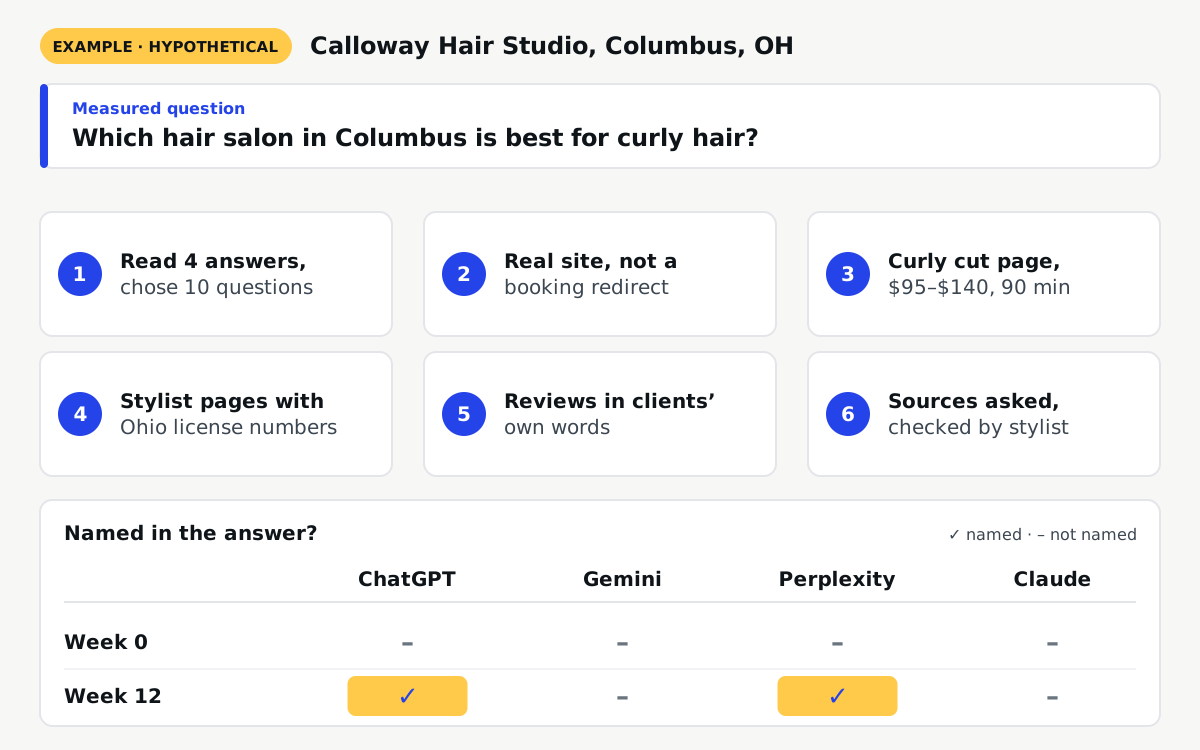
Example: a hypothetical salon, not a sayurname client. Imagine Calloway Hair Studio in Columbus, Ohio: six stylists, two of them booth renters, nine years open, 410 Google reviews averaging 4.8. One stylist, trained in a curl-by-curl dry-cutting method, does about 25 curly cuts a week at $95 to $140 for 90 minutes. Yet the domain redirected to Vagaro, whose menu said “Women’s haircut from $65”, and “curly” appeared nowhere the salon controlled.
The measured question was “Which hair salon in Columbus is best for curly hair?”. At week 0 the salon was named by 0 of 4: ChatGPT named two curl-only studios and a national chain, Gemini the most-reviewed salons, Perplexity a Reddit thread and a StyleSeat stylist, Claude three salons with no sources.
- Read the four answers and their sources with the owner and the curl stylist, then chose ten questions, from dry cuts to color correction.
- Fixed the base: a real site on the salon’s domain instead of a redirect, with the same name, hours and categories on Google, Yelp and Vagaro.
- Published a curly cut page: who cuts, which curl patterns, dry versus wet, 90 minutes, $95 to $140, and locs referred to a named loctician.
- Added stylist pages with years cutting, training and Ohio cosmetology license number, checkable on the state board’s lookup; the renters joined with written consent.
- Asked curly clients for a Google review after their second visit, with no discount and no suggested wording.
- Asked StyleSeat and the curly-salon lists of r/curlyhair to include the salon, and published a page for each measured question, each checked by the stylist named on it, starting with who should not book a dry cut.
Perplexity moved first: in week 3 it cited the curly page as a source, and in week 6 it named Calloway. ChatGPT followed in week 9, after a dozen new reviews mentioned the curly cut and the stylist by name. At week 12 Gemini still led with two curl-only studios and their 900 and 600 Maps reviews; Claude named the salon in one run of four, which does not count.
What did not work: a “Columbus’s best curly salon” banner moved nothing; a paid placement in the booking app brought app bookings but changed no answer; and the gray-blending question went backwards when the renter who did it left in week 7 with her StyleSeat profile and reviews. Results vary by city, question and competition; another salon might see none of this in twelve weeks.
What to publish
A citable salon page answers one client’s question with checkable facts. Titles that work: “Curly haircuts in Columbus: the dry cut, how long it takes and what it costs”; “Color correction: how we quote before we mix anything”; “Gray blending instead of full coverage: who it suits”.
From the first: “Maya has cut curly hair here since 2019, about 25 curly cuts a week. She cuts dry, curl by curl, to see where each curl sits before taking length, then washes and styles with you so you can repeat it at home. Appointments run 90 minutes and cost $95 to $140; locs maintenance we refer to a loctician on Parsons Avenue.”
Citable means a named, licensed stylist, hair types in the client’s words, time and price as ranges, the line between what you do and what you refer, and product claims backed by the manufacturer’s safety data. “Formaldehyde-free keratin” for a product that releases formaldehyde under a flat iron is a liability, not content.
When it is not worth it
If your stylists are booked six weeks out and you are not hiring, more demand only lengthens the wait; raise prices or add a chair first. A walk-in barbershop, or a small-town salon where everyone knows who cuts curls, gains little.
Nor does it pay in a booth-rental salon with no shared site, where each stylist’s own profile and reviews are the asset. And it fails when the owner will not name stylists because turnover is high: the AI recommends people, and a page without people has no one to recommend. Then fix the Google profile first.
How the work runs, within your state board’s rules
It starts with the free test: one client’s question sent to the four AIs, full answers saved as the starting point. Subscribed, we measure up to 10 questions every week in the four assistants, fix the site’s base so the AI can read your service pages, find out where the AI gets the answer to each question and ask for the salon’s inclusion wherever there is a path: StyleSeat, Booksy, Fresha, the curly communities’ salon lists. Some of those sources are paid or curated, so we promise the request, not the listing; you see what was asked and what got in. We also publish content that answers the measured questions.
It costs $299/month, with no lock-in. A one-time $599 bonus is charged only when an AI starts naming the salon for a measured question, checked by a person on our team, or Google Analytics shows a visit from an AI. Nobody controls AI answers, so there is no guarantee. Hairdressing is a licensed trade and the content stays inside it: only services your licensed staff may perform under your state cosmetology board’s rules, no promised results, before-and-after photos only with written consent, no invented or paid reviews.
Questions
Do reviews matter more than my website?
Reviews say the salon is liked and what for; the site says which services, which stylists, at what price. In the example, 410 reviews were not enough until a page said “curly”.
Can I pay the booking app to feature me?
A featured spot brings bookings inside that app, not a place in an AI answer, which draws on several independent sources.
My stylists rent their chairs. Whose name goes on the page?
Theirs, with consent, because assistants recommend people. Agree in writing what happens when a renter leaves; her app reviews leave with her.
How long until anything changes?
In the example, the first assistant named the salon in week 6; two had not by week 12. Some questions never move, because another salon is the better answer.
What if the AI says we offer extensions and we don’t?
Usually an old listing, a booking-app category or a former stylist’s profile said so. Correct the source, state on your site what you do, and watch the weekly measurement.