

The question homeowners actually ask
Owners usually notice the problem by accident. One asked ChatGPT about his shop and got praise; asked again in a clean session, as a stranger, it named three others, because the first answer had echoed his earlier question. Another heard clients say they found the shop through Perplexity, while analytics showed nothing. What counts is what the assistants tell a stranger, every week.
Homeowners rarely type “cabinet maker near me”. They type a piece of work, a place and a constraint, and the constraint decides who is named. Construction: “who builds custom inset kitchen cabinets in Sacramento”, where the AI must tell a workshop from a dealer. Scope: “cabinet maker for built-in bookshelves in East Sacramento”, which turns on whether small jobs are accepted. Price and time: “what do custom kitchens cost in Sacramento and how long is the wait”. Matching: “who can match the cabinets in a 1920s bungalow”. Each shape draws on different sources.
Where the AI’s answer about cabinetmakers comes from
With web search on, each assistant runs a few searches and summarizes what the pages agree on. For cabinetry they are predictable: the Google Business Profile, whose primary category matters more than owners think; Houzz projects and review wording; Yelp and Nextdoor; Reddit’s home-improvement threads; the state license lookup where installation requires one (in California, the CSLB’s C-6 Cabinet, Millwork and Finish Carpentry classification); and the shop’s own pages.
The sector’s peculiarity is the word “custom”. Showrooms reselling semi-custom factory lines, refacing franchises and big-box kitchen departments all use it, and directories file them beside workshops. The assistant separates them only on stated facts: built in our shop at this address, plywood boxes, inset doors, finished in-house. A shop that states none of this is averaged in with dealers. The assistants disagree because each searches a different index and varies between runs, so three anonymous tabs give three lists. Fame is not the criterion: the busiest showroom wins “kitchen cabinets Sacramento”, but the inset question goes to whoever states inset construction plainly, with an independent source agreeing.
The most common mistake: letting the photos speak
Almost every cabinet shop’s website is a gallery: forty kitchens, no captions, “quality craftsmanship since 2011” above them. Clients do choose with their eyes, but the assistant reads text, and a gallery gives it nothing to quote: not the neighborhood, the species, or whether the shop built the boxes or installed someone else’s. Instagram, which assistants barely reach, has the same problem, so the AI fills the gap with sources that have words, usually describing dealers.
The cost: a homeowner who wanted exactly what the shop builds is sent to a showroom. The fix keeps every photo and adds words: one page per notable project with neighborhood, species, construction, weeks from deposit to installation and a price band. Twelve described projects do more than a hundred bare images.
A worked example, step by step
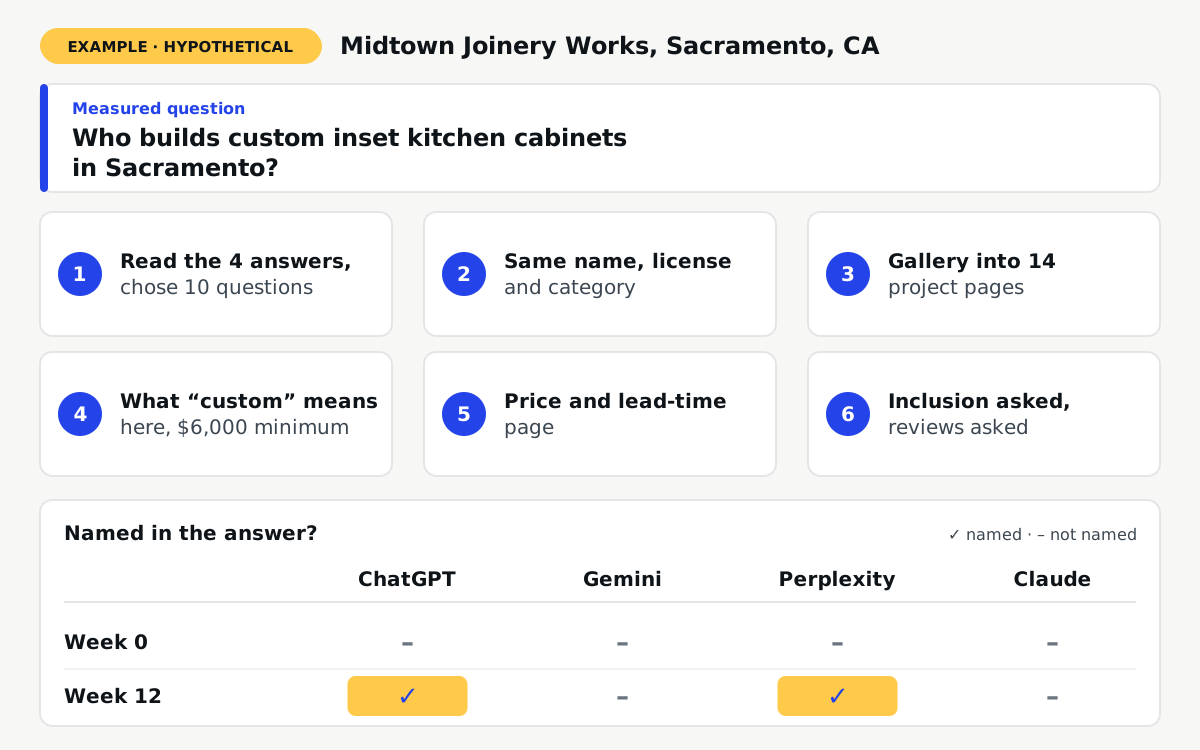
Example: a hypothetical shop, not a sayurname client. Imagine Midtown Joinery Works in Sacramento, California: the owner, three cabinetmakers, an installer and a designer, 14 years open, a C-6 license, 86 Google reviews averaging 4.8 and 31 on Houzz. Kitchens run $32,000 to $70,000, built-ins start at $6,000, lead time is 12 to 16 weeks. The website was 140 uncaptioned photos, and Google listed a kitchen remodeler.
The measured question: “Who builds custom inset kitchen cabinets in Sacramento?”. At week 0 the shop was named by 0 of 4: ChatGPT named two showrooms and a refacing franchise, Gemini the most-reviewed Yelp businesses, Perplexity a Houzz list and a Reddit thread, Claude nobody.
- Read the four answers and their sources, and chose ten questions with the owner, from inset kitchens and built-ins to price, lead time and the Davis area.
- Fixed the base: identical name, address, phone and C-6 license number everywhere, and the Google category changed from kitchen remodeler to cabinet maker.
- Turned the gallery into 14 project pages: neighborhood, species, construction, finish, weeks to installation and a price band.
- Wrote a page on what custom means here: boxes and doors built at the Sacramento shop, no reselling of factory lines, no refacing, a $6,000 minimum job.
- Published a price and lead-time page with the ranges, the 12-to-16-week schedule and deposit stages, since price was the most asked question.
- Submitted two finished kitchens to Houzz with the shop named as maker, published one page per measured question, each checked by the owner, and asked the last 30 clients for reviews naming their project, with no incentive.
Nothing moved for five weeks, normal while new pages are found. In week 6 Perplexity named the shop for the inset question, citing the construction page; ChatGPT followed in week 11, after new reviews mentioned inset doors. At week 12 Gemini still led with showrooms, and Claude named the shop in one run of four, which does not count.
What did not work: a paid Houzz Pro upgrade changed no answer; a kitchen-trends post answered nobody’s question; the 1920s matching question never moved, because a restoration specialist is the better answer. Results vary with city, question and competition; another shop might see none of this in twelve weeks.
What to publish
A citable cabinetry page answers one homeowner’s question with checkable facts. Titles that work: “Custom inset kitchen cabinets in Sacramento: how we build them, lead time and price range”; “Built-in bookcases: minimum job and schedule”; “Matching cabinets in older homes: what we can match and when we refer you”.
An excerpt: “Every inset kitchen starts as a shop drawing the client signs off and is made in our shop on 16th Street: ¾-inch maple plywood boxes, hardwood face frames, doors sprayed in our own booth. A 25-to-30-foot kitchen takes 12 to 16 weeks from deposit and usually costs $38,000 to $55,000. We do not reface cabinets.” Citable means where the work is made, construction a dealer could not honestly copy, the license number where required, price and time ranges, and what the shop does not do.
When it is not worth it
If the order book is full for six months, more inquiries only lengthen the queue; raise prices or hire first. A shop working only for general contractors, or for three designers who fill its calendar, is chosen by those buyers, not by homeowners asking an AI.
Nor does it pay in a small town where the two shops are known by name and nobody asks an AI. And a shop installing without the contractor license its state requires should fix that first: the assistants read the license lookup too. Then start smaller: correct the Google category, describe the ten best projects in words, and return when there is capacity to sell.
How the work runs
It starts with the free test: one homeowner’s question sent to the four AIs, full answers saved as the starting point. Subscribed, we measure up to 10 questions every week in the four assistants, fix the site’s base so they can read your pages, find out where the AI gets the answer to each question, and ask for the shop’s inclusion wherever there is a path: Houzz projects, Yelp, Nextdoor. Some of those are editorial or paid, so we promise the request, not the listing; you see what was asked and what got in. We also publish content that answers the measured questions. Content goes out on a subdomain through DNS, or we deliver it and you publish.
It costs $299/month, with no lock-in. A one-time $599 bonus is charged only when an AI starts naming the shop for a measured question, checked by a person on our team, or Google Analytics shows a visit from an AI. Nobody controls AI answers, so nothing guarantees a recommendation. Where your state requires a contractor license, its number goes on the relevant pages, and the owner checks every piece.
Questions
Do Houzz and Google reviews matter more than my website?
Reviews tell the AI the shop is real and well regarded; your pages tell it what you build. In the example, 86 good reviews were not enough while the site was only photos.
Can I pay a directory to be the shop the AI names?
A paid placement can bring leads from that directory, but an AI answer is written from what several independent sources agree on. In the example, Houzz Pro changed no answer.
My work is visual. Isn’t Instagram enough?
For people who already follow you, often. Assistants barely read Instagram and cannot see construction in a photo, so projects need described pages on your site.
How long until anything changes?
In the example, the first assistant named the shop in week 6 and a second in week 11. Some questions never move, because another business is the better answer.
What if the AI lumps us in with showrooms or refacing companies?
It repeats what it read: a directory category or a vague “custom cabinets” line. Correct the category, state what you build and do not, and watch the weekly measurement.