

The question buyers actually ask
One consultant asks ChatGPT about her own firm, then asks as a stranger would and finds herself gone: the first answer knew her only because she had named herself. Another hears a client say “Perplexity suggested you” while analytics shows only direct visits. What counts is the answer a buyer gets to a buyer’s question, asked the same way every week, and the sources behind it.
Buyers do not type “management consultant”. They combine industry, problem and constraint: “consultant who helps food manufacturers with 50 to 300 employees cut changeover time”; “we just took private equity money, who can run a 100-day plan for a mid-size plant?”. Then comes the due-diligence check: a colleague gave the buyer your name, and the buyer asks the AI what your firm has done. A vague answer there loses a referral you had already won.
Where the AI’s answer about consultants comes from
With web search on, each assistant runs a few searches and summarizes what the pages agree on. Consulting has few sources, so each weighs more: “top consultants for X” lists and profiles on Clutch and The Manifest, with verified client interviews; public LinkedIn pages; IMC USA’s directory of Certified Management Consultants; trade associations’ supplier and speaker pages; r/consulting threads; and the firm’s own service and case pages. Google Business Profile matters only when a city is named.
The AI matches constraints, not reputation: “food, 50 to 300 employees, changeover” needs a page stating all three, and “strategy, operations and growth for businesses of all sizes” matches none. With few sources one list can swing an answer, so the four assistants, searching different indexes, disagree more than in local services, and three anonymous runs can return three names. Nor is fame the criterion: large firms win “best consulting firms”, but narrow questions go to whoever the AI can verify on more than one site.
The most common mistake: positioning for everyone
Small consultancies describe themselves broadly because partners fear turning work away and because referrals never needed a niche: the referrer supplies it. An AI has no referrer. It reads “we partner with organizations across industries to unlock growth”, finds no industry, problem, client size or number, and moves on to the firm that wrote “food and beverage plants, 50 to 300 employees, changeover and scheduling”.
The cost is invisible: referrals keep coming while the questions you should win go elsewhere. The fix is to separate the headline from the service list. State your strongest niche in one checkable sentence, give each problem its own page with industry, size, method, duration and fee range, and keep broader work on separate pages. Then test each page: could a stranger tell from it alone whether you fit a 120-person bakery with a two-hour changeover?
A worked example, step by step
Example: a hypothetical firm, not a sayurname client. Imagine Lakeshore Operations Partners in Grand Rapids, Michigan: two partners, both former plant managers, three associates, 14 years and about 70 engagements, mostly with food and beverage plants of 50 to 300 employees. A three-week diagnostic costs a fixed $18,000; implementation runs $60,000 to $150,000. The firm had six Clutch reviews, 2,100 LinkedIn followers and a one-page site whose services sat in an image slider.
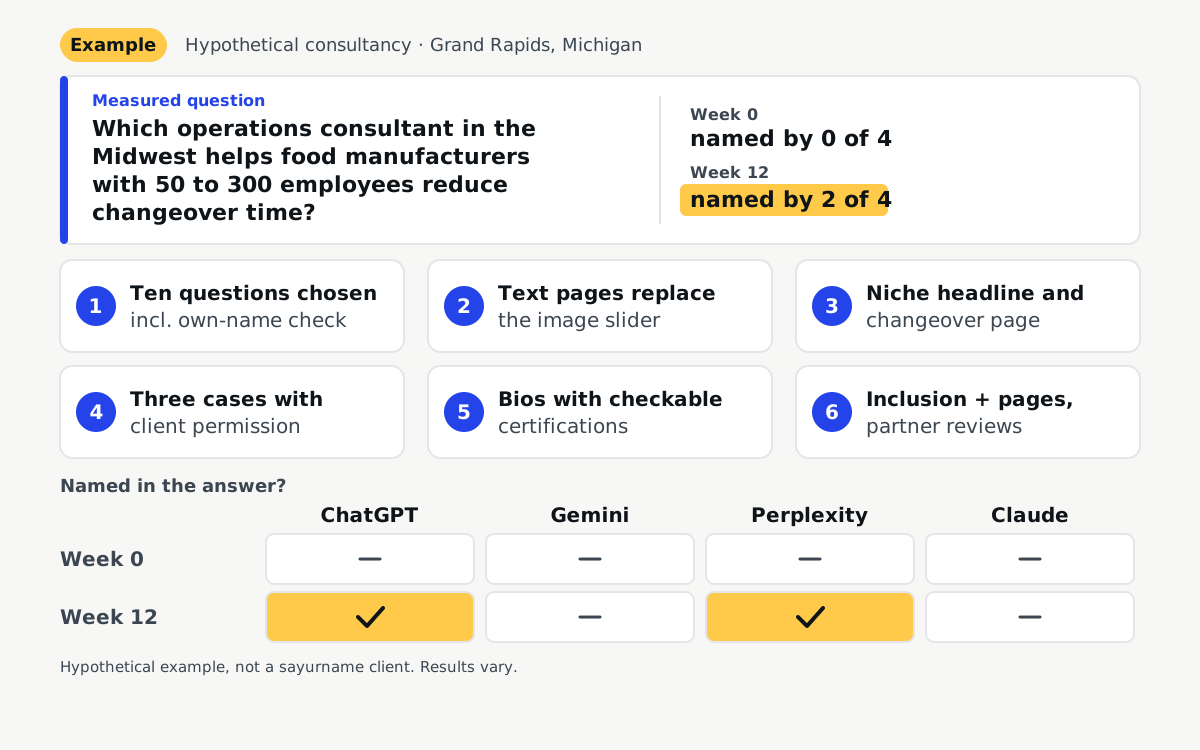
The measured question was “Which operations consultant in the Midwest helps food manufacturers with 50 to 300 employees reduce changeover time?”. At week 0 it was named by 0 of 4: ChatGPT named two national firms and a lean trainer, Gemini a directory list, Perplexity the state’s Manufacturing Extension Partnership center, Claude nobody.
- Read the four answers and their sources, and chose ten questions combining industry, problem, size and region, including a check on the firm’s own name.
- Fixed the base: replaced the slider with crawlable pages, one per service, and made the name, partners and niche sentence identical on the site, LinkedIn, Clutch and the IMC USA directory.
- Rewrote the headline as “operations for food and beverage manufacturers, 50 to 300 employees, Midwest” and built a changeover page with method, duration, fees and what is referred out, such as automation.
- Published three case studies with written client permission, two anonymized but still giving industry, headcount, state and result, such as changeover cut from 95 to 38 minutes in 14 weeks.
- Rewrote the partner bios with years in plant management and their CMC and ASCM certifications, both checkable on the issuers’ sites.
- Asked to be included in a Clutch “top consultants” list and on a trade association’s speaker page, published one page per measured question, each reviewed by a partner, and asked past clients for Clutch reviews with no incentive or suggested wording.
The name check moved first: by week 3 all four described the right niche. In week 6 Perplexity named the firm for the changeover question, citing the new page; in week 9 ChatGPT listed it as a “specialist boutique” after the national firms, which counts. At week 12 Gemini still led with the extension center, and Claude named the firm in one run of four, which does not count. Google Analytics showed the first chatgpt.com visits in week 10.
What did not work: a paid wire press release changed no answer; general leadership posts on LinkedIn moved nothing, while two on allergen changeovers were later cited; the ERP selection question never moved, correctly, since the firm does not do that work. Results vary; another firm might see none of this in twelve weeks.
What to publish
A citable page answers one buyer’s problem with facts a stranger could check. Titles that work: “Changeover reduction for food plants with 50 to 300 employees: method, timeline and fees”; “Allergen changeovers without losing a shift”; “What a three-week operations diagnostic covers, and what it does not”.
An excerpt from the first: “We work with food and beverage plants of 50 to 300 employees, usually after a new line has pushed changeovers past an hour. We start with a three-week diagnostic at a fixed $18,000, including a week on the line; implementation takes 10 to 16 weeks. Automation we refer to integrators named in our report.” Citable means industry and size in words, problem and method, duration and fees, verifiable credentials, cases with numbers and permission, and a clear line between what you do and what you refer.
When it is not worth it
If two or three anchor clients fill the partners’ year, more buyers only mean more refusals; raise fees or hire first. A subcontractor working under larger firms’ brands is never chosen by the end client, work won through public tenders follows procurement rules, and board advisory is picked from the chair’s network.
Nor does it pay when the firm will not commit to specifics: no niche, no named people, no case even anonymized, no fee model. Confidentiality is real, but a firm that cannot describe one engagement gives the AI nothing to cite. Start smaller: one anonymized case with consent, and the niche stated on the homepage.
How the work runs
It starts with the free test: one buyer’s question, four AIs, full answers saved as the starting point. Subscribed, we measure up to 10 questions every week in the four, fix the site’s base, find out where the AI gets the answer to each question and ask for the firm’s inclusion wherever there is a path: Clutch and The Manifest lists, the IMC USA directory, trade associations’ supplier and speaker pages. Some of those are editorial, paid or for members only, so we promise the request, not the listing; you see what was asked and what got in. We also publish content that answers the measured questions. Onboarding is online, and no client is named without written permission.
It costs $299/month, with no lock-in. A one-time $599 bonus is charged only when an AI starts naming the firm for a measured question, checked by a person on our team, or Google Analytics shows a visit from an AI. Nobody controls AI answers, so there is no guarantee of being recommended.
Questions
Do Clutch reviews matter more than my own site?
They do different jobs: reviews show satisfied clients exist; service and case pages say what you do and for whom. In the example, six reviews were not enough without the changeover page.
Most of my work is under NDA. What can I publish?
Industry, size, region, problem, method and measured change, without the client’s name and with written consent. One anonymized case with numbers gives an AI more to cite than ten logos.
If I narrow my positioning, will I lose other work?
Not if the narrowing is in the headline, not the service list. Referrals keep their own logic, and other services keep their own pages.
How long until anything changes?
In the example, the description changed by week 3 and the first assistant named the firm in week 6; two had not by week 12. Some questions never move.
What if the AI confuses us with a firm of the same name?
Common, since names like “Summit” repeat across states. Keep full name, city, partners and niche identical everywhere; the weekly measurement shows when the confusion stops.