
The question your patients actually ask
Owners usually find the problem by accident: one asks ChatGPT about dentists in town and sees the practice named, then asks again as a stranger in a fresh session and the name is gone: the first answer leaned on the earlier conversation. Another opens three private windows and gets three different lists. One answer is a sample; the useful measure is the same question, asked the same way, over weeks.
Patients type a treatment, a place and a constraint, and the constraint decides the answer: a complication (“implant dentist in [city] who does the bone graft in the same office”), urgency (“dentist open Saturday in [neighborhood] for a broken tooth”), fear (“dentist good with anxious patients who offers sedation”) or payment (“dentist that takes Delta Dental PPO”). Each shape draws on different sources, so a practice can be named for one and absent from the next.
Where the AI’s answer about dentists comes from
With web search on, the assistants do not consult a ranking of dentists; they run a few searches and summarize what the pages found agree on. In dentistry they are predictable: the Google Business Profile and Maps listing (categories, hours and the words patients use in reviews), Healthgrades, Zocdoc and Yelp, insurer “find a dentist” directories, the state dental board’s license lookup, city magazine “top dentists” lists, and the practice’s own treatment pages.
The practice’s own pages matter more than owners expect, because only they can state what a constrained question needs: grafts done in-house, a CBCT scanner, emergencies on Saturday mornings. The four assistants disagree because each searches a different index, and each varies between runs. Fame is not the criterion: a chain with thousands of reviews wins “dentist in [city]”, while the constrained question goes to whoever states the fact plainly, with independent sources agreeing.
The most common mistake: claiming instead of describing
The typical dental site was built to persuade someone already on it: a hero photo, “gentle, modern dentistry”, and a services grid where the implant card says “restore your smile with natural-looking implants”. Nothing is false and nothing is checkable, so an AI testing the practice against “bone graft in the same office” finds no sentence that answers it.
The reflex fix makes it worse: “Best implant dentist in [city]”, or a general dentist billed as an “implant specialist”. Superlatives are not evidence to an AI, and they are what dental advertising rules scrutinize; many state boards reserve “specialist” for recognized specialties. Replace each claim with a fact a stranger could verify, starting with who performs the treatment and a license number the board’s lookup confirms.
A worked example, step by step
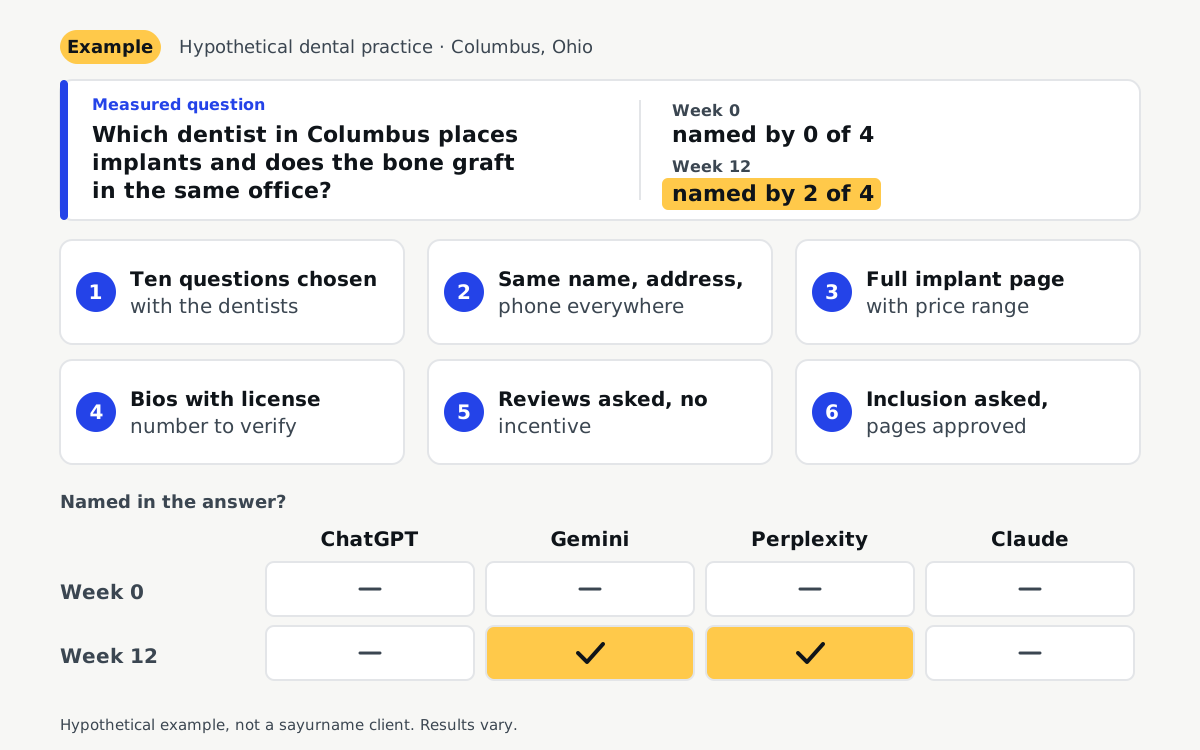
Example: a hypothetical practice, not a sayurname client. Imagine Clintonville Family Dental in Columbus, Ohio: two general dentists, 14 years open, 212 Google reviews averaging 4.8. One dentist places about 140 implants a year and grafts in-house with the practice’s CBCT scanner; an implant with crown costs $3,800 to $4,600. The site had a services grid and a 90-word implant card.
The measured question was “Which dentist in Columbus places implants and does the bone graft in the same office?”. At week 0 it was named by 0 of 4 assistants: ChatGPT named two chains and an oral surgery group, Gemini the most-reviewed practices downtown, Perplexity a city magazine’s list, and Claude nobody.
- Chose ten questions with the dentists: implants, Saturday emergencies, sedation, accepted insurance, the Invisalign price and five more.
- Fixed the base: identical name, address and phone on the site, Google profile, Healthgrades, Zocdoc and Yelp, where an old suite number survived, with implants and grafts listed as services.
- Replaced the implant card with a full page: who places implants and how many a year, grafts and CBCT in-house, the timeline, the price range, and which cases go to an oral surgeon.
- Rewrote both bios with dental school, year of licensure, implant training hours and Ohio license number, so anyone could confirm them on the board’s lookup.
- Asked every implant patient for a review after the final crown, with no incentive and no suggested wording, and answered reviews without confirming anyone was a patient.
- Asked Healthgrades and the city magazine’s list to include the practice, and published one page per measured question, each approved by the dentist before going live.
The insurance question moved first, in week 4. In week 6 Perplexity named the practice for the implant question, citing the new page; in week 9 Gemini followed, after new reviews mentioned grafts on site. At week 12 ChatGPT named it in one run of four, which does not count, and Claude still gave general advice.
What did not work: a “Columbus’s trusted implant experts” headline moved nothing and was removed; a paid premium directory profile brought bookings but no change in answers; the sedation question never moved, probably because the practice offers only oral sedation. Results vary by city, question and competition; another practice could see none of this in twelve weeks.
What to publish
A citable dental page answers one patient question with facts others can check. Titles that work: “Dental implants with a bone graft in Columbus: who places them, how long it takes and what it costs”; “Saturday emergency dentist in Clintonville: what we treat the same day”; “Insurance we accept, and what a crown costs without it”.
An excerpt from the first: “Dr. Ana Patel has placed about 140 implants a year since 2017. When the jaw needs a graft, she does it here after a CBCT scan, and the implant goes in four to six months later. An implant with crown costs $3,800 to $4,600; sinus lifts and full-arch cases go to an oral surgeon we work with.” What makes it citable: a named practitioner with a verifiable credential, where and with what equipment, the line between treated and referred, a timeline, a price range where your rules allow, one treatment per page.
When it is not worth it
If new patients already wait four months, more demand adds nothing; spend on capacity instead. A referral-only oral surgeon is chosen by referring dentists, not by patients asking an AI, so those relationships matter more. One of two dentists in a small town is already the answer, and a complete Google Business Profile is enough.
It also does not pay when the practice cannot change its own pages or will not say anything specific: no named dentists, no case limits, no timelines. Then start smaller: correct the Google profile and directory listings, come back when there is something concrete to publish.
How the work runs, within your board’s rules
It starts with the free test: one patient question sent to the four AIs, with the full answers saved as the starting point. Subscribed, we measure up to 10 questions every week in the four assistants, fix the base of the site so the AI can read the treatment pages, find out where the AI gets the answer to each question and ask for the practice’s inclusion wherever there is a path: Healthgrades, Zocdoc, insurer directories, the city magazine’s list. Some of those are editorial or paid, so we promise the request, not the listing; you see what was asked and what got in. We also publish content that answers the measured questions.
It costs $299/month, with no lock-in. A one-time $599 bonus is charged only when an AI starts naming the practice for a measured question, checked by a person on our team, or Google Analytics shows a visit from an AI. Nobody controls AI answers, so there is no guarantee of being recommended. The content is informative and follows your state dental board’s advertising rules: no promised results, no testimonials or before-and-after images where forbidden, no solicitation, no patient information, and the dentist approves every piece.
Questions
Do reviews matter more than my website?
Reviews tell the AI the practice is real and well regarded; the treatment page tells it what the practice does. In the example, 212 reviews were not enough until a page stated that grafts were done in the office.
Can I just pay a directory to be listed higher?
A premium listing can bring bookings from that directory. It does not buy a place in an AI’s answer, which is written from what several sources say.
Is this allowed by my state dental board?
Informative content about treatments, credentials and process is generally what dental advertising rules allow; they restrict unverifiable claims, misleading titles and solicitation. The dentist approves each piece, and any restriction your board sets applies to everything we publish.
How long until anything changes?
In the example, the first assistant named the practice in week 6 and two had not by week 12. Narrow questions such as accepted insurance tend to move sooner than implants; some take months.
What if the AI says something wrong about my practice?
It happens: an old address, a retired dentist, a plan you no longer accept. The AI repeats what it read, so correct the source, usually a directory or an old page, and state the right fact on your own site.