
The question homeowners actually ask
Electrical contractors usually meet the problem as a puzzle rather than as a lost job. One owner asked ChatGPT about his own company and saw it praised, then asked the same thing the way a stranger would and it was gone: the first answer had only echoed what he had typed earlier in the conversation. Another asked the AI to optimize the website and noticed nothing afterwards, because rewritten prose adds no fact the assistant did not already have. A third heard customers say they had found him through Perplexity while Google Analytics showed only direct visits. The only reliable reading is the answer to a stranger’s question, asked the same way every week.
Homeowners almost never type “electrician near me” into an AI. They type a job, a place and a constraint, and the constraint decides who gets named. Equipment: “electrician in [city] to install a Level 2 charger, I have a 100-amp panel”, where the real question is whether a panel upgrade is needed at all. Old hardware: “replace a Federal Pacific panel in [city], cost”, where the answer leans on whoever explains why that panel is replaced and what the job includes. Urgency: “half my house has no power, electrician open now in [neighborhood]”, read against stated hours and against whether the fault is the utility’s. Credentials: “licensed electrician who pulls permits for a service upgrade in [city]”, answered from license lookups and permit records. Each shape sends the assistant to different sources, so a company named for one can be absent from the next.
Where the AI’s answer about electricians comes from
With web search on, each assistant runs a handful of searches and summarizes what the pages it finds agree on. For electricians the sources are predictable: the Google Business Profile and Maps (categories, hours, the wording of reviews), Angi, Yelp, Thumbtack, Nextdoor and the BBB, city subreddits where people ask who replaced their panel without upselling, the state licensing board’s lookup, charger makers’ installer directories such as Tesla’s, the utility’s pages on service upgrades and rebates, and the contractor’s own service pages. Permit records matter more than most owners think: many cities publish them, and a company whose name sits on hundreds of finalized electrical permits is, to a careful reader, verifiably active.
What sets this trade apart is that most questions are technical decisions disguised as hiring questions. Someone asking about a charger on a 100-amp panel needs a load calculation, and the assistant prefers a page that explains when a load-management device or a smaller circuit avoids the upgrade, written by an electrician who says so in plain numbers. A generic homepage cannot answer that; a specific service page can. The four assistants disagree because each searches a different index and phrases its searches differently, and the same assistant changes between runs, which is why one check proves little and the weekly measurement repeats the same question. Being the best-known company is not the criterion: the firm with 2,000 reviews wins “electrician in [city]”, but the 100-amp charger question goes to whoever states the answer plainly, with an independent source agreeing.
The most common mistake: one services page that lists everything
Almost every electrical contractor’s site has a services page that reads like a keyword list: panel upgrades, EV chargers, generators, lighting, rewiring, troubleshooting, commercial, residential, thirty bullets and no sentence about any of them. It happens because the page was built for an older search habit, where matching words was enough, and because writing a real page per job feels like giving the estimate away. To an AI, a bullet that says “EV chargers” is a claim without detail, identical to the same bullet on fifty other sites, so it carries no weight against a competitor who explains amperage, permits and price.
The cost is concrete. Charger and panel questions are the most valuable ones in residential work, often leading to a service upgrade in the $3,000 to $4,500 range, and they go to whoever wrote the explanatory page: sometimes a company two counties away, sometimes a lead-generation site that sells the inquiry back to local contractors. The remedy is not more bullets but fewer, deeper pages, one per job that brings real money or real urgency, each stating who does it, under which license, for which houses, with which permit and inspection, in what time and at what price range. Five such pages do more than thirty bullets.
A worked example, step by step
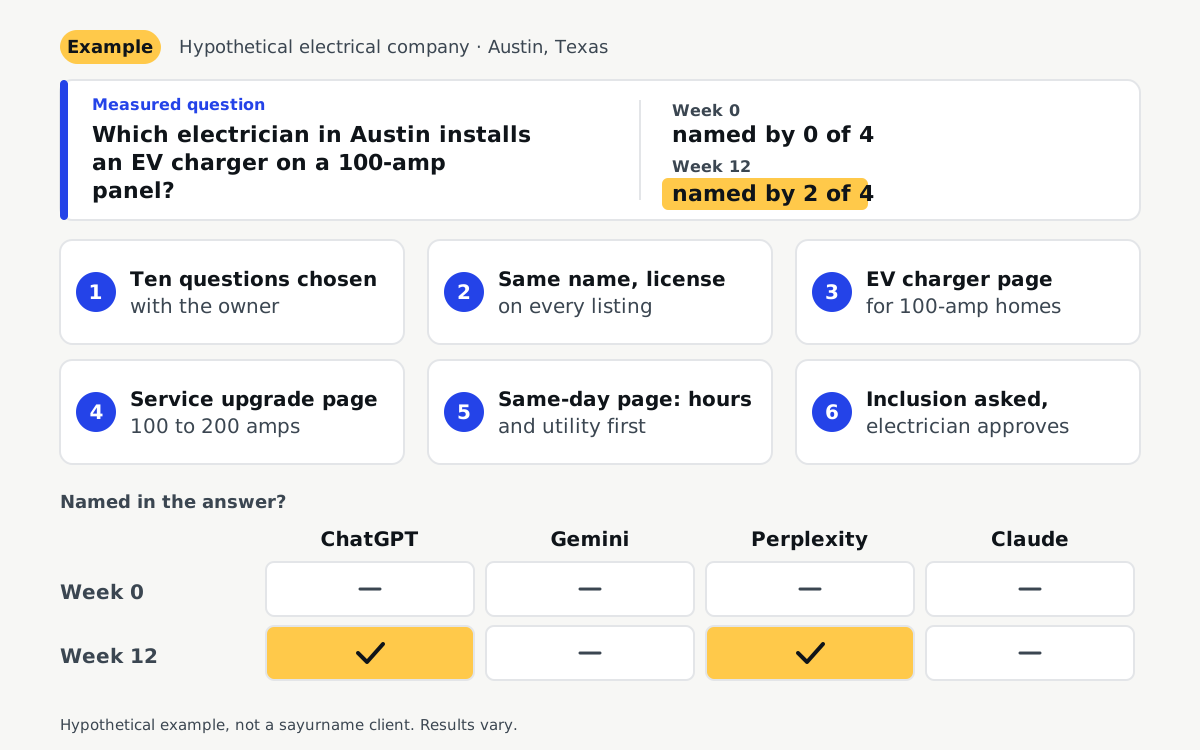
Example: a hypothetical company, not a sayurname client. Imagine Hollow Oak Electric in Austin, Texas: a master electrician who owns it, six licensed electricians and two apprentices, 14 years in business, 212 Google reviews averaging 4.8. It installs about 150 EV chargers a year; a Level 2 install with no panel work costs $650 to $1,400, and a 200-amp service upgrade $2,800 to $4,200 including the city permit. The site had a 31-item services list, the contractor license number appeared nowhere, and Angi still showed a phone line dropped in 2023.
The measured question was “Which electrician in Austin can install an EV charger in a house with a 100-amp panel?”. At week 0 the company was named by 0 of 4: ChatGPT named two large companies and suggested a lead-generation site, Gemini listed the most-reviewed businesses on Maps, Perplexity cited a Reddit thread and a charger maker’s installer list, and Claude gave sound advice about load calculations and named nobody.
- Read the four answers and their sources with the owner, and chose ten questions: chargers on small panels, Federal Pacific replacements, partial outages, generator interlocks and permitted service upgrades.
- Fixed the base: the same name, address, phone and hours on the site, Google, Angi, Yelp, Nextdoor and the BBB, and the Texas contractor license number on every page, matching the state’s license lookup.
- Replaced the 31 bullets with an EV charger page for 100-amp homes: how the load calculation is done, when a load-management device or a 40-amp circuit avoids an upgrade, the permit and inspection, price ranges and a typical timeline.
- Wrote a service upgrade page explaining the 100-to-200-amp job step by step, including what Austin Energy does to disconnect and reconnect, how long scheduling takes, and what is and is not in the price.
- Rewrote the urgent page: what the crew fixes the same day, the hours the phone is answered, and when the right first call is the utility’s outage line rather than any electrician.
- Requested listings in two charger makers’ installer directories, including Tesla’s, and published one page per measured question, each checked by the master electrician, including short job notes with the permit number of each installation, and asked charger customers for reviews with no incentive and no suggested wording.
The urgent question moved first, and in an unexpected direction: by week 4 Perplexity began telling people with a street-wide outage to check the utility’s outage map before calling anyone, citing the company’s page, and named Hollow Oak for partial outages inside the house. In week 6 Perplexity named the company for the 100-amp charger question, quoting the load-management paragraph; in week 9 ChatGPT followed, after several reviews mentioned that no panel upgrade had been needed. At week 12 Gemini still led with the Maps leaders, each with over 1,000 reviews, and Claude named the company in one run out of four, which does not count as named.
What did not work: an “Austin’s #1 electrician” banner moved nothing and came down; a paid featured listing on a lead site brought a few calls but changed no AI answer; the standby generator question never moved, since the company installs about ten a year and a dedicated generator dealer is the better answer. Results depend on the city, the question and the competition; another company doing the same work might see none of this in twelve weeks.
What to publish
A citable electrical page answers one homeowner’s decision with facts anyone can check. Titles that work: “EV charger on a 100-amp panel in Austin: load calculation, permit and what it costs”; “Upgrading from 100 to 200 amps: what we do, what the utility does and how long it takes”; “Federal Pacific and Zinsco panels: why we replace them and what the job includes”; “Power out in part of the house: what we fix today and when to call the utility first”.
An excerpt from the first: “Most 100-amp houses we survey can take a Level 2 charger without an upgrade. We run a load calculation from your last twelve months of usage and the appliances on site; if the margin is thin, a 40-amp circuit or a load-management device that pauses charging while the dryer runs usually solves it for $650 to $1,400, permit and inspection included. When the numbers do not work, we say so and quote the 200-amp upgrade separately.” Citable here means a named master electrician and a license number the state lookup confirms, the houses and cases the page covers, the line between what is done and what is referred, a price range, the permit and inspection, and the timeline. Leave out instructions for opening the panel yourself: a contractor’s page that teaches live work undermines the very credential it relies on.
When it is not worth it
If the schedule is already booked six weeks out, more inquiries only lengthen the queue and annoy the people waiting; hire or raise prices first. A company that lives on subcontract work for builders and general contractors is chosen by people who read bids, not by homeowners asking an AI, and commercial and industrial work is won through tenders and relationships, where the measured questions rarely exist. The same goes for small towns where everyone calls the electrician the neighbor used: people there do not ask an AI, and measuring every week a question nobody types is money wasted.
Nor does it pay when the basics are out of order: a license that has lapsed or does not match the business name, permits pulled under someone else’s number, or a franchise where head office controls every page and nothing local can be published. An assistant that cross-checks the license lookup will find the mismatch, and content cannot fix it. Start there instead: bring the license and the business name into agreement, correct the Google profile and hours everywhere, and come back when there is something concrete to publish.
How the work runs, within your state’s licensing rules
It starts with the free test: one homeowner’s question sent to the four AIs, with the full answers saved as the starting point. Once subscribed, we measure up to 10 questions every week in ChatGPT, Gemini, Perplexity and Claude, fix the site’s base so the assistants can read and understand the service pages, find out where the AI gets the answer to each question, and ask for the company’s inclusion wherever there is a path: charger makers’ installer directories such as Tesla’s, Angi, Thumbtack, the BBB. Some of those are curated or paid, so we promise the request, not the listing; you see what was asked and what got in. We also publish content that answers the measured questions. Publishing happens on a subdomain connected by DNS, or we deliver the pieces and you publish them. Onboarding is online, with no call.
It costs $299/month, with no lock-in. A one-time $599 bonus is charged only when an AI starts naming your company for a measured question, checked by a person on our team, or Google Analytics shows a visit coming from an AI. Nobody controls AI answers, so there is no guarantee of being recommended. The content follows your state licensing board’s advertising rules, which in many states means showing the contractor license number; it promises no outcomes, does not describe work outside your license class and does not teach live electrical work. A licensed electrician on your side approves every piece.
Questions
Do reviews matter more than my website?
Reviews tell the AI the company is real and well regarded; a service page tells it what the company does, for which houses and at what price. In the example, 212 reviews were not enough until the charger page existed, and reviews that described the job helped more than star ratings alone.
Can I pay a lead site to be recommended?
A paid listing can bring calls from that site, but it does not buy a place in an AI answer, which is written from what several independent sources agree on. In the example, the featured listing produced calls and moved no answer.
Does my license number really matter?
Yes, because it is the one claim an assistant can verify against the state’s lookup. A license number on every service page, matching the business name, turns “licensed and insured” from a slogan into a fact.
How long until anything changes?
In the example, the first assistant named the company in week 6 and the second in week 9; two had not by week 12. Some questions never move, because another company is genuinely the better answer.
What if the AI sends people to us for a utility outage?
That usually comes from a vague “24/7 emergency” line. State on your site what you handle and when the utility is the right first call; the AI repeats what it reads, and the weekly measurement shows when the correction lands.