

The question a homeowner actually types
Engineers who test this often see their practice named from their own ChatGPT account and gone when they ask as a stranger in a private window, because the assistant was echoing an earlier conversation. What matters is what a stranger gets when the same question is asked every week.
Homeowners describe a job, a place and a constraint: “engineer to design a beam so I can remove a load-bearing wall in my Philadelphia rowhouse”; “structural engineer to look at a bowing party wall before I close on a house”; “engineer who only stamps drawings for the permit”. The first rewards a page naming the job and the city; the second, one explaining the inspection and the letter a buyer receives; the third, a plain statement of scope. A homepage offering “comprehensive structural engineering solutions” answers none of them.
What the assistants read
With web search on, the assistants draw here on Google Business Profile and Maps, marketplaces such as Angi, Thumbtack and Houzz, Reddit threads, and the practices’ own service pages. The state board’s license lookup recommends nobody, but a PE number on your site that matches the register gives two agreeing sources, which matters more for a house’s safety than for a painter’s work.
Homeowners describe the job, not the discipline, so a contractor whose Maps listing says “load-bearing wall removal” often beats an engineer whose site says “structural analysis and design”. Fame points the wrong way: a city’s best-known structural firms design towers and hospitals and will not call back about a rowhouse beam. Answers differ between assistants because each searches a different index, and between runs because generation is probabilistic; in our measurements Perplexity picks up a clear new page first, while ChatGPT and Claude wait for facts repeated across sources.
The usual mistake: a capability statement, not an answer
Engineering sites are usually written for other professionals: disciplines, software, sectors served, a PDF capability statement. Nothing there matches a homeowner’s question: no job in plain words, no city, no turnaround, no fee or deliverable. Asking the AI itself to optimize the site brings keyword advice and no change: the missing ingredient was facts.
The cost: the question goes to a contractor, who subcontracts an engineer, perhaps you, at a markup and with your name invisible. The fix is one page per job homeowners ask about, in their words: what you inspect, what you deliver (a sealed letter, calculations, permit drawings), how soon you visit, a fee range where your board allows it, and what you do not do.
A worked example, step by step
Example: a hypothetical practice, not a sayurname client. Imagine Ridgeway Structural in Philadelphia: two licensed PEs and a drafter, fourteen years in practice, about 70% residential work, mostly pre-1940 rowhouses. A site visit with a written letter costs $450 to $650; beam design with sealed permit drawings, $1,400 to $2,600. It had 41 Google reviews, 6 on Houzz, a 90-word services page and its project list only in a PDF.
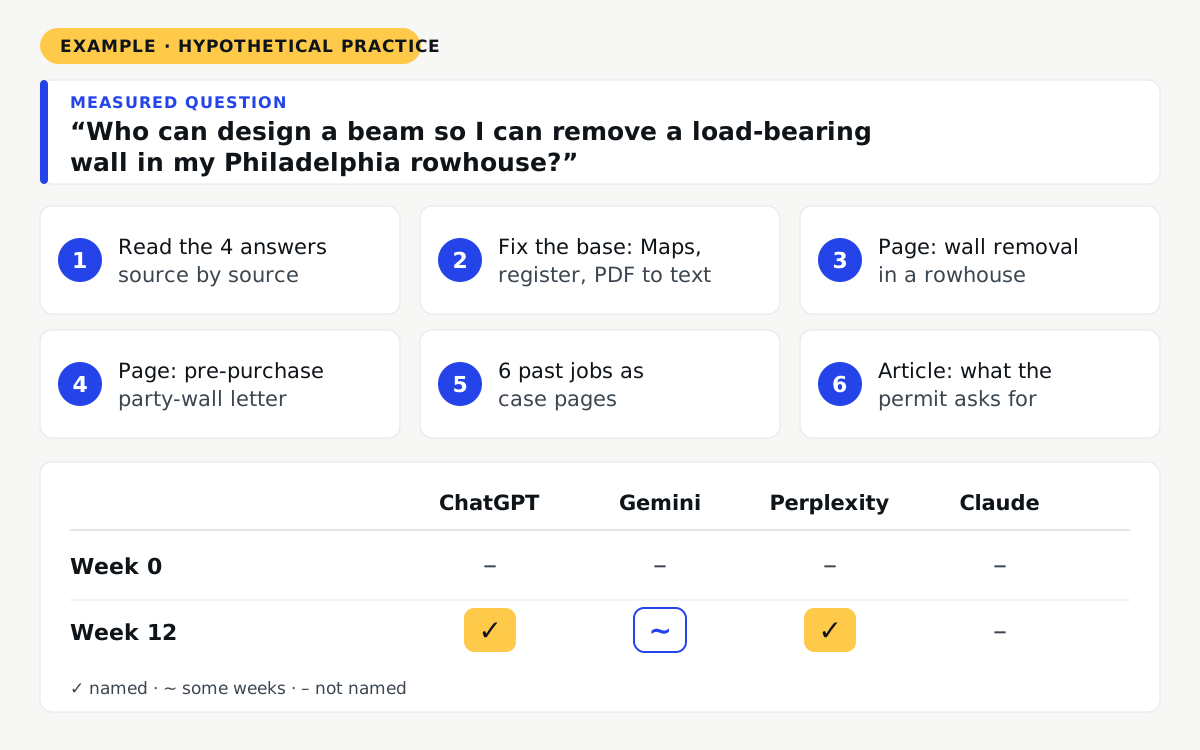
The measured question: “Who can design a beam so I can remove a load-bearing wall in my Philadelphia rowhouse?”. In week 0 none of the four assistants named Ridgeway (0 of 4): ChatGPT and Claude named two large commercial firms, Gemini a design-build contractor from Maps, and Perplexity cited an Angi list and a Reddit thread.
- We read the week-0 answers source by source: the Reddit thread named an engineer with a clear wall-removal page, the contractor’s Maps listing said “load-bearing wall removal”, and Ridgeway used neither phrase.
- We fixed the base: the PDF project list became text pages, the Google profile category changed from “Engineer” to “Structural engineer”, and both PE license numbers, as on the state board’s register, went on the about page.
- We wrote “Removing a load-bearing wall in a Philadelphia rowhouse”: what the visit checks, what the permit needs from the engineer, the timeline (visit within five business days, drawings in eight to twelve), the fee range, and the fact that Ridgeway does not build.
- A second page answered the pre-purchase question on bowing party walls and sagging joists: what the letter covers and what it cannot tell a buyer.
- With the owners’ consent, six past jobs became case pages of 250 to 350 words: neighborhood, year built, span opened, steel or engineered-lumber beam and why, permit duration.
- An article explained what the city asks for when a permit involves a structural change, which the week-0 answers left vague, quoting the city’s guidance.
Nothing moved for three weeks. In week 4 Perplexity named Ridgeway, citing the wall page; Gemini followed in some weeks from week 9; ChatGPT named it from week 10, citing a case page on a 1925 Fishtown rowhouse. By week 12 Claude still had not: 2 of 4, with Gemini intermittent.
What did not work: a paid listing on a general engineering directory was never cited, and a page aimed at “best structural engineering firm in Philadelphia” was wasted: that broad question goes to firms with decades of press. This is one hypothetical path; with more competition, results come later or not at all.
What to publish
Cited titles name the job, the building type and the place: “Removing a load-bearing wall in a Philadelphia rowhouse: what the engineer does and what it costs”; “Bowing party walls: when a buyer needs a structural letter”; “Case: a 14-foot opening in a 1925 Fishtown rowhouse with a steel beam”. A sample excerpt for the first: “We visit within five business days and measure the joists and the wall below. For most rowhouse openings up to 16 feet we design a steel or engineered-lumber beam and issue sealed calculations and permit drawings within about two weeks. We do not perform the work.”
A page is citable when its claims can be checked: who seals the drawings and under which license, which jobs you take or refer out, the area you cover, timelines from real jobs, fee ranges where your board allows them, and what the client holds at the end. “Trusted experts” gives an assistant nothing to repeat.
When it is not worth it
If most of your work comes from architects and contractors who already know you, the person choosing the engineer rarely asks an AI. The same holds for public tenders, infrastructure, or forensic work referred by attorneys and insurers. And with a three-month backlog, a page promising a visit within a week does harm.
It also fails when the question is too broad or outside your license: a practice licensed only in Pennsylvania should not chase New Jersey homeowners. Run the free test on your real question first; if the answers already name you, or nobody asks it, you know before spending.
How the work runs, within your state board’s rules
It starts with the free test: one question, four assistants, full answers saved as your starting point. Onboarding is online, with no call; you choose up to 10 questions and publish on a subdomain we connect through DNS or receive each piece to publish yourself. Every week we ask those questions in the four assistants. We fix the site’s base, find out where the AI gets the answer to each question and ask for the practice’s inclusion wherever there is a path: Angi, Thumbtack, Houzz. Some of those are paid or curated, so we promise the request, not the listing; you see what was asked and what got in. We also publish content that answers the measured questions.
The price is $299/month with no lock-in, plus a one-time $599 bonus charged only when an AI starts naming your practice for a measured question (a person checks it) or Google Analytics shows a visit from an AI. There is no guarantee of a recommendation. Engineering is a licensed profession: the content is informative, follows your state engineering board’s advertising rules, including use of the PE title and seal, avoids restricted testimonials, promises no results and solicits no one. You review everything first.
Questions
Do my Google and Angi reviews matter more than my site?
Reviews show that you exist and that clients were satisfied, but rarely which jobs you take. For a specific job, the cited source is usually a service or case page.
Can I pay to be listed in the AI’s answer?
No. There is no paid placement in these answers; in the example, a paid directory listing was never cited.
Is this allowed by my state engineering board?
Informative content about services, process, credentials and completed work is generally accepted; rules vary by state, usually covering misleading claims, misuse of the title or seal, and some testimonials.
How long until anything changes?
In the example the first change came in week 4 and was still partial in week 12: plausible, not a promise.
What if an assistant tells homeowners they do not need an engineer?
It happens, especially with wall removal. We find the source of the claim, publish a clear page with the correct information, and measure whether the answer changes.