

The question corporate buyers actually ask
One planner asked ChatGPT about her firm and got a warm description, then asked as a stranger would and the firm was gone: the first answer had echoed what she said earlier in the chat. Another had the AI rewrite her services page and saw nothing change, because better sentences added no facts.
The buyer is rarely a meeting professional; it is an executive assistant or a sales director handed an event, who types a format, a headcount, a place and a constraint. Size: “corporate event planner in [city], two-day offsite, 80 people”, matched against pages that state headcount ranges. Budget: “cost per head of a 100-person sales kickoff”, answerable only by a page with ranges. Each shape pulls on different sources, so a firm named for one is often absent from the next.
Where the AI’s answer about event planners comes from
With web search on, each assistant runs a few searches and summarizes what the pages agree on. For corporate events the sources are predictable: the Google Business Profile, where the category matters more than owners think; B2B directories such as Clutch, whose “top event companies in [city]” lists are lifted almost whole; the convention bureau’s partner directory (Choose Chicago); venues’ preferred-planner pages. Instagram, where planners spend most of their effort, is largely closed to these searches.
The best corporate work is confidential, so the open web holds less evidence about a good corporate planner than about an average wedding planner, and the AI fills the gap with whoever is documented. And categories leak: a firm listed on Google as “wedding planner” is read as one for every corporate question. The four assistants search different indexes and vary between runs, hence three anonymous tabs, three lists. Size is not the criterion: “two-day offsite for 80” goes to whoever states that headcount and format plainly, with an independent source agreeing.
The most common mistake: a portfolio emptied by NDAs
Corporate planners sign confidentiality clauses, and many conclude that nothing can be shown. The site ends up with mood photographs, a service list that fits any firm and “references on request”: prudent toward clients, fatal toward the AI, which finds nothing tying the firm to an 80-person offsite, a venue or a budget, and prefers a competitor who described one in detail.
The fix is the anonymized case study, which most NDAs allow and clients usually approve when asked. Name the industry, not the company (“a medical-device sales team”); give the headcount, season, venue, format, budget band and one thing that went wrong. Ask each client in writing, and where the answer is no, leave the event out rather than blur it.
A worked example, step by step
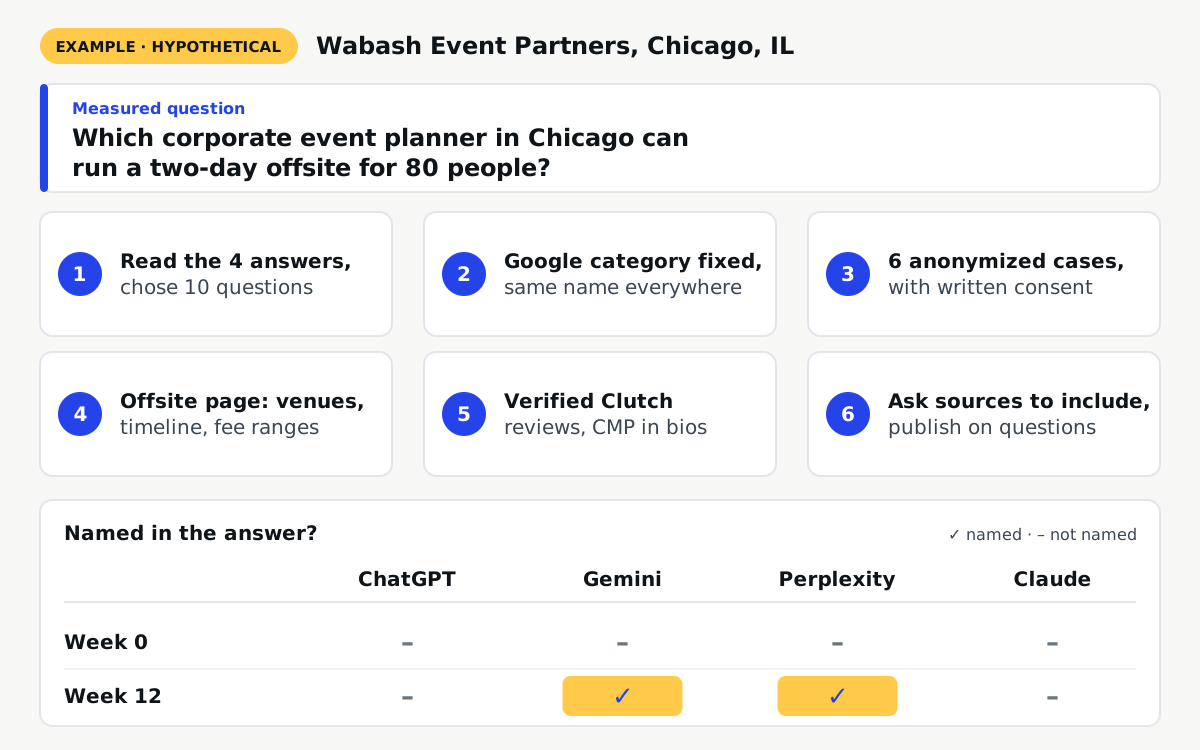
Example: a hypothetical firm, not a sayurname client. Imagine Wabash Event Partners in Chicago: two founders, four planners, 14 years in business, about 45 corporate events a year for 40 to 250 people. A two-day offsite for 80 carries a fee of $9,000 to $16,000 on a total of $650 to $1,100 per attendee. It had 31 Google reviews averaging 4.9, the Google category “Wedding planner”, an empty Clutch profile and a portfolio page reading “our work is confidential”.
The measured question was “Which corporate event planner in Chicago can run a two-day offsite for 80 people?”. At week 0 the firm was named by 0 of 4: ChatGPT named national agencies and a venue platform, Gemini three party planners, Perplexity the top of a Clutch list, Claude nobody.
- Read the four answers and their sources with the founders and chose ten questions, from the offsite to hybrid town halls.
- Fixed the base: Google category changed to “Event planner”, corporate services listed, and identical name, address and phone on the site, Google, Clutch, LinkedIn and Choose Chicago.
- Asked eleven past clients for written permission and wrote six anonymized case studies, each with industry, headcount, season, named venue, format, budget band and one problem solved.
- Built an offsite page: 30 to 250 people, eight venues within two hours such as Lake Geneva and Galena, a 12-to-16-week timeline, fee ranges, and what the firm does not do, such as international incentive trips.
- Asked the same clients for Clutch reviews, which Clutch verifies, and added each planner’s CMP credential to the bios, checkable in the Events Industry Council register.
- Asked three of the eight venues to add the firm to their preferred-planner pages, and published one page per measured question, each approved by a founder: venue comparisons, per-head cost breakdowns, how hotel attrition clauses work.
Perplexity moved first: in week 6 it named the firm for the offsite question, citing the new page and the Clutch reviews. Gemini followed in week 11, after the category change and two Google reviews that mentioned offsites by name. At week 12 ChatGPT still named the national agencies and the Clutch list, where the firm now sat 14th; Claude named it in one run of four, which does not count.
What did not work: a paid wire-service press release changed no answer, and a “Chicago’s premier” headline moved nothing. The international incentive question never moved, rightly: the firm runs about two such trips a year, and destination management companies are the better answer. Results vary by city, question and competition; another firm might see none of this in twelve weeks.
What to publish
A citable page answers one buyer’s question with checkable facts. Titles that work: “Two-day offsites for 50 to 150 people within two hours of Chicago: venues, timeline and cost per head”; “A sales kickoff for 120: what the planner handles and what your team still owns”.
From the first: “For an offsite of 80 we start 12 to 16 weeks out, shortlist three venues within two hours of the Loop and cap room-block attrition at 20 percent. Last spring a medical-device sales team of 85 spent two days at a Lake Geneva resort; the coach ran 40 minutes late, so the opening session was held on board. Total spend was $780 per attendee, our fee $11,500.” Citable means a named venue, headcount, season, timeline, price range and a real complication, with no client named without written consent.
When it is not worth it
If three anchor clients book the firm through next year, more demand only adds proposals nobody can write. Firms that win work through RFPs and approved-supplier lists are chosen by purchasing departments, not by someone asking an AI; their effort belongs in the tender.
Nor does it pay when nothing can be said in public: if clients refuse every anonymized case and the founders will not commit to headcounts, venues or fees, the new pages will be as vague as the old ones. Start smaller: fix the Google category, collect verified reviews on one directory, and return when three events can be described.
How the work runs
It starts with the free test: one buyer’s question sent to the four AIs, the full answers saved as the starting point. Subscribed, we measure up to 10 questions every week in the four assistants, fix the site’s base so the AI can read the service and case pages, find out where the AI gets the answer to each question and ask for the firm’s inclusion wherever there is a path: Clutch’s city lists, the Choose Chicago partner directory, venues’ preferred-planner pages. Some of those are curated or paid, so we promise the request, not the listing; you see what was asked and what got in. We also publish content that answers the measured questions.
It costs $299/month, with no lock-in. A one-time $599 bonus is charged only when an AI starts naming the firm for a measured question, checked by a person on our team, or Google Analytics shows a visit from an AI. Nobody controls AI answers, so there is no guarantee of being recommended.
Questions
Do reviews matter more than my website?
Reviews tell the AI the firm is real; the service and case pages tell it what the firm does, for how many people and where. In the example, 31 reviews were not enough without the offsite page.
Can I pay to be listed first in a directory?
A sponsored slot can bring leads from that directory, but the AI writes from what several independent sources agree on. Earned reviews on that same directory do more.
Our clients make us sign NDAs. What can we publish?
Usually more than you think: industry, headcount, season, venue, format and budget band identify no one. Ask each client in writing and drop any event they decline; never imply a relationship you cannot confirm.
How long until anything changes?
In the example, Perplexity named the firm in week 6 and Gemini in week 11; ChatGPT had not by week 12. Some questions never move, because another firm is the better answer.
What if the AI calls us a wedding planner?
It is repeating what it read, usually a Google category or an old page. Correct the category, state which events you run and which you no longer take; the answers follow the sources.