

The question your clients actually ask
A new client says Perplexity suggested the firm, yet Google Analytics shows nothing labeled AI: those visits arrive as direct traffic or an unread referral. Others ask ChatGPT to optimize their site and see no change in what it tells strangers. It cannot rewrite what other sources say, and one answer in your own chat, shaped by your history, is not a measurement.
Prospects describe a situation plus a condition about pay: a fee structure (“flat-fee planner in [city] who won’t move my assets”), a life event (“Roth conversions before I retire”), a niche (“planner for physicians”) or a credential (“fee-only CFP near me”). The fee condition decides most: it filters out the brokerage and insurance brands that win the generic question, and most planner websites leave it unstated.
Where the AI’s answer about financial planners comes from
Assistants treat personal finance cautiously, so they start with criteria, not names: a fiduciary, how the adviser is paid, BrokerCheck or the SEC’s adviser search. With web search on, they name firms from sources that corroborate those criteria: the Form ADV brochure, the CFP Board’s Let’s Make a Plan search, fee-only directories such as NAPFA, Google reviews, Reddit threads, and the firm’s own fee pages.
A site stating fee, minimum, niche and registration plainly can be matched to a constrained question; “holistic wealth” cannot. The assistants disagree because each searches a different index and weighs caution differently (Claude is often the most reluctant to name anyone), and each varies between runs. Size is not the criterion: national brands win “financial advisor in Denver”; the flat-fee Roth question goes to whoever states those facts, backed by the public record.
The most common mistake: a site that disagrees with your regulatory record
Planner sites are written to sound trustworthy, not to be checked: “independent, fiduciary, comprehensive wealth management” and “contact us for pricing”. The precise version is the Form ADV brochure: pay, minimums, conflicts. When the two disagree (the site says “fee-only”, the brochure mentions insurance commissions, or an old broker registration shows on BrokerCheck), an assistant reading both drops the firm or names it with a warning.
A stronger adjective does not fix it; unsubstantiated claims are what advertising rules target. Make the site say what the record says: how you are paid, the fees or their ranges, any minimum, whether you hold assets or sell products, and your CRD number, so anyone can check. If the filing itself is outdated, correct it first.
A worked example, step by step
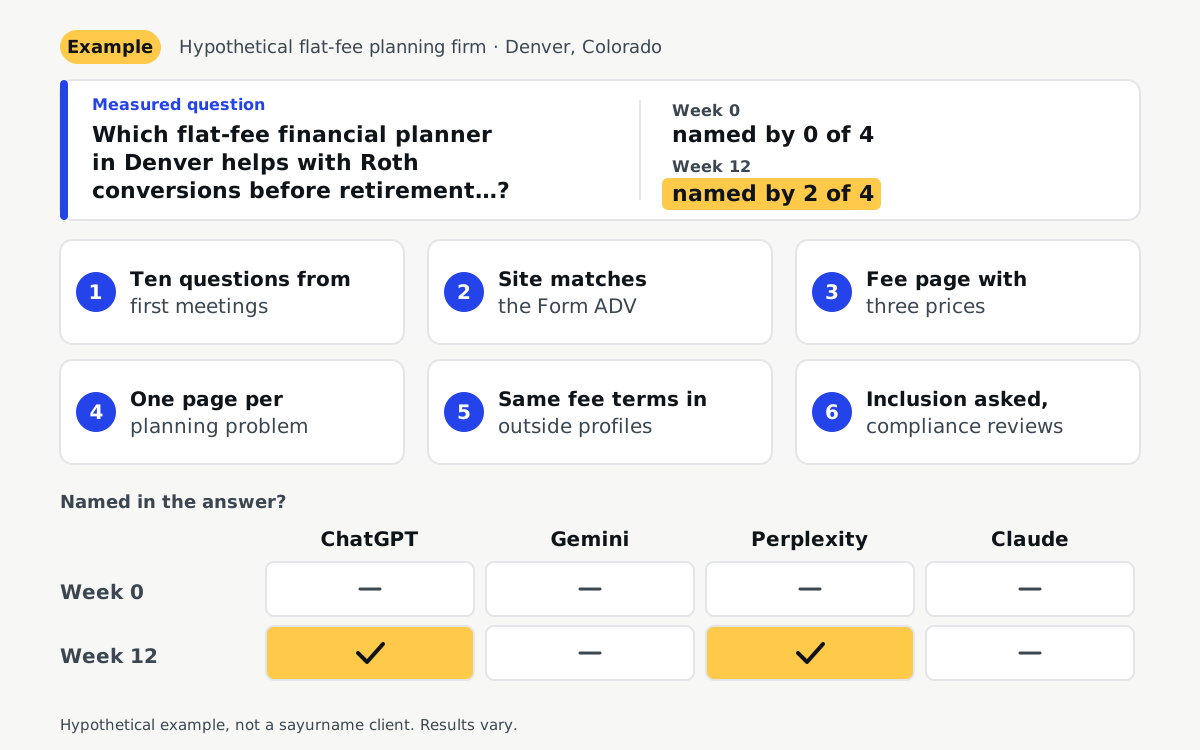
Example: a hypothetical firm, not a sayurname client. Imagine Larkin & Shaw Planning in Denver, Colorado: two CFP professionals, state-registered for nine years, 118 households, flat fees only ($3,400 for a one-time plan, $4,200 to $8,400 a year ongoing), no asset minimum, no products sold. Half its clients are near retirement with a Colorado PERA pension. The site offered “holistic fiduciary planning” and “contact us for pricing”.
The measured question was “Which flat-fee financial planner in Denver helps with Roth conversions before retirement without managing my investments?”. At week 0 it was named by 0 of 4: ChatGPT a national network and a wealth firm with a $1 million minimum, Gemini the most-reviewed advisers on Maps, Perplexity a Reddit thread; Claude listed criteria only.
- Chose ten questions with both planners from what prospects ask in first meetings: Roth conversions, PERA options, flat fees without asset management, Social Security timing and six more.
- Aligned the site with the record: the homepage promised “wealth management” though the Form ADV describes planning fees only, and one bio listed a lapsed insurance license; the wording now matches the brochure, with the CRD number in every footer.
- Published a fee page: three prices, what each covers, no minimum, no custody, no commissions, and the cases declined, such as clients who want their portfolio run.
- Wrote one page per planning problem, starting with Roth conversions: who runs the analysis, the inputs, an anonymized case, and a note that it is general information, not individual advice.
- Gave NAPFA, Let’s Make a Plan and the Google Business Profile the same fee description; the Google category still read “investment service”.
- Asked NAPFA and the CFP Board’s search to list the firm’s planners, and published one page per measured question, each reviewed by the chief compliance officer and archived before going live.
The Social Security question moved first, in week 3. In week 5 Perplexity named the firm for the Roth question, citing the fee page and NAPFA profile; from week 8 ChatGPT named it in most weekly runs. Gemini kept favoring the most-reviewed advisers on Maps, where the firm had 19 reviews; at week 12 Claude still named nobody.
What did not work: a “Denver’s most trusted fiduciary” headline moved nothing and compliance pulled it as unsubstantiated; a paid lead-matching service sent three inquiries, all wanting portfolio management, and changed no answers. Results vary by city, question and competition; another firm could see none of this in twelve weeks.
What to publish
A citable page answers one client situation with facts a stranger can verify. Titles that work: “Roth conversions before retirement in Colorado: how we run the numbers and what it costs”; “Flat-fee planning in Denver: what each fee covers”; “PERA pension options compared”; “Who we are not a fit for”.
An excerpt from the first: “Every Roth conversion analysis is run by Maria Shaw, CFP®. We model conversions year by year until required minimum distributions begin, against your tax bracket, PERA benefit and the Medicare surcharges that look back two years at income. It is part of the $3,400 one-time plan; we manage no accounts and take no commissions.” What makes it citable: a named planner with a checkable credential, a method you can judge, fees in the Form ADV’s terms, stated limits, no projected returns.
When it is not worth it
If one planner already serves 120 households and keeps a waiting list, more inquiries add nothing; hire or raise fees first. If nearly every client comes through CPAs and estate attorneys, invest in those relationships. A broker-dealer representative whose compliance takes six weeks per piece cannot keep this pace; agree on pre-approved templates first.
Nor does it pay when the firm will not state a fee, a minimum or a niche because every prospect must call first: the assistant has nothing to match, and more content will not change that. Start by making the site agree with the record and completing directory profiles.
How the work runs, within your regulator’s advertising rules
It starts with the free test: one client question sent to the four AIs, full answers saved as the starting point. Subscribed, we measure up to 10 questions weekly in the four assistants, fix the site’s base so the AI can read your fee pages, find out where the AI gets the answer to each question and ask for the firm’s inclusion wherever there is a path: fee-only directories such as NAPFA, the CFP Board’s Let’s Make a Plan search. Some of those are limited to members or certificants, so we promise the request, not the listing; you see what was asked and what got in. We also publish content that answers the measured questions.
It costs $299/month, with no lock-in. A one-time $599 bonus is charged only when an AI starts naming the firm for a measured question, checked by a person on our team, or Google Analytics shows a visit from an AI. Nobody controls AI answers, so there is no guarantee of being recommended. The content is informative and follows the advertising rules of the SEC, FINRA or your state securities regulator: no promised returns, no testimonials where your rules restrict them, no solicitation, no client data, and the planner or compliance officer approves and archives every piece.
Questions
Do reviews matter more than my website?
Reviews tell the AI the firm is real and well regarded, and Gemini leans on them; fee pages tell it what the firm does and how it is paid. In the example, 19 reviews sufficed for two assistants once the pages stated facts. Check your rules before asking.
Can I just pay a matching service to be recommended?
A paid lead service can send inquiries from its own users. It does not buy a place in an AI’s answer, which draws on several independent sources.
Is this allowed under my advertising rules?
Informative content about services, fees, process and credentials is generally permitted; the rules restrict unsubstantiated claims, misleading performance and undisclosed testimonials. Your compliance review covers every piece, and your regulator’s or broker-dealer’s restrictions bind everything we publish.
How long until anything changes?
In the example, the first assistant named the firm in week 5 and two had not by week 12. Narrow questions tied to a stated fact, such as fee structure, usually move first; some never move.
What if the AI says something wrong about my firm?
It happens: an old fee schedule, a retired partner, a dropped broker registration. The AI repeats what it read: correct the source, often a directory or the filing, and state the right fact on your site.