

The question homeowners actually ask
Most owners find the problem the same way. One asks ChatGPT for flooring installers in town, sees the company named, then asks it to answer as it would for a stranger and the name disappears: it had come up only because the owner mentioned the company earlier in the conversation. Another opens three private windows, asks the same thing and gets three lists with different names. A single answer is an anecdote; what tells you something is the same question, worded the same way, asked of each assistant every week.
Homeowners rarely ask for “a flooring company”. They name a material, a house and a complication, and the complication decides who gets named: the substrate (“who installs LVP over a concrete slab in [city] and tests for moisture first”), the age of the floor (“refinish original 1940s oak floors in [neighborhood] without replacing boards”), the disruption (“low-dust hardwood refinishing so we don’t have to move out”), a repair (“match and replace water-damaged oak boards in a hallway”) or the arrangement (“installer who will lay flooring I already bought”). The last shape is more common than installers think, because many homeowners buy material online or at a big-box store and then look for labor alone, and a site that talks only about its showroom never matches it.
Where the assistants get flooring names from
With web search on, ChatGPT, Gemini, Perplexity and Claude do not consult a ranking of installers. They run a few searches, read what comes back and summarize what the pages agree on. In flooring those pages are predictable: the Google Business Profile and Maps listing (categories, service area and the words customers use in reviews), Yelp, Houzz, Angi and Thumbtack profiles, Reddit threads in city and flooring subreddits, the NWFA’s directory of certified professionals and manufacturers’ installer lists, the state contractor license lookup where the state licenses flooring work (California’s CSLB, under its C-15 classification, is one), and the company’s own service and project pages.
Flooring has a peculiarity that works against installers: the businesses with the most readable text are retailers. A showroom publishes a page on every material because it sells them, while the crew doing its installs often has an Instagram account and a Google profile with a phone number. So when the question is about a material, the assistant finds the retailer’s page and names the retailer. Installers can win the questions a retailer cannot answer credibly, about process, substrate, repair and the particular house, but only with pages that state those facts: board thickness, how many sandings the floor can take, the dust system, the cure time.
The four assistants disagree because each searches a different index and weighs it differently. Gemini tends to lean hardest on Maps and review volume, Perplexity on pages and forum threads it can quote, and every one of them varies from run to run. Fame is not the criterion: a national franchise wins “floor refinishing in [city]”, while the question with a constraint goes to whoever states the fact plainly, with independent sources saying the same.
The most common mistake: a gallery that says nothing
The typical installer site is a photo gallery and a list, “Hardwood · LVP · Laminate · Tile · Carpet · Stairs · Refinishing”, with “quality craftsmanship, free estimates” underneath. The photos are often excellent, and to an assistant they are close to invisible: it cannot tell from a picture that the floor was 1938 red oak in Hyde Park, that six boards were replaced and woven in, or that the job took four days with a water-based finish. The list is worse than nothing for a constrained question, because it says the company does everything and shows it doing nothing in particular.
It happens because the site was built for referrals: someone already recommended the company and the visitor only needs reassurance. The cost appears where nobody looks. On “refinish original oak without moving out”, the answer names a showroom whose blog explains dust containment, even though the showroom subcontracts that work to crews like yours. The fix is not more photos. Write each finished job as a short project record (neighborhood, house age, species or product, square footage, what you found, what you did, days on site, price range) and cut the services list to the work you want to be asked about. Avoid the reflexes that make it worse: “Austin’s best flooring company” on the homepage, or praise posted on Reddit under invented names; assistants discount superlatives, and forum regulars spot planted praise quickly.
A worked example, step by step
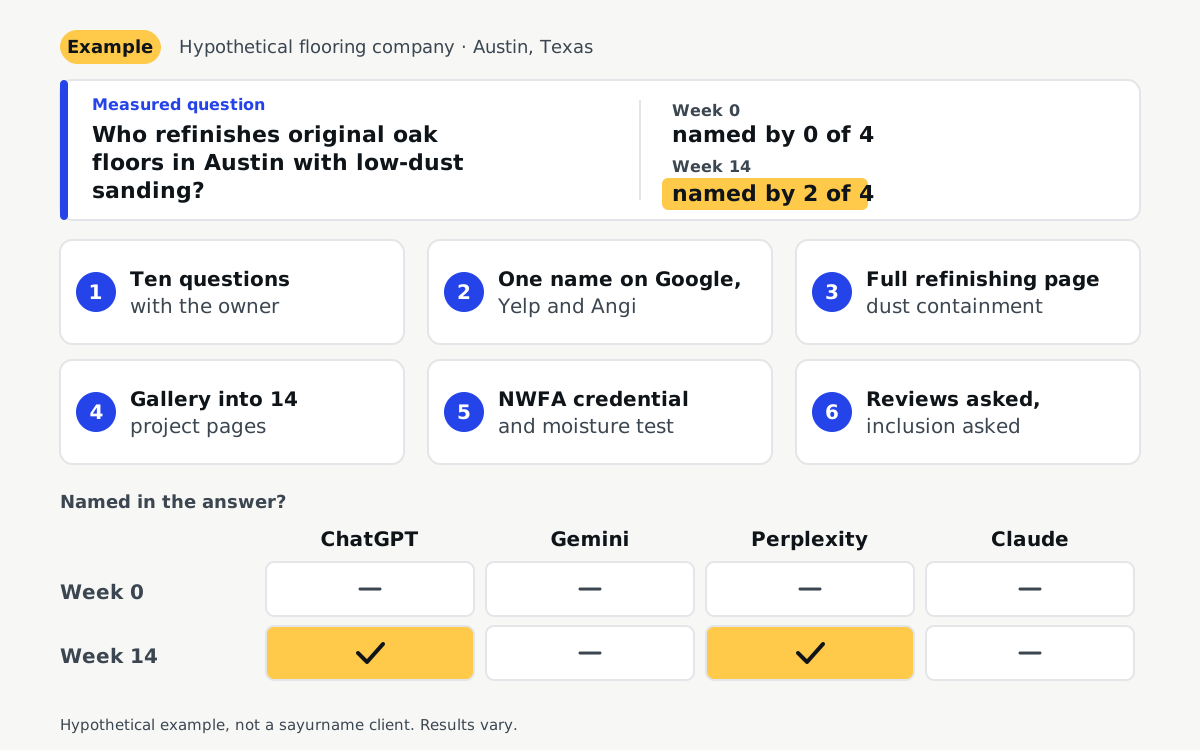
Example: a hypothetical company, not a sayurname client. Imagine Crestview Floor Works in Austin, Texas: the owner and four installers, 11 years in business, 96 Google reviews averaging 4.9 and 23 on Yelp. About 40% of its work came as a subcontractor for two local showrooms. Refinishing oak cost $4.50 to $6.50 a square foot, and labor for LVP ran $2.75 to $4. Texas does not license flooring contractors, so its verifiable credentials were an NWFA sand-and-finish certification and its insurance. The site had a gallery of 140 photos and a services list.
The measured question was “Who refinishes original oak floors in Austin with a low-dust sanding system?”. At week 0 it was named by 0 of 4 assistants: ChatGPT named a national refinishing franchise and a large showroom, Gemini the three most-reviewed companies on Maps, Perplexity a Houzz list and a two-year-old Reddit thread, and Claude gave general advice on refinishing with no names.
- Chose ten questions with the owner, all asked by callers that year: original oak refinishing, LVP over a slab, stairs, water-damaged boards, installing material the customer bought, and five more.
- Fixed the base: the company was Crestview Floor Works on Google, Crestview Flooring on Yelp and Angi, and listed with the owner’s old mobile number on Thumbtack; all were unified, and the Google categories were set to flooring contractor and floor refinishing service, with the service area named by neighborhood.
- Replaced the one-line refinishing card with a full page: how many full sandings a 3/4-inch solid floor usually allows, the dust-containment sanders connected to a vacuum (“contained, not dust-free”), the water-based finish and its cure times, the price range, and when they recommend a screen and recoat instead.
- Turned the gallery into 14 project pages written from job notes: neighborhood, year the house was built, species, square footage, what was found under the carpet, boards replaced, days on site and price range.
- Rewrote the owner’s bio with the NWFA certification and directory listing, general liability and workers’ compensation coverage, and the moisture test used before any LVP goes on a slab, the in-situ relative humidity probes described in ASTM F2170.
- Asked every refinishing customer for a review a week after the final coat, with no discount and no suggested wording, asked two flooring manufacturers to add the company to their installer lists, and published pages for the measured questions, each checked by the owner for technical accuracy.
The LVP-over-slab question moved first: in week 5 Perplexity named the company, quoting the moisture-test paragraph. On the measured refinishing question Perplexity named it in week 7, citing two project pages, and ChatGPT followed in week 10, in three of four runs at first and consistently by week 14. Gemini did not: its answer kept the three Maps leaders, each with more than 400 reviews, and newer reviews mentioning “original oak” and “barely any dust” had not shifted that by week 14. Claude still gave general advice.
What did not work: a homepage line, “Austin’s trusted hardwood experts”, changed nothing and was removed; paying for Angi leads brought estimate requests but no change in any assistant; the stairs question never moved, probably because there were only two stair projects to show. The real cost was the owner’s time, about 30 minutes of notes and photos per project page. Results depend on the city, the question and the competition; another company could see none of this in fourteen weeks.
What to publish
A citable flooring page answers one homeowner question about one material in one situation, with facts others can check. Titles that work: “Refinishing original oak floors in older Austin houses: what we check, how long it takes, what it costs”; “LVP over a concrete slab: the moisture test we run first and when we say no”; “Replacing water-damaged hardwood boards so the repair does not show”; “We install flooring you bought yourself: what we need before quoting”.
An excerpt from the first: “Most pre-war Austin houses have 3/4-inch solid red or white oak, which can usually take four to six full sandings over its life; before quoting, we lift a floor vent to see how much wood is left above the tongue. We sand with dust-containment machines connected to a vacuum, so the dust is contained, not gone, and we use a water-based finish that takes light foot traffic after 24 hours. A 600-square-foot job usually takes three to four days and costs $2,700 to $3,900.”
What makes it citable: the limits stated (what you will not sand, which slabs fail the test), numbers a stranger can check (thickness, cure times, days on site, price per square foot), named standards and certifications, and the license number where your state requires one. Photos still help the person reading; put the facts in the text beside them.
When it is not worth it
If the crew is booked twelve weeks out on showroom and builder work, more homeowner demand only lengthens the wait; hiring or raising prices pays better. A company that works entirely as a subcontractor for one retailer, under its brand and contract, may not be allowed to sell direct, and direct leads would put that relationship at risk. In a small town with two flooring crews, people ask the hardware store, not an assistant, and a complete Google profile is enough.
It also does not pay for a pure commodity offer: if the pitch is the cheapest laminate or carpet per square foot, the questions are about price, and price is won on lead marketplaces, not in AI answers. And it does not work when the owner will not say anything specific: no project details, no limits, no price ranges. Start smaller then: fix the Google profile and directory listings, write up three recent jobs properly, and come back when there are facts to publish.
How the work runs
It starts with the free test: one homeowner question sent to the four assistants, with the full answers saved as your starting point. Subscribed, we measure up to 10 questions every week in the four, fix the base of the site so the assistants can read the service and project pages, find out where the AI gets the answer to each question, and ask for the company’s inclusion wherever there is a path: the NWFA directory, manufacturers’ installer lists, Houzz. Some of those are curated or paid, so we promise the request, not the listing; you see what was asked and what got in. We also publish content that answers the measured questions. Publishing goes on a subdomain connected through DNS, or we deliver and you publish. Onboarding is online, with no call.
It costs $299/month, with no lock-in. A one-time $599 bonus is charged only when an assistant starts naming the company for a measured question, checked by a person on our team, or Google Analytics shows a visit from an AI. Nobody controls AI answers, so there is no guarantee of being recommended. Where your state licenses flooring work, the license number goes on every page that describes it, and we write no claim your license, insurance or manufacturer certifications do not support.
Questions
Do reviews matter more than my website?
Reviews show the company is real and well regarded, and Gemini in particular weighs their volume. They rarely say what you do in enough detail: in the example, 96 reviews did not answer a question about low-dust refinishing until project pages, and newer reviews, described it.
I mostly work as a subcontractor for showrooms. Can this bring me direct jobs?
It can, on the process and repair questions showrooms do not answer well, but read your agreements first: some retailers forbid soliciting their customers. Many installers keep the subcontract work and use their own pages for the jobs that come direct.
Do I need a license or certification for this to matter?
Only where your state requires a license, as California does for flooring under the C-15 classification; there the number belongs on the site, because the license lookup is a source an assistant can check. Elsewhere, NWFA certification, the Certified Tile Installer credential from CTEF and proof of insurance are the verifiable credentials.
How long until anything changes?
In the example, the first assistant named the company in week 5 for a narrow question and in week 7 for the main one; two had not by week 14. Narrow technical questions tend to move before broad ones, and some never move.
What if the AI says something wrong about my company?
It happens: an old phone number, a service area you left, or the claim that you sell flooring when you only install it. The assistant repeats what it read, so correct the source, usually a directory profile or an old page, and state the right fact plainly on your own site.