

The question families actually ask
Funeral directors usually meet this as a phone call, not as a lost arrangement. Someone asks about their own home and the assistant praises it, because the question already contained the name. A son then asks the way a stranger does, from another state, at 11 p.m., and the home is gone. The only reading that matters is that stranger’s question, asked the same way every week.
Families almost never type “best funeral home near me”. They type a rite, a place and a constraint, and the constraint decides who is named. Price: “direct cremation in [city], what does it cost, itemized”. Distance: “my father died in [city] and I live out of state, who can I arrange this with by phone”. Faith and place: “funeral home that can hold a visitation and then a Catholic mass at [named parish]”. A specific cemetery: “burial at [named cemetery], who handles the paperwork”. Veterans, infants, and green burial are narrower still. Each shape sends the assistant to different pages, so a home named for one can be absent from the next. Kindness is not the criterion. The assistant cannot verify “compassionate”. It can verify a price, a license and a cemetery.
Where the answer about a funeral home comes from
With web search on, each assistant runs a few searches and summarizes what the pages agree on. For this trade the sources are stable: the Google Business Profile, the state licensing board’s lookup, the cemetery’s own fee schedule, obituary sites, church and parish pages, veterans’ burial benefits pages, and the funeral home’s site. National cremation brands rank high because they publish one number that is the same in many cities. A local home with no number loses that comparison even when its service is the one the family actually needs.
The Federal Trade Commission’s Funeral Rule is the mechanism, not a slogan. Anyone who asks in person must be offered a General Price List before any specific goods are discussed, and a home may not require a casket for a direct cremation. An assistant does not enforce the Rule. It repeats whoever already published the list. The four assistants disagree because each searches a different index, and the same assistant changes between runs, which is why one screenshot proves little. Fame is not the criterion either: the home with 400 reviews wins “funeral home in [city]”, and the price question goes to whoever states an itemized number a stranger could check against the list.
The most common mistake: comfort copy, and the price list behind a form
Almost every independent funeral home’s site is written as condolence. “A caring staff”, “celebrating a life”, “call us and we will guide you”. The General Price List, if it exists as a file at all, sits behind “request a quote”. It happens because directors were trained to give the list in the arrangement room, where they can explain a cash advance, and because publishing numbers feels like inviting families to shop the cheapest casket. To an assistant, adjectives are identical on fifty sites. A number is not.
The cost is concrete. The daughter in another state cannot visit the arrangement room tonight. She takes the brand that printed $1,895 on a page she can read. The local home may be the better choice, with a licensed director, a known cemetery and an honest cash-advance line, and it never enters the answer. The remedy is not a sadder homepage. It is the price list as a page: what direct cremation includes, what is the home’s fee, what is a cash advance paid to the crematory, the cemetery or the county for death certificates, and the line that a casket is not required.
A worked example, step by step
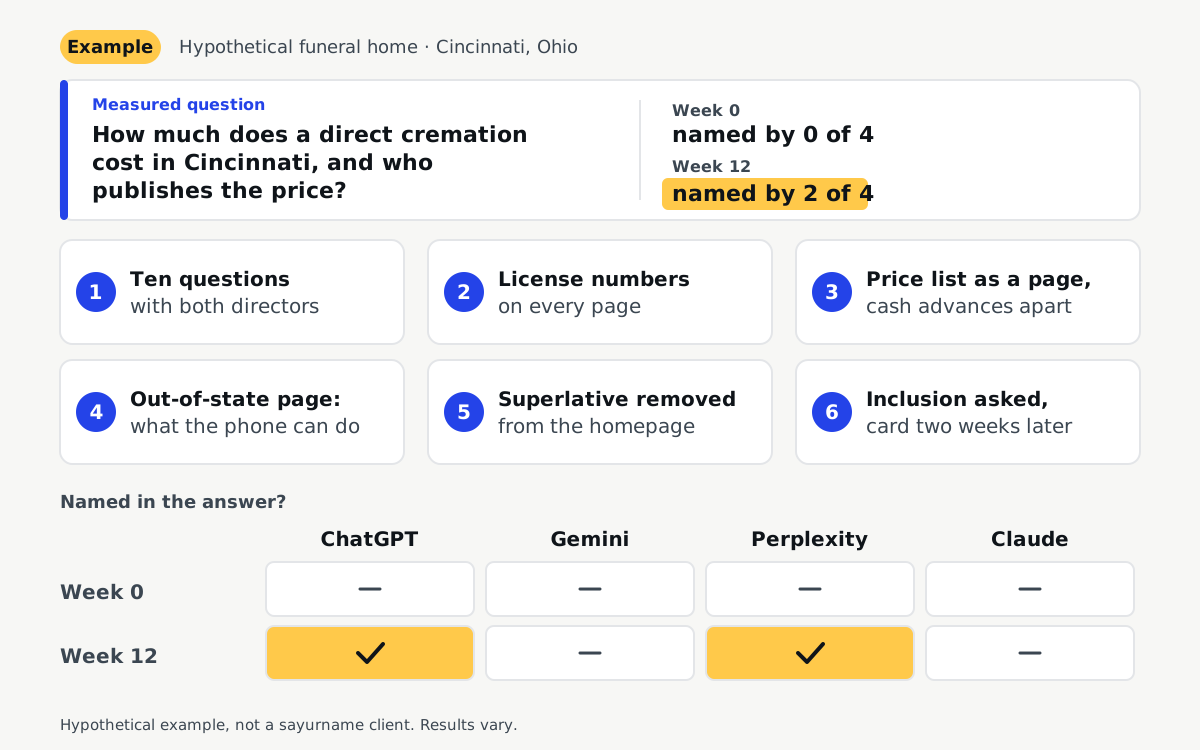
Example: a hypothetical funeral home, not a sayurname client. Imagine Hartwell & Sons in Cincinnati, Ohio: two licensed funeral directors and five staff, 41 years on the same corner, 128 Google reviews averaging 4.9. A direct cremation is $2,150 to $2,650 for the home’s services; a traditional service with one evening of visitation is $7,400 to $9,800 before cemetery charges and cash advances. The site was 600 words of comfort and a form. The General Price List was a PDF emailed after someone called. The Ohio license numbers were on the lobby wall and nowhere online.
The measured question was “How much does a direct cremation cost in Cincinnati, and which funeral home publishes the price?”. At week 0 the home was named by 0 of 4. ChatGPT named two national cremation brands and gave their advertised ranges. Gemini listed the most-reviewed homes on Maps, none with a price. Perplexity cited a three-year-old Reddit thread. Claude explained that the Funeral Rule requires a General Price List and named nobody.
- Read the four answers with both directors and chose ten questions families had actually asked that year: direct cremation price, arranging from out of state, a Catholic mass at a named parish, burial at Spring Grove, a veteran’s marker, and what an infant funeral includes.
- Fixed the base: the same legal name, address and phone on the site, Google and the obituary notices, and both Ohio funeral-director license numbers in the footer, matching the state board’s lookup.
- Published the General Price List as a page, not a form: the direct-cremation package itemized, the statement that no casket is required, and a separate column for cash advances, with the crematory, the cemetery and the death certificates named as other people’s charges.
- Wrote an out-of-state page: what can be decided on the phone, which documents need a signature, who meets the family at the airport, and what the home will not decide for them.
- Removed “Cincinnati’s most caring funeral home” from the homepage. It had moved nothing, and no source can confirm a superlative.
- Asked the two parishes they serve most and the main cemetery to list the home among local providers, published one page per measured question, each read by a licensed director, and left a short card two weeks after the service asking for a review, with no incentive and no suggested wording. They do not ask on the day of the service.
Nothing moved for five weeks, which is normal while new pages are found. In week 6 Perplexity named Hartwell for the cremation question and quoted the cash-advance paragraph. In week 10 ChatGPT followed, after two reviews mentioned that the price on the phone matched the page. At week 12 Gemini still led with the Maps leaders, and Claude named the home in one run of four, which does not count.
What did not work: a paid listing on a grief website brought two calls and no change in any answer. The green-burial question never moved, because the home does not offer it and a cemetery thirty miles away publishes that option in detail; they stopped writing around it. Results depend on the city, the question and the competition. Another home doing the same work might see none of this in twelve weeks.
What to publish
A citable funeral page answers one family’s decision with facts a stranger could check. Titles that work: “Direct cremation in Cincinnati: what our fee includes and what is a cash advance”; “Arranging a funeral from out of state: what we can do by phone”; “Burial at Spring Grove: what we file and what the cemetery charges”; “A veteran’s funeral: which benefits we help the family claim, and which we do not”.
An excerpt from the first: “Our charge for a direct cremation, with no visitation and no casket, is $2,150 to $2,650. That is our fee. The crematory, the death certificates and any obituary are cash advances: we pay them and list them at the same amount, with no markup. You do not have to buy a casket. The General Price List on this page is the same document we hand you in the arrangement room.” What makes it citable: a named director and a license number the board confirms, the homes and cases the page covers, the line between the home’s fee and someone else’s charge, a range, and what the home will not do. Leave out instructions for caring for a body at home. That is not a funeral home’s page.
When it is not worth it
If the calendar is already full, more inquiries only lengthen a wait no family should have. Hire or narrow the work first. A home that exists only as the in-house chapel of one cemetery is chosen by people who already picked that cemetery, and an assistant’s answer rarely changes that. The same is true of a prepaid-plan company whose contract forbids the local home from publishing any price: there is nothing concrete to put on a page, and content cannot break the contract.
Nor does it pay when the license does not match the name on the door, or when the person who answers the phone is not a licensed director and the site says otherwise. An assistant that checks the board will find the mismatch. Start there: make the name, the license and the General Price List agree, and come back when there is a number you are willing to print.
How the work runs, within the Funeral Rule and your state board
It starts with the free test: one family’s question sent to the four AIs, with the full answers saved as the starting point. Once subscribed, we measure up to 10 questions every week in ChatGPT, Gemini, Perplexity and Claude, fix the site’s base so the assistants can read the service pages, find out where the AI gets the answer to each question, and ask for the funeral home’s inclusion wherever there is a path: obituary sites, the parish pages that list local homes, the cemetery’s list of providers. Some of those are editorial or paid, so we promise the request, not the listing; you see what was asked and what got in. We also publish content that answers the measured questions. Publishing happens on a subdomain connected by DNS, or we deliver the pieces and you publish them. Onboarding is online, with no call.
It costs $299/month, with no lock-in. A one-time $599 bonus is charged only when an AI starts naming your home for a measured question, checked by a person on our team, or Google Analytics shows a visit coming from an AI. Nobody controls AI answers, so there is no guarantee of being recommended. The content follows the Funeral Rule and your state board’s advertising rules: the General Price List is accurate, cash advances are labeled, and a licensed director on your side approves every piece. It promises no outcome and does not describe care of a body.
Questions
Does publishing prices cheapen the funeral?
The Funeral Rule already requires you to offer the General Price List to anyone who asks. Publishing the same list lets a family in another state read it before they call. In the example, the homes that stayed unnamed were the ones whose only price was a form.
Can a national cremation brand be the better answer?
Yes, when the question is only a nationwide price and that brand states it clearly. The local home wins the question it can actually answer: this cemetery, this parish, this license, this cash-advance line. Writing around a service you do not offer makes the other firm the better citation.
Should we ask grieving families for reviews?
Not on the day of the service, and never with a discount or a suggested sentence. In the example, a card two weeks later, with no incentive, was enough for the reviews that later mentioned the price matching the page.
How long until anything changes?
In the example, the first assistant named the home in week 6 and the second in week 10; two had not by week 12. Some questions never move. The weekly measurement is what shows which is which.
What if our prepaid-plan partner forbids prices on the site?
Then there is nothing citable to publish, and the work should wait. A page that hints at a price the contract forbids is worse than silence, because the assistant will repeat the hint next to your name.