

The question a new member actually asks
Gym owners usually meet this as a tour, not as a lost member. They ask an assistant about their own gym and it praises the place, because the question already contained the name. A stranger then asks the way a person asks before they will cross town: a class, a time of day, and a level. The gym is gone. The only reading that matters is that stranger’s question, asked the same way every week.
Almost nobody types “best gym near me” into an AI and stops there. They add a constraint, and the constraint decides who is named. A skill: “Olympic lifting for a beginner”. A clock: “before work, weekday morning”. A body: “I am coming back after a desk job, not after a competition”. A limit: “a class of fewer than ten, not an open floor”. Each shape sends the assistant to a different page. A gym famous for open gym can be absent from the beginner question. “Welcoming” is not the criterion. The assistant cannot verify a mood. It can verify a coach’s name, a credential, a time, a cap and a price.
Where the answer about a gym comes from
With web search on, each assistant runs a few searches and summarizes what the pages agree on. For gyms the sources are predictable: the Google Business Profile, ClassPass and similar directories, Reddit threads from people who tried a first class, the coach’s own certificate listing when one exists, and the gym’s site. A university or a national chain ranks for a broad question because many pages repeat its name. A small room ranks for the narrow question only if a page states the class in sentences, not in a picture.
What sets this trade apart is that the fact the stranger needs is a timetable, and most timetables are built so a person can book, not so a page can be quoted. A widget loads the week after a click. A PNG of the grid has no coach name a search can match. The four assistants disagree because each searches a different index, and the same assistant changes between runs, so one screenshot proves little. Fame is not the criterion: the gym with 2,000 reviews wins “gym in [city]”, and the morning lifting question goes to whoever states the class in text a stranger could check on Tuesday.
The most common mistake: the schedule lives only in the booking app
Almost every independent gym’s site is a logo, three photos and a “book now” button. The real schedule, the coach and the level sit inside Mindbody, WellnessLiving or a ClassPass link. It happens because the app already has the week, and typing it again feels like double work that will go stale. To an assistant, a button is not a class. It cannot tell a 6:15 beginner barbell hour from an open gym.
The cost is concrete. The person asking at 10 p.m. will not create an account to see Thursday. They take the rec center whose page says “barbell for beginners, Mondays, instructor named”. The local gym may be the better room, eight people, a coach who actually teaches the lifts, and it never enters the answer. The remedy is not more photos of plates. It is the schedule as HTML: class name, day, time, coach, level, how many people, what the first month costs, and the date the grid was last checked. The trade-off is maintenance. A page that still lists a coach who left in March is worse than the widget, because the assistant will repeat the old name. Update the page the day the grid changes, or write the term dates and stop implying it is this week.
A worked example, step by step
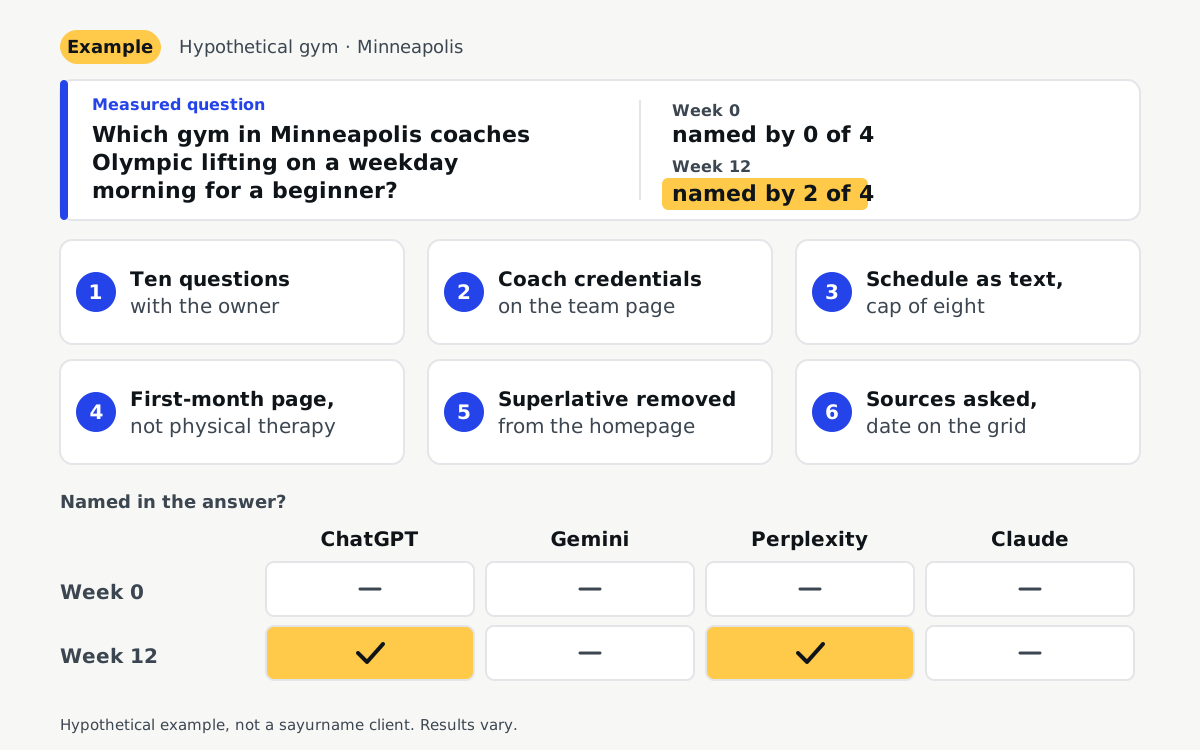
Example: a hypothetical gym, not a sayurname client. Imagine Iron Range Athletic in Minneapolis: the owner and four coaches, nine years in one room, 210 Google reviews averaging 4.7. Beginner Olympic lifting runs Monday, Wednesday and Friday at 6:15 and 9:30, coached by a USA Weightlifting Level 1 coach, capped at eight. Membership is $180 a month; a first-month intro is $90 and includes four coached sessions. Drop-in is $28. The site was a homepage and a booking widget. The schedule was a PNG exported on Sundays.
The measured question was “Which gym in Minneapolis coaches Olympic lifting on a weekday morning for someone who has never lifted?”. At week 0 the gym was named by 0 of 4. ChatGPT named a university recreation center and a national chain. Gemini listed the most-reviewed gyms on Maps. Perplexity cited a two-year-old Reddit thread about a different box. Claude explained how to learn the lifts safely and named nobody.
- Read the four answers with the owner and chose ten questions callers had actually asked that year: beginner Olympic lifting before work, a lunch-hour strength class, returning after a year off, training while pregnant, a class cap, and what the first month costs.
- Fixed the base: the same legal name, address and hours on the site and on Google, and each coach’s credential and certificate number on the team page, written so a stranger can look the certificate up.
- Replaced the PNG with a schedule page in text: for the beginner Olympic class, the three mornings, the coach’s name, the cap of eight, the $180 month and the $90 first month, and the line that this is coaching, not physical therapy.
- Wrote a first-month page: what “never lifted” means here, which lifts the first four sessions cover, what to wear, and when they say no, including an injury that still belongs with a clinician.
- Removed “Minneapolis’s best lifting gym” from the homepage. It moved nothing, and no source can confirm a superlative.
- Asked ClassPass to list the beginner Olympic class, published a page for each measured question, each read by the owner, and asked members for a review that named the class, with no discount and no suggested wording. The schedule page carries the date it was last checked.
Nothing moved for four weeks, which is normal while a new page is found. In week 6 Perplexity named the gym for the morning question and quoted the cap of eight. In week 9 ChatGPT followed, after three reviews mentioned the 6:15 class by name. At week 12 Gemini still led with the Maps leaders, and Claude named the gym in one run of four, which does not count.
What did not work: paying for a featured ClassPass slot brought intros and no change in any answer. The pregnancy question never moved, because a prenatal specialist publishes that work in more detail and is the better answer; they stopped writing around it. Results depend on the city, the question and the competition. Another gym doing the same work might see none of this in twelve weeks.
What to publish
A citable gym page answers one person’s decision with facts a stranger could check on a Tuesday. Titles that work: “Beginner Olympic lifting in Minneapolis: mornings, coach, cap and price”; “Your first month if you have never lifted”; “What we do not coach: injury rehab, and who that belongs with”; “The schedule this term, and the date we last checked it”.
An excerpt from the first: “Beginner Olympic lifting is Monday, Wednesday and Friday at 6:15 and 9:30, coached by a USA Weightlifting Level 1 coach, eight people. The month is $180. The first month is $90 and includes four coached sessions. This is strength coaching. It is not physical therapy, and we do not clear you to train through an injury.” What makes it citable: a named coach and a credential a directory can confirm, the level, the clock, the cap, a price, the date of the grid, and the line of what the gym will not do. Leave out a program that tells a stranger how to load a bar alone at home. A gym page that teaches unsupervised lifting undercuts the coach it is trying to name.
When it is not worth it
If every class is already full and the owner wants the waitlist to stay a waitlist, more inquiries only annoy the people waiting. Raise the cap or the price first. A franchise whose head office owns every page cannot publish a local coach’s name, and measuring a question the local room is not allowed to answer is wasted money. The same goes for a gym that lives on walk-in day passes from people already standing at the door: they are not asking an assistant.
Nor does it pay when the credential on the site does not match the person coaching, or when the page still names a coach who left. An assistant that checks the certificate listing will find the mismatch, and a stale schedule is a false citation. Start there: make the name, the coach and this week’s classes agree, and come back when there is a sentence you are willing to keep true.
How the work runs
It starts with the free test: one stranger’s question sent to the four AIs, with the full answers saved as the starting point. Once subscribed, we measure up to 10 questions every week in ChatGPT, Gemini, Perplexity and Claude, fix the site’s base so the assistants can read the class pages, find out where the AI gets the answer to each question and ask for the gym’s inclusion wherever there is a path: ClassPass and similar directories, the coach’s certificate listing. Some of those sources are paid or curated, so we promise the request, not the listing; you see what was asked and what got in. We also publish content that answers the measured questions. Publishing happens on a subdomain connected by DNS, or we deliver the pieces and you publish them. Onboarding is online, with no call.
It costs $299/month, with no lock-in. A one-time $599 bonus is charged only when an AI starts naming your gym for a measured question, checked by a person on our team, or Google Analytics shows a visit coming from an AI. Nobody controls AI answers, so there is no guarantee of being recommended. The content names only credentials the coaches hold, does not describe the work as medical care, and an owner on your side approves every piece. It promises no outcome.
Questions
Isn’t the booking app enough, since that is where people sign up?
The app is enough for someone who already chose you. The stranger asking at 10 p.m. never opens it. In the example, the gym stayed unnamed until the same class existed as sentences on a page.
What if the schedule changes every week?
Then the page has to change the day the grid changes, and it should show that date. A stale coach name is worse than no page. If you cannot keep the week current, publish the term dates and say the live week is at the desk.
Can we say we help injuries?
Only if a licensed clinician does that work and the page says so. Strength coaching is not physical therapy. In the example, the line that they do not clear an injury is part of what made the page safe to quote.
How long until anything changes?
In the example, the first assistant named the gym in week 6 and the second in week 9; two had not by week 12. Some questions never move, because another gym is genuinely the better answer.
Does a ClassPass feature buy the answer?
It can buy intros from that app. It did not change any assistant in the example. The answer is written from pages that agree, not from a paid slot.