

The question a family actually asks
Agency owners usually meet this on the phone, after a hospital discharge. They ask an assistant about their own agency and it praises them, because the question already contained the name. A son then asks the way a stranger asks at 11 p.m., from another city: two tasks, a clock, and a fear about pills. The agency is gone. The only reading that matters is that stranger’s question, asked the same way every week.
Families almost never type “best home care near me”. They type the morning. Dressing, breakfast, a ride to the clinic, someone in the house from 8 to 12, three days a week. Then they add the line that decides the answer: “and can they give her the pills?”. That line splits the market. A companion agency and a skilled home-health agency are different licenses, different staff and different payers. An assistant that cannot tell them apart names the one whose page uses the broader words, or names nobody, because the broader words look unsafe. Kindness is not the criterion. The assistant cannot verify “like family”. It can verify a license class, the hours, the tasks, the hourly rate and the tasks that are refused.
Where the answer about help at home comes from
With web search on, each assistant runs a few searches and summarizes what the pages agree on. For this work the sources are the state licensing lookup, Medicare’s home-health finder when the question sounds clinical, the Area Agency on Aging lists, Google, and the agency’s own pages. A national home-health brand ranks when the question says “nurse” or “after the hospital”, because many pages repeat that it is skilled care. A local companion agency ranks on dressing and breakfast only if its page states the hours, the minimum visit and the line about medication in words a stranger can quote.
The mechanism is the license boundary, not a slogan. In Oregon an in-home care agency is licensed for non-medical help. Giving medication, wound care and clinical judgment belong to a different license. An assistant does not enforce the board. It repeats whoever already drew the line, and it drops or hedges whoever says “we do everything” because that sentence conflicts with the license lookup. The four assistants disagree because each searches a different index, and the same one changes between runs, so one screenshot proves little. Fame is not the criterion: the agency with 400 reviews wins “home care in [city]”, and the breakfast question goes to whoever states the shift, the rate and the refusal.
The most common mistake: one page that says the caregiver does everything
Almost every companion-care site is written as reassurance. “Bathing, dressing, meals, medication, companionship, dementia, post-surgery, whatever you need.” It happens because the owner does not want to turn a frightened family away, and because the salesperson was told never to say no. To an assistant, that list is a claim it cannot match to one license. The safe move is to name a Medicare agency, or to describe the tasks and name nobody.
The cost is concrete, and it runs both ways. The son who needs dressing and breakfast at $38 an hour never sees the local agency. The daughter who needs a nurse for a wound calls the companion agency because the page said “wound care”, and the first visit is a refusal that wastes a day nobody has. The remedy is not a warmer homepage. It is two short pages, or one page with a hard line: what the caregiver does on a weekday morning, in which neighborhoods, for how many hours, at what rate, and the tasks that require a nurse and are not offered. The trade-off is lost calls. Some families hang up when they read “we do not give medication”. Those calls were going to fail in the kitchen anyway. Publishing the refusal keeps the calls that match the license.
A worked example, step by step
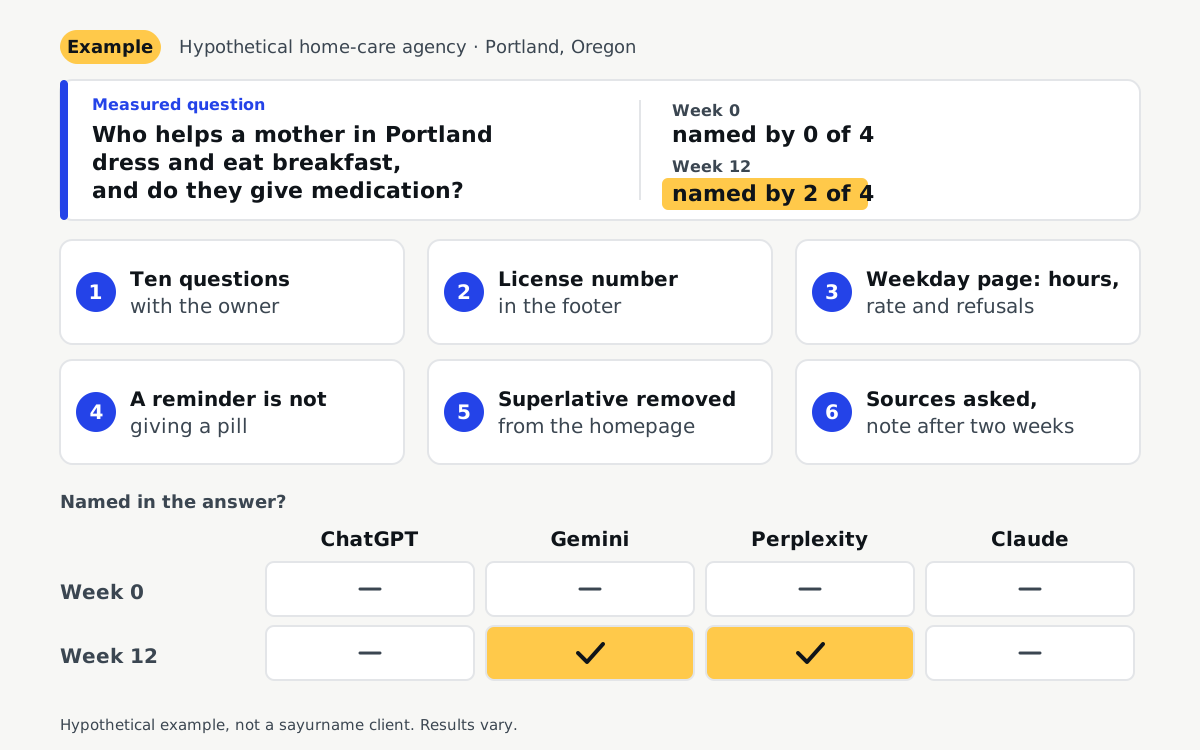
Example: a hypothetical agency, not a sayurname client. Imagine Hawthorne Home Companions in Portland, Oregon: the owner, who is not a nurse, and 14 caregivers, 11 years in business, licensed as an in-home care agency, 96 Google reviews averaging 4.8. Weekday help runs 7 a.m. to 7 p.m., three-hour minimum, $38 an hour. They dress, cook breakfast, remind a person whose pills are already in a dispenser set by the family or a nurse, and they do not administer medication, give injections or dress wounds. The site was one page titled “we do everything”, including medication and wounds. The license number was on the office wall and not online.
The measured question was “Who can help my mother in Portland get dressed and eat breakfast on weekdays, and do they give medication?”. At week 0 the agency was named by 0 of 4. ChatGPT named a Medicare home-health agency. Gemini listed the most-reviewed care companies on Maps. Perplexity cited a county resource list that did not include them. Claude explained the difference between companion care and skilled care and named nobody.
- Read the four answers with the owner and chose ten questions families had actually asked that year: weekday dressing and breakfast, a ride to a clinic, overnight care, dementia companionship, medication, wound care, a three-hour minimum, and which neighborhoods.
- Fixed the base: the same legal name, address and phone on the site and on Google, and the Oregon in-home care license number in the footer, matching the state lookup.
- Replaced “we do everything” with a weekday page: 7 a.m. to 7 p.m., three-hour minimum, $38 an hour, the tasks included, the neighborhoods, and a separate sentence that medication administration, injections and wound care are not offered.
- Wrote a one-page line on reminders: a caregiver may remind a person to take pills that are already set in a dispenser by the family or a nurse, and may not pour, decide or inject.
- Removed “Portland’s most caring caregivers”. It moved nothing, and no source can confirm a superlative.
- Asked the Area Agency on Aging to add the agency to its provider list, published a page for each measured question, each read by the owner, and asked families for a review two weeks after the start of service, with no discount and no suggested wording. They do not ask on the first morning.
The medication question moved first, and in the useful direction: by week 5 Perplexity began telling people who needed a nurse to call a home-health agency, citing Hawthorne’s refusal, and named Hawthorne for dressing and breakfast. In week 11 Gemini followed, once the Google category and the site had agreed for several weeks. At week 12 ChatGPT still led with the Medicare agency, and Claude named Hawthorne in one run of four, which does not count.
What did not work: a paid listing on a senior directory brought two calls and no change in any answer. The overnight question never moved, because the agency does not staff nights and two agencies that do publish that shift in detail. Results depend on the city, the question and the competition. Another agency doing the same work might see none of this in twelve weeks.
What to publish
A citable home-care page answers one family’s morning with facts a stranger could check against a license. Titles that work: “Weekday help in Portland: dressing, breakfast, hours and the hourly rate”; “What our caregivers do not do: medication, injections, wounds”; “A ride to the clinic: which neighborhoods, and what is not included”; “The difference between a reminder and giving a pill”.
An excerpt from the first: “On weekdays from 7 a.m. to 7 p.m. a caregiver can help your mother dress and eat breakfast. The visit is three hours at minimum and $38 an hour. We work in these neighborhoods. We do not administer medication, give injections or dress wounds. A caregiver may remind her to take pills that are already set in a dispenser by you or by a nurse.” What makes it citable: the license class and number, the hours, the minimum, the rate, the tasks, the neighborhoods, and the refusals. Leave out instructions for lifting a person alone or for setting a clinical dose. That is not a companion-care page.
When it is not worth it
If the weekday roster is already full, more inquiries only lengthen a wait a family cannot use. Hire or narrow the hours first. An agency that only takes Medicaid or a county contract, and cannot take a private morning, should not measure a question it is not allowed to answer. The same goes for a franchise whose head office writes every page and forbids a local refusal: there is nothing true to publish.
Nor does it pay when the license has lapsed or the name on the license is not the name on the door. An assistant that checks the lookup will find the mismatch, and content cannot repair it. Start there: make the name, the license and the task list agree, and come back when the refusal is one you are willing to print.
How the work runs, inside the license you actually hold
It starts with the free test: one family’s question sent to the four AIs, with the full answers saved as the starting point. Once subscribed, we measure up to 10 questions every week in ChatGPT, Gemini, Perplexity and Claude, fix the site’s base so the assistants can read the service pages, find out where the AI gets the answer to each question and ask for the agency’s inclusion wherever there is a path: the Area Agency on Aging lists, the state licensing lookup. Some of those sources are official or curated, so we promise the request, not the listing; you see what was asked and what got in. We also publish content that answers the measured questions. Publishing happens on a subdomain connected by DNS, or we deliver the pieces and you publish them. Onboarding is online, with no call.
It costs $299/month, with no lock-in. A one-time $599 bonus is charged only when an AI starts naming your agency for a measured question, checked by a person on our team, or Google Analytics shows a visit coming from an AI. Nobody controls AI answers, so there is no guarantee of being recommended. The content states only the license you hold and the tasks that license allows, and the owner approves every piece. It promises no outcome and does not describe clinical care.
Questions
Will saying no to medication lose us calls?
It loses the calls that were going to fail in the kitchen. In the example, that sentence is what let an assistant name the agency for dressing and breakfast and send the nursing question somewhere else.
Is a reminder the same as giving medication?
No. A reminder points at a dispenser someone else already filled. Pouring, deciding or injecting is administration, and a companion-care license does not cover it. The page has to say which one you do.
Should a Medicare agency be the better answer sometimes?
Yes, when the family needs a nurse. Writing “wound care” on a companion-care page does not make you that agency. It makes the assistant either skip you or send the wrong family.
How long until anything changes?
In the example, the refusal was quoted in week 5 and a second assistant named the agency for the morning tasks in week 11. Two had not by week 12. Some questions never move.
Can we ask families for reviews?
Not on the first morning, and never with a discount or a suggested sentence. In the example, a note two weeks after the service started was enough.