

The question homeowners actually ask
One owner saw ChatGPT name his company, asked again in a private window as a stranger would, and it was gone: the first answer had leaned on his own history. Another had the AI rewrite the site “for AI” and felt no result, because smoother prose adds no fact a search can use. The reliable picture is the same question, asked cold, every week, in each assistant.
Homeowners type a job, a place and a constraint, and the constraint decides who is named. A bundle: “someone in [city] to patch drywall and hang two fixtures in one visit”, where the AI wants a business that groups small jobs. A deadline: “who can fix the inspection items before closing”, where a written quote matters. A trust test: “licensed handyman in [neighborhood] to replace a ceiling fan”, where the AI checks whether the job needs an electrician. Each shape pulls different sources.
Where the AI’s answer about home repairs comes from
With web search on, each assistant summarizes what a few searches agree on. The sources are predictable: the Google Business Profile and Maps, above all review wording; Angi, Thumbtack and TaskRabbit; Yelp, Nextdoor and the Better Business Bureau; city subreddits; the state contractor-license lookup; and the company’s own service pages. Marketplace profiles are structured, which is why the AI often says “check Angi” instead of a name.
The AI reads review text, not the star average: forty reviews saying “fixed our whole inspection list in a day” are evidence for that question; four hundred saying “very professional” prove nothing in particular. And licensing filters: for electrical or plumbing work, assistants prefer a business that names the licensed trade doing it. The four disagree, and vary between runs, because each searches its own index. Fame is not the criterion: a franchise with 1,000 reviews wins “handyman in [city]”; the narrow question goes to whoever states job, area and limits plainly.
The most common mistake: “we do it all”
Most handyman sites list thirty or forty services under “no job too small”, from gutter cleaning to “electrical”. To an assistant that is a page without evidence: no price, no time, no area, and “electrical” beside no license raises a doubt. Asked about a specific job, the AI finds a marketplace or specialist page that says more, and names that.
The cost is double: the company vanishes from the specific questions that bring the best jobs, and collects calls for work it should not take, which ends in refusals or unlicensed work. Instead, group services into a handful of job families, each with its own page: what is included, minimum charge, typical time, area served, and what goes to a licensed electrician, plumber or roofer. Saying what you do not do makes you credible for what you do.
A worked example, step by step
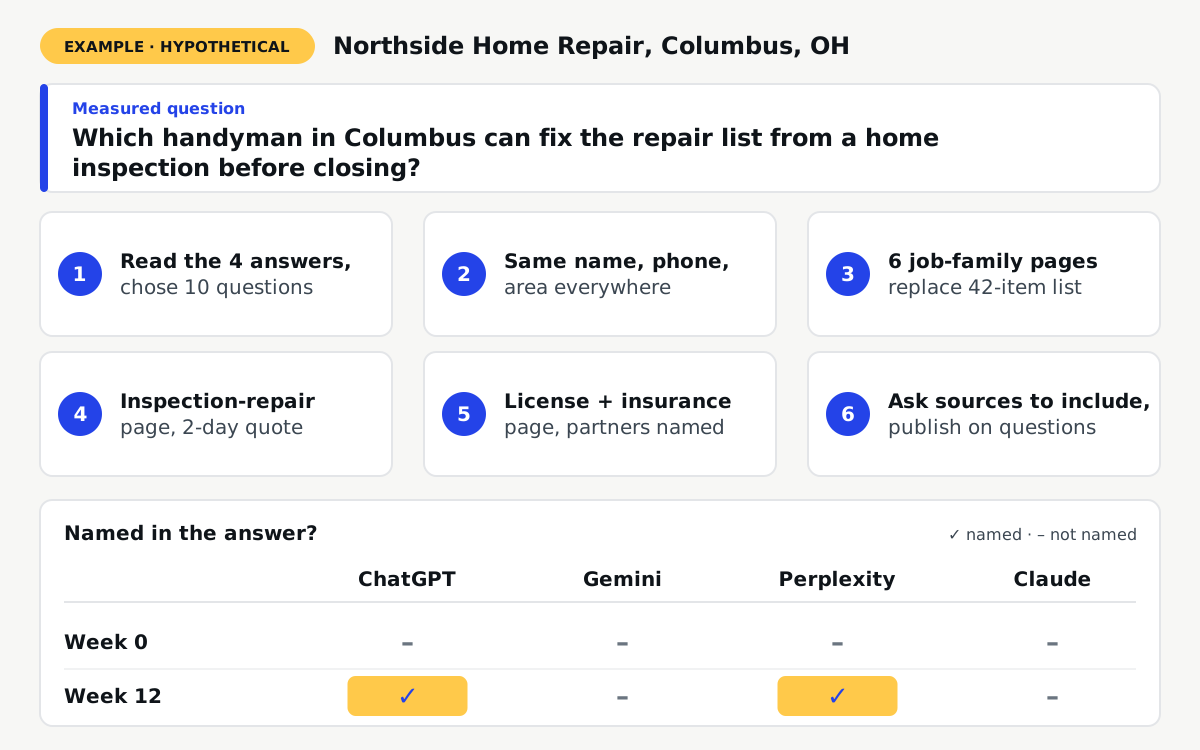
Example: a hypothetical company, not a sayurname client. Imagine Northside Home Repair in Columbus, Ohio: an owner and three technicians, nine years in business, 186 Google reviews averaging 4.8, $129 for the first hour and $95 after, about 25 inspection-repair jobs a month in spring. The site had a 42-item services list under “no job too small”.
The measured question was “Which handyman in Columbus can fix the repair list from a home inspection before closing?”. At week 0 the company was named by 0 of 4: ChatGPT named two franchises and suggested Angi, Gemini the most-reviewed Maps listings, Perplexity a subreddit thread, Claude a checklist with no names.
- Read the four answers and their sources with the owner; chose ten questions, from inspection lists to ceiling fans.
- Fixed the base: one name, phone and service area (Columbus and eight named suburbs) on the site, Google, Yelp, Nextdoor and Angi.
- Replaced the 42-item list with six job-family pages stating what is included, the minimum charge, typical time and what goes to a licensed trade.
- Wrote an inspection-repair page: send the report, get a line-by-line quote in two business days, see which items go to a licensed trade.
- Published a licensing and insurance page: the insurance certificate, two partners’ license numbers checkable on the state lookup, and what is never touched: panels, gas, structure.
- Asked Thumbtack and the Better Business Bureau to list the company, published one page for each measured question, and asked recent customers for reviews naming the job, without incentives or suggested wording.
The licensing question moved first: by week 4, ChatGPT and Perplexity cited the new page for the ceiling-fan question. In week 6 Perplexity named Northside for the inspection question; in week 9 ChatGPT followed, after a dozen reviews mentioned inspection lists and a local agent linked the page. At week 12 Gemini still led with a franchise and its 1,100 Maps reviews; Claude named the company in one run of four, which does not count.
What did not work: fourteen near-identical “handyman in [suburb]” pages moved nothing; a paid marketplace listing brought leads but changed no answer; the TV-on-brick question never moved, because an audio-video installer is the better answer. Results vary by city, question and competition; another company might see none of this in twelve weeks.
What to publish
A citable page answers one homeowner’s question with facts a stranger could check. Titles: “Home inspection repairs in Columbus: how we quote a report”; “Drywall patches: what a visit includes and costs”; “Ceiling fans: what we replace and when you need an electrician”.
From the first: “Send the inspection report as a PDF and we return a line-by-line quote within two days. Most lists of 10 to 15 items take one technician a day, at $129 for the first hour and $95 after. Items needing a licensed electrician, plumber or roofer are marked with the partner who will do them.” Citable means a named job and area, a price or minimum, the line between what you do and what you refer, and a verifiable license or insurance fact.
When it is not worth it
If the calendar is booked six weeks out, more demand only lengthens the wait. If most work comes from two property managers or a few agents, the buyer is a business relationship, not a homeowner asking an AI; an hour with each is worth more than a month of content.
Nor does it pay to attract work you cannot legally do: where your state requires a contractor license above a job value, those pages bring liability, not revenue. Where people find repair help only through neighbors, run the free test first; if no assistant answers, fix the Google profile first.
How the work runs, and where licensing fits
It starts with the free test: one homeowner’s question sent to the four AIs, full answers saved as the starting point. Subscribed, we measure up to 10 questions every week in the four assistants, fix the site’s base so the AI can read your job pages, find out where the AI gets the answer to each question and ask for the company’s inclusion wherever there is a path: Angi, Thumbtack, Yelp, the Better Business Bureau. Some of those are paid or curated, so we promise the request, not the listing; you see what was asked and what got in. We also publish content that answers the measured questions. Content goes live on a subdomain via DNS, or we deliver and you publish; onboarding is online.
It costs $299/month, with no lock-in. A one-time $599 bonus is charged only when an AI starts naming the company for a measured question, checked by a person on our team, or Google Analytics shows a visit from an AI. Nobody controls AI answers, so there is no guarantee. The content describes only work you are licensed and insured to do, names the licensed partner for the rest, shows license numbers where your state requires them in ads, and promises no outcome.
Questions
Do I need an Angi or Thumbtack profile?
No, but those profiles are among the sources assistants read, so keep yours accurate. Alone, it makes the AI recommend the marketplace; your own pages let it name you.
Do reviews matter more than my website?
Reviews show you are real and what you did; the site says what you do, where, for how much and within which limits. In the example, 186 good reviews were not enough until the inspection page existed.
I am not licensed for electrical work. Can I mention it?
Mention it as a referral, naming the licensed partner. Rules vary by state and city, some with a job value above which a contractor license is required, so check with your state licensing board first.
How long until anything changes?
In the example, the first assistant named the company in week 6, and two had not by week 12. Some questions never move, because another business is the better answer.
What if the AI lists old prices or a service I dropped?
It is repeating an old marketplace profile or a forgotten page. Correct the source, state current terms on your site, and watch the weekly measurement.