

The question a guest actually asks
Hoteliers usually meet this at the desk, after the guest has already booked the wrong room. They ask an assistant about their own hotel and it praises the place, because the question already contained the name. A stranger then asks the way a person asks before they will book: a constraint about sleep, and a second constraint about a child. The hotel is gone. The only reading that matters is that stranger’s question, asked the same way every week.
Almost nobody types “best hotel near me” and stops. They add the thing that ruined the last stay. A room that does not face the street. A crib for a child under two. A floor with no elevator, said in advance. A late checkout that is a fact, not a favor asked at noon. Each constraint sends the assistant to a different page. A well-reviewed hotel can lose the quiet-room question to a plainer one whose own site says which rooms face the courtyard. “Charming” is not the criterion. The assistant cannot verify charm. It can verify a room count, which side the windows face, whether there is a crib, what it costs, and what the building does not have.
Where the answer about a hotel comes from
With web search on, each assistant runs a few searches and summarizes what the pages agree on. For a small hotel the sources are the OTAs, the Google profile, recent reviews that mention noise or a crib, the city’s visitor bureau, and the hotel’s own site. The OTA ranks because it is the only place that wrote “quiet room”, “courtyard” and “crib” as text. The hotel’s site, if it is a booking engine with six photos, contributes the rate and nothing else. The assistant then quotes the OTA, and the OTA’s sentence may be two years old.
The mechanism is authorship. The page the assistant can quote is the page that states a checkable fact in a sentence. An embedded booking widget does not. The four assistants disagree because each searches a different index, and the same one changes between runs, so one screenshot proves little. Fame is not the criterion: the hotel with 2,000 reviews wins “hotel in [city]”, and the light-sleeper question goes to whoever says which rooms are off the street, how many there are, and what a crib costs, on a page the hotel controls.
The most common mistake: the website is only the booking engine
Almost every independent hotel’s site is a photo, a rate and a “check availability” box. The sentences about the rooms were written once, inside an OTA extranet, by whoever set the property up. It happens because the engine already takes the booking, and writing the same facts again feels like work that will drift out of date. To an assistant, the box is not a room. It cannot tell a courtyard room from a room over the street.
The cost is concrete. The light sleeper books the chain whose OTA page says “quiet rooms available”, then arrives on the street side and writes the review that the next assistant will quote. The local hotel had eleven courtyard rooms and a crib, and never entered the answer. The remedy is not a longer adjective. It is a rooms page the hotel owns: how many rooms, which face the courtyard, which face the street, the crib and what it costs, the floors, and what the building does not have, including no elevator if that is true. The trade-off is that you must change the page when a room’s windows change, or when the crib is retired. A stale “crib in every room” is worse than silence, because the assistant will repeat it next to your name.
A worked example, step by step
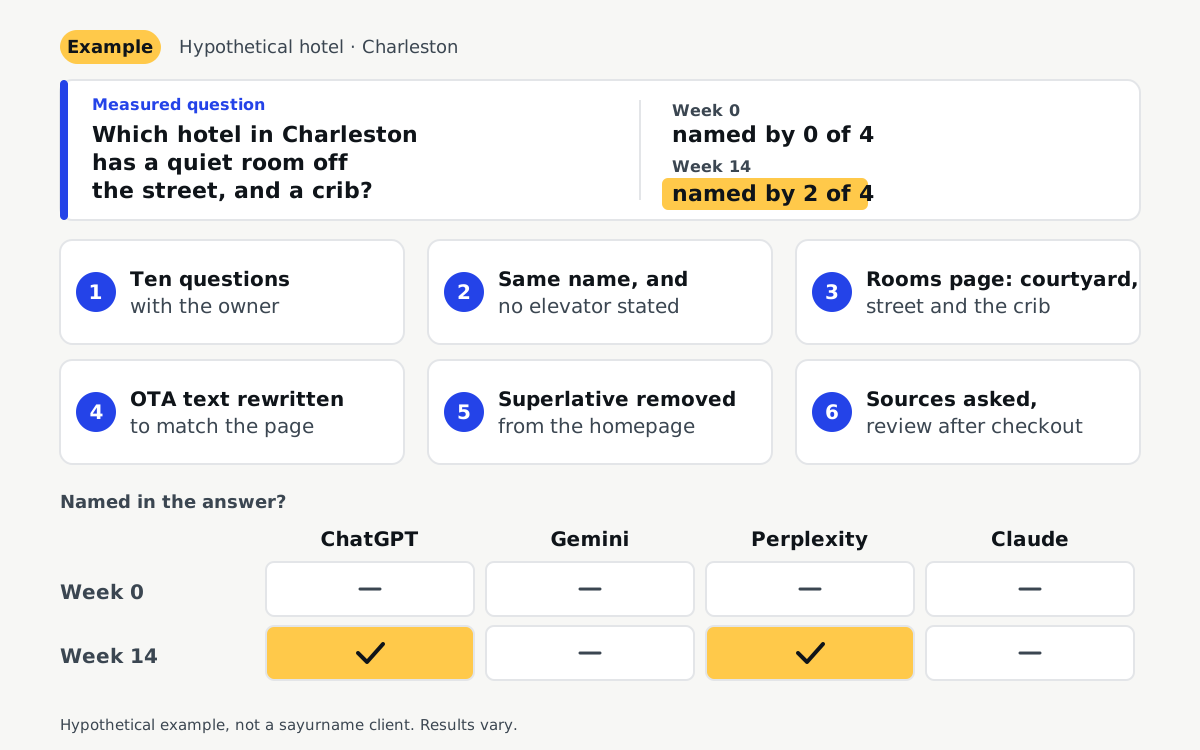
Example: a hypothetical hotel, not a sayurname client. Imagine Harbor & Church in Charleston, South Carolina: 28 rooms, family owned, 14 years, 640 Google reviews averaging 4.6. Eleven rooms face the courtyard. A crib for a child under two is $40 a night, one per room, requested when booking. Courtyard rooms start at $245; street rooms at $189. There is no elevator; the house is three floors. The site was a booking engine and six photos. “Quiet” and “crib” appeared only on two OTAs, in text the hotel had not reread since 2023.
The measured question was “Which hotel in Charleston has a quiet room off the street, and a crib?”. At week 0 the hotel was named by 0 of 4. ChatGPT quoted two chain listings from a booking site. Gemini listed the most-reviewed hotels on Maps. Perplexity cited an OTA page that called every room quiet. Claude gave advice about earplugs and named nobody.
- Read the four answers with the owner and chose ten questions guests had actually asked that year: a quiet room, a crib, no elevator, late checkout, a room for one night, parking, and which floor faces the street.
- Fixed the base: the same legal name, address and phone on the site, Google and both OTAs, and the sentence that the house has 28 rooms and no elevator.
- Published a rooms page the hotel owns: eleven courtyard rooms, the rest on the street, courtyard from $245, street from $189, one crib at $40 if requested at booking, three floors, no elevator.
- Rewrote the OTA descriptions to match that page, and dated the hotel’s own page so a reader can see when the counts were last checked.
- Removed “Charleston’s most charming stay”. It moved nothing, and no source can confirm a superlative.
- Asked the city’s visitor bureau to list the hotel and the OTAs to add the quiet rooms and the crib to its description, published a page for each measured question, each read by the owner, and asked guests for a review after checkout that mentioned the room side, with no discount and no suggested wording.
The crib question moved first. In week 5 Perplexity named the hotel and quoted the $40 line and the need to request it at booking. In week 8 ChatGPT named it for the quiet-room question, after several reviews said the courtyard room was the quiet one and the street room was not. At week 14 Gemini still led with the Maps leaders, and Claude named the hotel in one run of four, which does not count.
What did not work: raising the OTA commission bought rank inside that OTA and no change in the assistants. The “room with a view of the water” question never moved, because the hotel has no such room and two waterfront hotels publish it in detail. Results depend on the city, the question and the competition. Another hotel doing the same work might see none of this in fourteen weeks.
What to publish
A citable hotel page answers one guest’s constraint with facts a stranger could check against the front desk. Titles that work: “Courtyard rooms and street rooms in Charleston: how many, and what they cost”; “A crib: one per room, $40, ask when you book”; “Three floors, no elevator: who that suits and who it does not”; “What we changed on the booking sites, and the date we checked”.
An excerpt from the first: “Eleven of our 28 rooms face the courtyard. Those start at $245. The rooms on the street start at $189 and are not the quiet ones. One crib is $40 a night, for a child under two, if you ask when you book. The house has three floors and no elevator.” What makes it citable: a room count the desk can confirm, which side the windows face, a price, the limit on the crib, and the fact the building lacks. Leave out “quietest hotel in the city”. No source can confirm it, and the assistant will either drop it or repeat it as a promise you did not mean.
When it is not worth it
If the courtyard rooms are sold out months ahead and the owner wants them to stay that way, more inquiries only fill an inbox. A hotel whose brand standards forbid any sentence the flag did not write cannot publish a local fact, and measuring a question the local desk is not allowed to answer is wasted money. The same goes for a property that lives on walk-ins from people already on the sidewalk.
Nor does it pay when the OTA, the Google profile and the site disagree on the room count or the address. An assistant that sees three different numbers names a competitor whose three sources match. Start there: make the name, the count and the crib agree everywhere, and come back when there is a sentence you will keep true.
How the work runs
It starts with the free test: one guest’s question sent to the four AIs, with the full answers saved as the starting point. Once subscribed, we measure up to 10 questions every week in ChatGPT, Gemini, Perplexity and Claude, fix the site’s base so the assistants can read the room pages, find out where the AI gets the answer to each question and ask for the hotel’s inclusion wherever there is a path: the OTAs’ property pages, the city’s visitor bureau listing. Some of those sources are paid or curated, so we promise the request, not the listing; you see what was asked and what got in. We also publish content that answers the measured questions. Publishing happens on a subdomain connected by DNS, or we deliver the pieces and you publish them. Onboarding is online, with no call.
It costs $299/month, with no lock-in. A one-time $599 bonus is charged only when an AI starts naming your hotel for a measured question, checked by a person on our team, or Google Analytics shows a visit coming from an AI. Nobody controls AI answers, so there is no guarantee of being recommended. The content states only rooms and policies you actually offer, and the owner approves every piece. It promises no occupancy and no ranking.
Questions
Isn’t the booking site the page guests already read?
It is the page they read after they have a name. The stranger asking which hotel has a quiet room never opens your engine. In the example, the hotel stayed unnamed until the same facts existed on a page it controlled.
What if the OTA and our site disagree?
The assistant either names neither or quotes the louder one. In the example, the OTA called every room quiet until the hotel rewrote that text to match the courtyard count.
Should we claim to be quiet if some rooms are not?
No. Say which rooms are off the street and which are not, with the prices. A blanket “quiet” is the sentence that comes back in a bad review, and then in the next answer.
How long until anything changes?
In the example, the crib line was quoted in week 5 and a second assistant named the hotel for the quiet room in week 8. Two had not by week 14. Some questions never move.
Does paying the OTA more buy the answer?
It can buy rank inside that OTA. In the example it changed no assistant. The answer is written from pages that agree, not from a commission tier.