

The question homeowners actually ask
Owners usually find the problem by accident. One saw ChatGPT name his company until he asked it to answer as for a stranger; the name vanished, because it had only remembered his earlier questions. Another asked in three private windows and got three different lists. What counts is the same question, asked the same way in all four assistants every week, with sources recorded.
Homeowners rarely type “HVAC company near me”. They type a system, a place and a constraint, and the constraint decides who is named. Urgency: “AC stopped cooling, who in [suburb] can come today”, answered against stated hours. Price: “what does replacing a 3-ton heat pump cost in [city]”, where the assistant looks for a published range. Fit: “ductless mini-split for a house without ducts”. Trust: “who gives honest second opinions on a replacement quote?”. Each shape draws on different sources.
Where the AI’s answer about HVAC contractors comes from
With web search on, each assistant runs a few searches and summarizes what the pages agree on. For HVAC the sources are predictable: Google Maps and the Business Profile, Yelp, Angi, Nextdoor and the BBB, city subreddits and r/HVAC threads, cost guides, manufacturer dealer locators such as Mitsubishi Electric’s Diamond Contractor network, utility contractor lists, the state license lookup, and the company’s own service pages.
Urgent questions are seasonal and read literally: in July, “same-day service until 6 p.m., on call for existing customers after hours” beats a “24/7” banner nobody can back up. Price questions favor whoever publishes a range, since the assistant would rather quote a source than admit ignorance. And credentials are checkable: state contractor licenses and the EPA 608 certification required to handle refrigerant get repeated when a page states them with numbers. The four disagree because each searches a different index and varies between runs. Fame is not the criterion: the biggest advertiser wins “best HVAC company”, but the heat pump question goes to whoever explains heat pumps plainly.
The most common mistake: forty copies of the same town page
Most HVAC sites built by agencies or dealer programs carry a page per town: “AC repair in Cary”, “AC repair in Apex”, the same 400 words with the name swapped. To an assistant, those pages say nothing that distinguishes them or what the company does in each place, so none is the page it cites; search engines often index only one.
The cost is double. The pages that would answer real questions, such as how a heat pump is sized or what an after-hours call costs, were never written. And a copied manufacturer catalog makes the company read like a brand brochure, so the assistant credits the manufacturer. The fix is one honest service-area page, with towns, arrival times and the after-hours limit, and the effort moved to pages about systems and problems.
A worked example, step by step
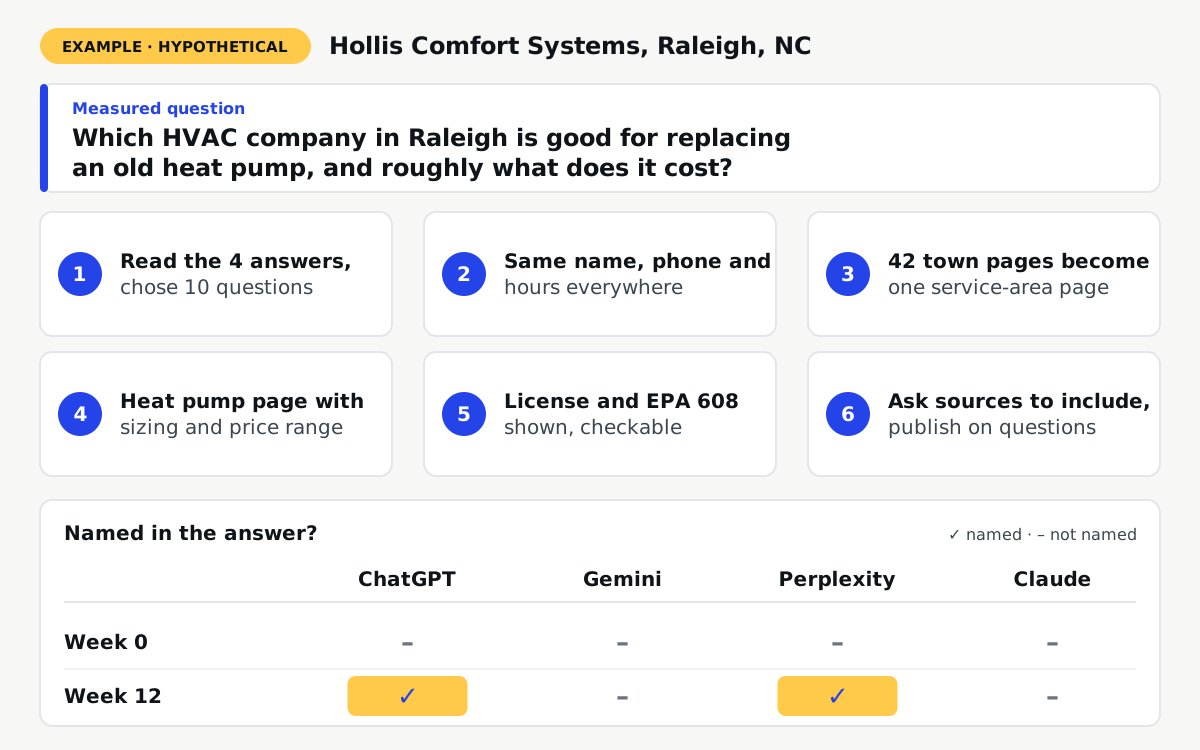
Example: a hypothetical contractor, not a sayurname client. Imagine Hollis Comfort Systems in Raleigh, North Carolina: family-owned for 17 years, 14 people including eight technicians, about 40 heat pump replacements a year, 410 Google reviews averaging 4.8. A 3-ton replacement runs $9,500 to $16,000 installed; after-hours calls add $149. The site had 42 cloned town pages and a “24/7 emergency service” banner, though nights meant one on-call technician for existing customers.
The measured question was “Which HVAC company in Raleigh is good for replacing an old heat pump, and roughly what does it cost?”. At week 0 Hollis was named by 0 of 4: ChatGPT named two franchises, Gemini the most-reviewed companies on Maps, Perplexity a Reddit thread and a cost guide, Claude no company.
- Read the four answers and their sources with the owner, and chose ten questions, from heat pump replacement to same-day no-cooling calls.
- Fixed the base: identical name, address, phone and hours on the site, Google, Yelp, Angi and the BBB, with the 24/7 banner replaced by the real after-hours terms.
- Replaced the 42 town pages with one service-area page for Wake and Johnston counties, with arrival times and the after-hours radius, redirecting the old addresses.
- Wrote the heat pump page: a load calculation instead of copying the old tonnage, price ranges by efficiency tier, what is included, the two-day timeline, and when repair is better.
- Added verifiable credentials: the owner’s North Carolina heating contractor license, checkable on the state board’s lookup, and every technician’s EPA 608 Universal certification.
- Requested inclusion in the utility’s contractor list and a manufacturer’s dealer locator, published one page for each measured question, each checked by the service manager, and asked for reviews after installations, without incentives or suggested wording.
The after-hours question moved first: by week 3 no assistant called Hollis a 24-hour service. In week 6 Perplexity named Hollis for the replacement question, citing the price range; in week 9 ChatGPT listed it among three companies. At week 12 Gemini still led with the two most-reviewed names on Maps, and Claude named Hollis in one run of four, which does not count.
What did not work: a “Raleigh’s most trusted HVAC company” headline, which no assistant can check; a featured Angi listing, which brought leads but changed no answer; and the commercial rooftop-unit question, where two mechanical contractors are the better answer. Results vary by city, season and competition; another company might see none of this in twelve weeks.
What to publish
A citable HVAC page answers one homeowner’s question with checkable facts. Titles that work: “Heat pump replacement in Raleigh: sizing, cost and timeline”; “Your AC stopped tonight: what we do after hours and what it costs”; “Ductless mini-splits for houses without ducts”; “Repair or replace a 12-year-old system”.
An excerpt from the first: “We size every replacement with a Manual J load calculation, because about a third of the systems we remove were oversized. A 3-ton variable-speed heat pump runs $11,000 to $14,000 installed, Wake County permit included; our EPA 608-certified technicians recover the old refrigerant, and the job takes two days.” Citable means a named, licensed company, the systems it installs, what it refers out, price ranges and the process in order.
When it is not worth it
If installations already wait three weeks every summer, more demand only lengthens the queue; hire first. A builder’s subcontractor is chosen by builders, not by homeowners asking an AI, and commercial and refrigeration contractors win work through bids and property managers.
Nor does it pay when head office controls the website, as in many franchises, or when nobody will commit to price ranges, a service area or after-hours terms. In a small town where everyone knows the three local contractors, the Google profile already does the job; keep its hours right instead.
How the work runs
It starts with the free test: one homeowner’s question sent to the four AIs, the full answers saved as the starting point. Subscribed, we measure up to 10 questions weekly in the four assistants, fix the site’s base so the AI can read your service pages, find out where the AI gets the answer to each question and ask for the company’s inclusion wherever there is a path: manufacturer dealer locators, utility contractor lists, Angi, the BBB. Some of those are curated or paid, so we promise the request, not the listing; you see what was asked and what got in. We also publish content that answers the measured questions, on a subdomain via DNS or delivered for you to publish.
It costs $299/month, with no lock-in. A one-time $599 bonus is charged only when an AI starts naming the company for a measured question, checked by a person on our team, or Google Analytics shows a visit from an AI. Nobody controls AI answers, so nothing is guaranteed. Pages state only licenses and certifications the company holds, with checkable numbers, follow your state’s contractor advertising rules and manufacturers’ badge rules, and are approved by the license holder.
Questions
Do reviews matter more than my website?
Reviews tell the AI the company is real and well regarded; service pages tell it what the company does, where and for how much. In the example, 410 reviews were not enough on their own.
Can I pay Angi or Google ads to be in AI answers?
Paid listings bring calls from those platforms but do not buy a place in an AI answer, which is written from what several independent sources say.
Does being a factory-authorized dealer help?
A little: the dealer locator is one independent source among several. In the example, the badge was on the site from the start and none of the four named the company.
How long until anything changes?
In the example, the first assistant named the company in week 6; two had not by week 12. Start before the cooling or heating rush.
What if the AI says we are open 24/7 or quotes a wrong price?
It is usually repeating an old listing or a line on your own site. Correct the source, state real hours and ranges on your pages, and watch the weekly measurement.