
The question business owners actually ask
One agency owner asked ChatGPT about her own agency, then asked it to answer as it would for a stranger, and the agency vanished: the first answer only echoed what she had typed earlier in the chat. What counts is the answer a stranger gets, asked the same way every week, and the sources it cites.
Commercial buyers type a business, a place and a constraint, and the constraint decides who is named. Trade: “broker in [city] who insures restaurants with a full bar”. A contract: “my landlord requires liquor liability, who places it in [city]”, won by a page that explains the requirement. A rejection: “my carrier non-renewed my roofing company, who handles hard-to-place contractors”, where the AI looks for brokers that say they reach the surplus lines market.
Where the AI’s answer about brokers comes from
With web search on, each assistant searches and summarizes what the sources agree on, and in insurance those sources are lopsided. Marketplace and comparison content (Insureon, NerdWallet, carriers such as Next and Hiscox) answers every cost question at scale and fills the general answers. Local names come from the Google Business Profile and Maps, Yelp, the Trusted Choice directory of independent agents, threads in r/Insurance and r/smallbusiness, and the agency’s own pages, with the state insurance department’s license lookup as the check behind them.
One feature sets this sector apart: the assistant must tell a broker from a carrier and from a captive agent, and a site that never says “independent, we place with these markets” reads as a sales page. The four assistants also search different indexes and resample each run, hence different names. Fame is not the criterion: the biggest agency wins “insurance broker in [city]”, but the liquor liability question goes to whoever explains it specifically, with an independent source agreeing.
The most common mistake: the template product menu
Most agency sites show a wall of carrier logos, the line “we shop dozens of carriers to save you money”, and thirty product pages written by the website vendor and installed on hundreds of other sites. It is cheap and looks complete; to an AI it is nearly empty. The restaurant page explains restaurant insurance in general and says nothing about who at this agency places it, for which restaurants, with which markets, at what premiums.
The cost is double. The agency is invisible where it is strongest, and the savings line is a claim state advertising rules distrust, since no broker knows the premium before underwriting. Keep fewer pages and make each one yours: for your two or three real niches, state the client count, coverages placed, what you decline and the premium ranges you see, signed by a licensed producer.
A worked example, step by step
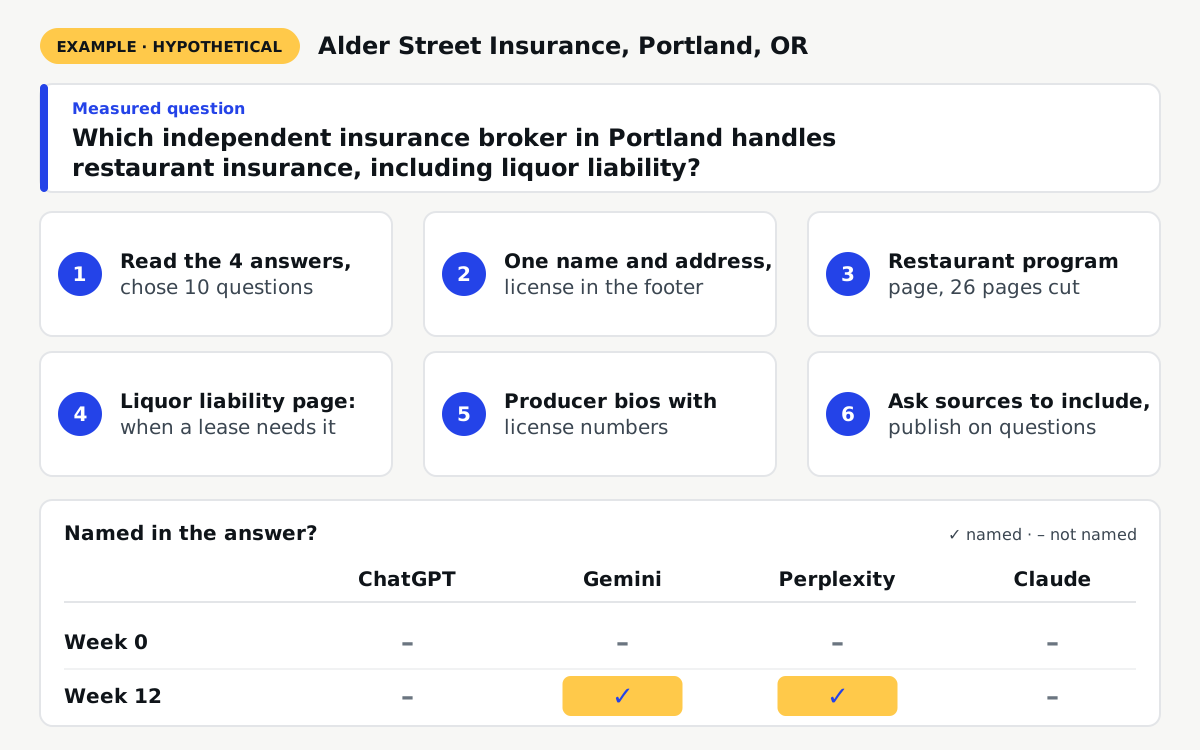
Example: a hypothetical agency, not a sayurname client. Imagine Alder Street Insurance in Portland, Oregon: three licensed producers, four account managers, 14 years open, about 180 restaurant and bar clients, 96 Google reviews averaging 4.8. A restaurant package (property, general liability, liquor liability, business income) runs $4,000 to $14,000 a year in its book. The site had 34 vendor product pages and one paragraph on restaurants.
The measured question was “Which independent insurance broker in Portland handles restaurant insurance, including liquor liability?”. At week 0 the agency was named by 0 of 4: ChatGPT named Insureon, Next and a national broker; Gemini the agencies with the most Maps reviews; Perplexity a Reddit thread and a NerdWallet guide; Claude named none.
- Read the four answers and their sources with the producers, and chose ten questions, from liquor liability to kitchen fires.
- Fixed the base: one name, address and phone on the site, Google, Yelp and Trusted Choice, the Google category set to insurance broker, the Oregon license number in the footer.
- Removed 26 vendor pages for lines the agency barely writes, and turned the restaurant paragraph into a program page: coverages, usual markets, premium ranges by size, declined risks.
- Wrote a liquor liability page: when a lease or lender requires it, how it differs from the host liquor coverage inside general liability.
- Rewrote the producer bios with year licensed, CIC or CPCU designations, and license numbers anyone can check on the state lookup.
- Pitched the restaurant program to NerdWallet’s small-business editors, published one page for each measured question, each approved by a licensed producer, and asked restaurant clients for reviews with no gift or suggested wording.
Perplexity moved first, naming the agency in week 5 and citing the liquor liability page. Gemini followed in week 10, after the category fix and a dozen reviews mentioning restaurants. At week 12 ChatGPT still led with Insureon, and Claude named the agency in one run of four, which does not count.
What did not work: a “Portland’s best restaurant insurance” headline came down because it could not be substantiated; a paid listing on a lead site brought only price shoppers. The “cheapest car insurance in Portland” question never moved, rightly: the comparison sites are the better answer there. Results vary by city, question and competition; another agency might see none of this in twelve weeks.
What to publish
A citable broker page answers one buyer’s question with facts someone can check. Titles that work: “Restaurant insurance in Portland: what a 60-seat place with a full bar pays, and why”; “Liquor liability or host liquor: which one your lease is asking for”; “Non-renewed: how we place contractors the standard carriers decline”.
From the first: “We insure about 180 restaurants and bars around Portland. For 60 seats with alcohol at a quarter of sales, the package we place usually costs $6,000 to $9,000 a year, depending on the underwriter’s review of hood-cleaning records, losses and sales. We do not place nightclubs open past 1 a.m.” Citable means a named producer, a license anyone can look up, trades served and declined, ranges rather than promises, and no client named without written consent.
When it is not worth it
A captive office usually cannot change its own site, because the carrier controls it and approves every ad. A firm that wins large accounts through formal proposals and CFO referrals will not be chosen in a chat window.
Nor does it pay for an agency built on cheap personal auto, where comparison sites own the answer and the commission does not cover the work, or for one without capacity: if each account manager carries 400 accounts, hire first. And if nobody will commit to named producers, niches and ranges, start smaller: fix the Google profile and license details, and return with something concrete to publish.
How the work runs, within your state insurance department’s rules
It starts with the free test: one buyer’s question sent to the four AIs, full answers saved as the starting point. Subscribed, we measure up to 10 questions every week in the four assistants, fix the site’s base so the AI can read your program pages, find out where the AI gets the answer to each question and ask for the agency’s inclusion wherever there is a path: the Trusted Choice directory, Yelp, comparison guides such as NerdWallet’s. Some of those are editorial or paid, so we promise the request, not the listing; you see what was asked and what got in. We also publish content that answers the measured questions.
It costs $299/month, no lock-in, plus a one-time $599 bonus charged only when an AI starts naming the agency for a measured question, checked by a person, or Google Analytics shows a visit from an AI. There is no guarantee of being recommended. The content is informative and follows your state insurance department’s licensing and advertising rules: license shown, coverage described as subject to the policy’s terms, no promised savings, coverage or claim outcomes, no gifts for reviews, and a licensed producer approves every piece.
Questions
Will online quote sites always beat a local broker in AI answers?
For general and price questions, often. For questions with a trade, a place and a constraint, a precise local page can be named alongside them, as in the example.
Can I pay a directory or lead site to be listed first?
That buys leads from that site, not a place in an AI answer, which is written from several independent sources. In the example it changed nothing.
Is this allowed by my state insurance department?
Informative content about the lines you place and your license is ordinary insurance advertising; the rules target misrepresentation, unsupported superlatives, promised savings and inducements. A licensed producer approves each piece.
How long until anything changes?
In the example, the first assistant named the agency in week 5 and a second in week 10; ChatGPT had not by week 12. Some questions never move, because another firm is the better answer.
What if the AI calls us a carrier, or misstates what a policy covers?
It repeats what it read, usually vendor text or an old listing: correct the source, and state on your site that you are an independent broker and that coverage depends on the policy wording.