

The question your future clients actually ask
A designer asks ChatGPT for interior designers in town and sees the studio named, then asks it to answer as it would for a stranger and the name is gone: the first answer leaned on the earlier conversation. Another opens three private windows and gets three different shortlists. One answer is an anecdote; the useful measure is the same question, asked the same way, over weeks.
Clients describe a project and a limit, and the limit decides the answer: scope (“interior designer in [city] who renovates condos and manages the contractor”), budget (“designer for a two-bedroom with a $60,000 budget”) or fee model (“flat fee, not a percentage of purchases”). Each limit draws on different sources, so a studio can be named for styling and absent for renovation, the work that pays its bills.
Where the AI’s answer about designers comes from
With web search on, the assistants run a few searches and summarize what the pages agree on; in interior design these are predictable: Houzz profiles and reviews; the Google Business Profile and its reviews; “best interior designers in [city]” articles, some of them paid; Reddit threads; and the studio’s own project pages.
An assistant cannot look at a kitchen photograph and conclude that the studio moved a wall and ran the contractor for five months; it can only repeat a sentence that says so. So a written project page beats a polished homepage, and fame is not the criterion: the firm in the design magazine wins the broad question, while “renovates condos and manages the contractor” goes to whoever states it plainly, with reviews describing the same kind of job. The four assistants disagree because each searches a different index, and each varies between runs.
The most common mistake: a portfolio that only shows
Designer websites are built like a book of plates: full-bleed photographs, a title such as “The Fitler Square Residence”, a line about “warm minimalism”, often with all text inside the images. To an AI it is nearly empty: it cannot tell styling from a gut renovation, nor the size, the cost, or what the studio did as opposed to the contractor.
The strongest work is skipped for a studio whose pages describe theirs, and writing “award-winning luxury interiors” over the photos does not help: an AI reads it as a claim, not evidence. Give each project three to five hundred written words: neighborhood, size, scope, timeline, budget band, the client’s problem and who did what. Keep clients’ names and addresses out without written consent, and say what you do not do, such as structural work that needs an architect.
A worked example, step by step
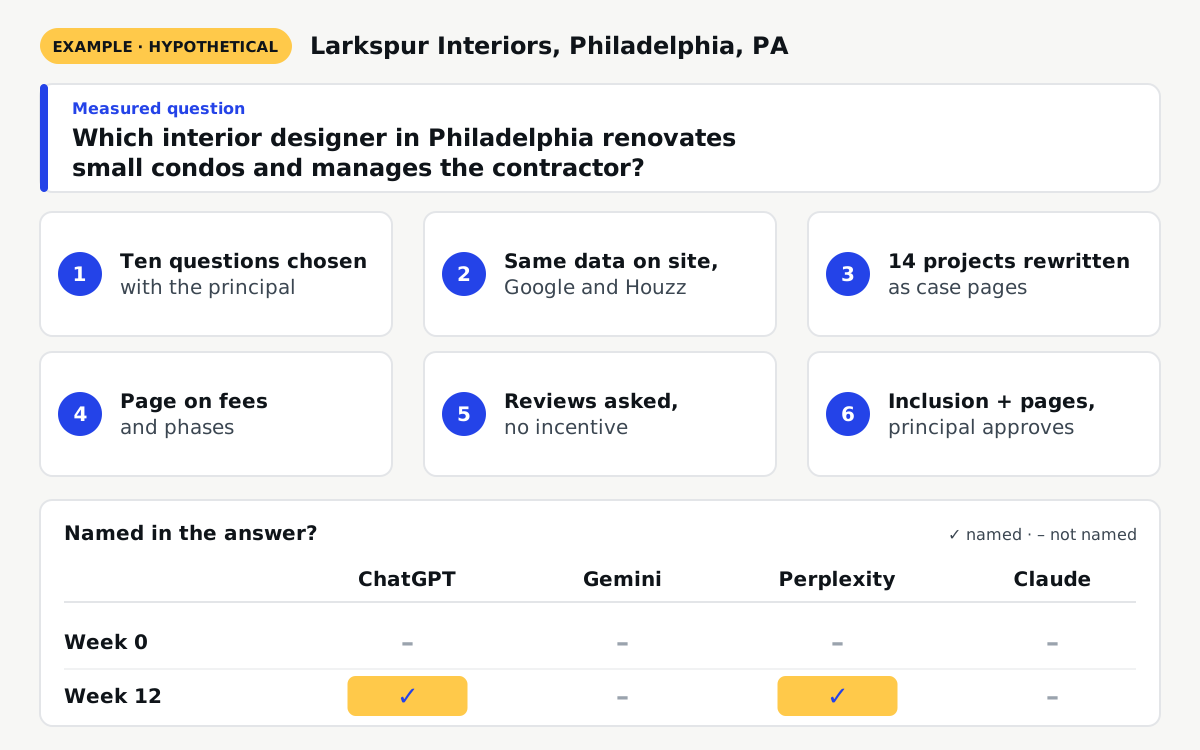
Example: a hypothetical studio, not a sayurname client. Imagine Larkspur Interiors in Philadelphia: an NCIDQ-certified principal, a junior designer and a part-time project coordinator, nine years in business, 38 Google reviews averaging 4.9 and 11 on Houzz. Most income comes from condo and rowhouse renovations, with design fees of $14,000 to $38,000. The site was a gallery of 14 projects, each a title and photos.
The measured question was “Which interior designer in Philadelphia renovates small condos and manages the contractor?”. At week 0 it was named by 0 of 4 assistants: ChatGPT named two large firms from a city magazine list, Gemini the most-reviewed studios, Perplexity a Houzz roundup and a Reddit thread, and Claude nobody.
- Chose ten questions with the principal: condo renovations, flat-fee design, rowhouse kitchens, e-design, condo board approvals and five more.
- Fixed the base: the same name, address and phone on the site, Google and Houzz; the Google category changed from “Furniture store”, a showroom leftover, to interior designer; gallery text made real text, not images.
- Rewrote the 14 projects as case pages with neighborhood, square footage, scope, months on site, budget band and who did what, with each client’s consent and no names or street numbers.
- Published a page on fees: the phases, the flat fee range, how purchases are billed, and when an architect or engineer joins.
- Asked past clients for Google and Houzz reviews, with no incentive and no suggested wording.
- Asked the editors of two “best interior designers in Philadelphia” articles to include the studio, and published one page per measured question, each read and approved by the principal.
The fee question moved first: in week 5 Perplexity named the studio for “flat-fee interior designer in Philadelphia”, citing the fees page. In week 7 it named it for the condo question, citing two case pages, and in week 10 ChatGPT followed, quoting a Houzz review that mentioned the contractor. At week 12 Gemini still preferred studios with more Google reviews, despite Larkspur’s 51, and Claude still gave general advice.
What did not work: a $1,200 placement in a “top designers” roundup changed no answer; doubling Instagram posts brought followers but nothing the assistants cited; the e-design question never moved, because national online design services own it. Results vary by city, question and competition, and another studio could see none of this in twelve weeks.
What to publish
A citable design page answers one client question with facts a stranger could check. Titles that work: “Renovating a small condo in Center City: what we design, what the contractor does and how long it takes”; “Interior design fees in Philadelphia: flat fee, hourly, and how purchases are billed”; “Before you renovate a condo: board approvals, insurance certificates and work hours”.
An excerpt from the first: “Most of our condo projects are one- and two-bedroom units of 700 to 1,100 square feet. We draw the plan, specify every finish, file the board’s alteration request and run the weekly site meeting with the contractor, whom the owner hires. Design fees for this scope run from $14,000 to $22,000; anything touching a structural wall goes to a licensed architect we work with.” What makes it citable: a defined scope and size, the line between the studio’s role and the contractor’s, the paperwork ahead, a fee range, one project type per page.
When it is not worth it
If the studio is booked a year ahead, more demand only lengthens the wait; raise fees or hire first. Designers who work through architects or developers are chosen by those firms, not by homeowners asking an AI. At the top of the market, where clients forbid publishing their homes, discretion is the product and there is little to write about.
It also does not pay in a small town where a complete Google profile already makes you the answer, or when the studio will not put fees, scope or projects in writing; then fix the Google and Houzz profiles, write three project pages properly, and come back later.
How the work runs, and where your title is regulated
It starts with the free test: one client question sent to the four AIs, full answers saved as the starting point. Subscribed, we measure up to 10 questions every week in the four assistants, fix the site’s base so the AI can read its pages, find out where the AI gets the answer to each question and ask for the studio’s inclusion wherever there is a path: Houzz, the “best interior designers in [city]” articles. Some of those are editorial or paid, so we promise the request, not the listing; you see what was asked and what got in. We also publish content that answers the measured questions.
It costs $299/month, with no lock-in. A one-time $599 bonus is charged only when an AI starts naming the studio for a measured question, checked by a person on our team, or Google Analytics shows a visit from an AI. There is no guarantee of being recommended. Interior design is unregulated in most places but not everywhere: Florida, Louisiana and Nevada license interior designers, and other states reserve titles such as “registered interior designer”; the content uses only titles you hold, and never client names, addresses or home photos without written permission.
Questions
Do reviews matter more than my website?
Reviews tell the AI the studio is real; the project page tells it what the studio does. In the example, 38 good reviews were not enough until case pages said the studio managed the contractor.
Will posting more on Instagram get me into AI answers?
Rarely. Instagram is mostly images and short captions that search engines index only in part. Give each project you post a written page on your site.
Should I publish my fees?
Ranges are enough, and they matter: many questions carry a budget or fee model, and without ranges the AI cannot match you to “flat-fee designer for a two-bedroom”.
How long until anything changes?
In the example, the fee question moved in week 5 and the condo question in week 7; two assistants had not named the studio by week 12. Some questions take months or never move.
What if the AI describes my studio wrongly?
It happens: an old address, a dropped service, a decorator confused with an architect. The AI repeats what it read, so correct the source and state the right fact on your site.