
The question a homeowner actually asks
Designers usually meet this as a site visit, not as a lost job. They ask an assistant about their own studio and it praises the photos, because the question already contained the name. A stranger then asks the way a person asks before they will pay for a plan: a place, a season, and a limit on maintenance. The studio is gone. The only reading that matters is that stranger’s question, asked the same way every week.
Almost nobody types “best landscape designer near me” and stops. They add the constraint that killed the last garden. Winter survival in a numbered hardiness zone. A slope that sheds water toward the neighbor. A front yard the owner will water themselves, not a crew every Thursday. Shade under a mature maple. Each constraint sends the assistant to a different page. A studio famous for estate photos can be absent from the low-maintenance question. “Beautiful” is not the criterion. The assistant cannot verify beauty. It can verify a species, a zone, a fee for the plan, and the plants the studio will not specify.
Where the answer about a landscape designer comes from
With web search on, each assistant runs a few searches and summarizes what the pages agree on. For this trade the sources are the Google profile, Houzz and garden forums, the extension service’s plant lists for that zone, nursery pages, and the studio’s own site. A chain ranks for a broad question because many pages repeat its name. A small studio ranks for the winter question only if a page names plants that actually live there, the soil they need, and what the designer refuses to draw.
The mechanism is a checkable horticultural fact, not a mood. A photo of a green border does not say whether the grass is a cultivar that dies at minus 20, or a sedge that does not. The four assistants disagree because each searches a different index, and the same one changes between runs, so one screenshot proves little. Fame is not the criterion: the studio with 300 photos wins “landscape designer in [city]”, and the low-maintenance question goes to whoever states the zone, three species, the plan fee, and the maintenance the owner will still have to do.
The most common mistake: a gallery that never names a plant
Almost every studio site is a grid of finished gardens with no caption. It happens because the photos already win the referral, and writing the plant list feels like giving the design away. To an assistant, an untitled photo is identical to the next studio’s untitled photo. It cannot match “zone 5, no weekly crew” to a picture of a lawn.
The cost is concrete. The homeowner takes the garden center whose blog names three shrubs for a Madison winter and a price for the plan. The local studio may be the better designer, and it never enters the answer. The remedy is not more photos. It is a project page: neighborhood, zone, soil, species, what was removed, what the owner maintains, the plan fee, and what the studio will not plant. The trade-off is that a named plant can be checked. If you specify a shrub that dies in that winter, the assistant and the client will both find the extension page that says so. Name only what you will stand behind.
A worked example, step by step
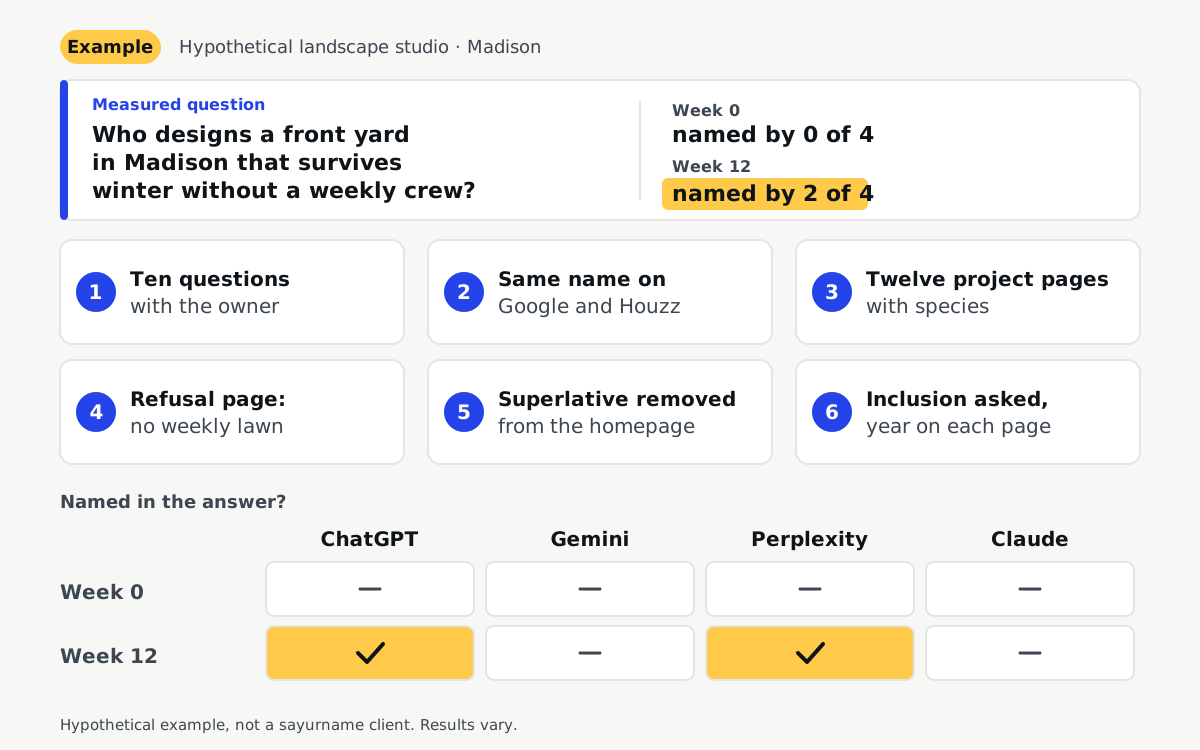
Example: a hypothetical studio, not a sayurname client. Imagine Lakeside Yard Works in Madison, Wisconsin: the owner and one designer, nine years, 74 Google reviews averaging 4.9. A front-yard plan is $1,800 to $3,200. Planting, if the client hires them to install, is quoted separately. They design for zone 5a, and they do not specify boxwood or a lawn that needs a weekly cut. The site was 90 photos with no captions and a contact form. The hardiness zone appeared nowhere.
The measured question was “Who designs a front yard in Madison that survives the winter without a weekly maintenance crew?”. At week 0 the studio was named by 0 of 4. ChatGPT named a national lawn chain and a garden center. Gemini listed the most-reviewed designers on Maps. Perplexity cited an extension article and a two-year-old forum thread. Claude explained zone 5 planting and named nobody.
- Read the four answers with the owner and chose ten questions callers had asked that year: a low-maintenance front yard, shade under a maple, a slope toward the neighbor, a plan without installation, deer, and what they will not plant.
- Fixed the base: the same legal name, address and phone on the site, Google and Houzz, and the line that the studio designs and does not run a weekly crew.
- Turned twelve photos into project pages: neighborhood, zone 5a, soil, species, what was removed, what the owner does in spring, and the plan fee band.
- Wrote a refusal page: no boxwood, no weekly-mow lawn, no plant they have watched die in a Madison January, with the extension list they check against.
- Removed “Madison’s most beautiful gardens”. It moved nothing, and no source can confirm a superlative.
- Asked Houzz and two local nurseries to list the studio among the designers they refer, published one page per measured question, each read by the designer, and asked the last twenty clients for a review that named a plant, with no discount and no suggested wording. Each project page carries the year it was built.
Nothing moved for five weeks, which is normal while new pages are found. In week 6 Perplexity named the studio and quoted the refusal of a weekly-mow lawn. In week 10 ChatGPT followed, after two reviews mentioned switchgrass and a serviceberry by name. At week 12 Gemini still led with the Maps leaders, and Claude named the studio in one run of four, which does not count.
What did not work: a paid Houzz badge brought profile views and no change in any answer. The large-estate question never moved, because two studios publish that scale in more detail and are the better answer. Results depend on the city, the question and the competition. Another studio doing the same work might see none of this in twelve weeks.
What to publish
A citable landscape page answers one yard with facts a stranger could check against a plant list. Titles that work: “A Madison front yard for zone 5a: three plants, the soil, and what we will not draw”; “Shade under a mature maple: what we specify and what dies”; “The plan fee, and what installation is not”; “What the owner still does in April”.
An excerpt from the first: “We design front yards in Madison for zone 5a. A typical plan is $1,800 to $3,200 and names the plants, the soil, and the spring work the owner does. We do not specify boxwood, and we do not draw a lawn that needs a weekly cut. Installation is a separate quote.” What makes it citable: a place, a zone, species, a fee, the owner’s remaining work, and the refusals. Leave out a recipe for applying a pesticide. That is not a design page.
When it is not worth it
If the studio is booked through next summer and the owner wants the calendar to stay full, more inquiries only lengthen a wait. Hire or raise the plan fee first. A designer who only draws for one developer, and never for a homeowner with a question, will not be chosen by an assistant asking about a front yard. The same goes for a garden crew that installs other people’s plans and has no plan of its own to publish.
Nor does it pay when the photos are of work the studio did not design, or the zone on the page is wrong. An assistant that checks the extension list will find the mismatch. Start there: make the name, the zone and the plants agree, and come back when there is a species you will stand behind.
How the work runs
It starts with the free test: one homeowner’s question sent to the four AIs, with the full answers saved as the starting point. Once subscribed, we measure up to 10 questions every week in ChatGPT, Gemini, Perplexity and Claude, fix the site’s base so the assistants can read the project pages, find out where the AI gets the answer to each question, and ask for the studio’s inclusion wherever there is a path: Houzz, the nursery pages that refer designers, the garden forums. Some of those are editorial or paid, so we promise the request, not the listing; you see what was asked and what got in. We also publish content that answers the measured questions. Publishing happens on a subdomain connected by DNS, or we deliver the pieces and you publish them. Onboarding is online, with no call.
It costs $299/month, with no lock-in. A one-time $599 bonus is charged only when an AI starts naming your studio for a measured question, checked by a person on our team, or Google Analytics shows a visit coming from an AI. Nobody controls AI answers, so there is no guarantee of being recommended. The content names only plants and fees you will stand behind, and the designer approves every piece. It promises no garden.
Questions
Won’t naming the plants give the design away?
A species list is not a plan for that yard. In the example, the studio stayed unnamed until the pages said which plants, which zone, and which plants they refuse. The drawing still belongs to the client who pays.
What if the extension service disagrees with a plant we like?
Then do not put that plant on a page you want quoted. The assistant will find the extension page. Name only what survives the winter you are designing for.
Does a Houzz badge buy the answer?
It can buy views on Houzz. In the example it changed no assistant. The answer is written from pages that agree on a plant and a place, not from a badge.
How long until anything changes?
In the example, the first assistant named the studio in week 6 and the second in week 10; two had not by week 12. Some questions never move, because another studio is the better answer.
Should we publish a weekly-maintenance offer if we do not staff a crew?
No. Say who maintains the yard after you leave. A page that implies a crew you do not have is the sentence the assistant will repeat, and the client will test.