

The question your students actually ask
Directors usually notice at enrolment: a student says she found the school through ChatGPT, yet the analytics show nothing, because such visits often arrive as direct traffic. Another sees the school named, asks again as a stranger in a fresh session, and the name is gone: the first answer leaned on the earlier conversation. One answer is a sample; the measure is the same question over weeks.
Adult learners type a language, a place and a constraint, and the constraint decides the answer: an exam and a deadline (“DELE B2 preparation in [city] before the May session”), a schedule (“beginners’ Spanish on weekday evenings near [neighborhood]”) or a format (“small groups, in person, not an app”). The exam question is worth most, because the learner has a date and a budget; the schedule question is where a local school beats every app.
Where the AI’s answer about language schools comes from
With web search on, the assistants run a few searches and summarize what the pages found agree on. For language schools those are predictable: the Google Business Profile and Maps, with the words students use in reviews, Yelp, the exam boards’ centre lists (Instituto Cervantes for DELE, the Cambridge English and IELTS centre searches, the Goethe-Institut), accreditation bodies such as Accreditation UK, Reddit threads, and the school’s own course pages.
The exam boards’ lists weigh more than owners expect: they are the only independent source tying a school’s name to an exam and a city, exactly the constraint in the most valuable question. The school’s pages supply the schedule, level and group size. The four assistants disagree because each searches a different index and varies between runs. Fame is not the criterion: the constrained question goes to whoever states the fact plainly, with an outside source agreeing.
The most common mistake: a timetable the AI cannot read
Most school sites keep the decisive facts where an AI reads them badly: the timetable in a PDF from two terms ago, start dates inside a booking widget, exam-centre status as a logo in the footer. The readable text says “learn Spanish with native teachers”, which answers nothing about “evening, B2, exam on site”, so the assistant names a school whose plain page does.
The reflex fix, “fluent in three months”, is no evidence to an assistant and a promise under consumer-protection rules. The better fix is duller: one readable page per course with CEFR level, days, times, group cap, hours, price and start date; exam status as text linked to the board’s list. Never call the school an exam centre if it only prepares students; the board’s list will contradict you.
A worked example, step by step
Example: a hypothetical school, not a sayurname client. Imagine Roscoe Village Language Studio in Chicago: 11 years open, nine teachers, about 420 adults a term in Spanish, French and Italian, 164 Google reviews averaging 4.9. It is a DELE exam centre listed by the Instituto Cervantes and charges $540 for a twelve-week evening DELE B2 course, but the timetable lived in a PDF.
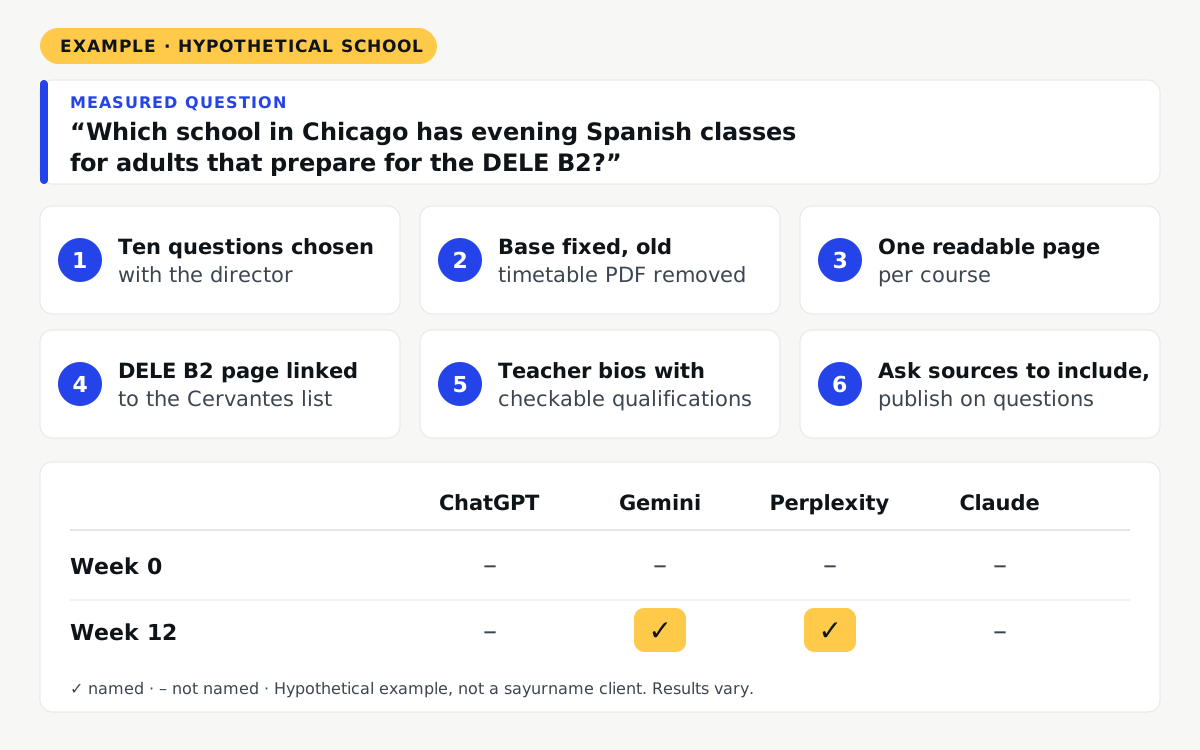
The measured question was “Which school in Chicago has evening Spanish classes for adults that prepare for the DELE B2?”. At week 0 it was named by 0 of 4 assistants: ChatGPT named the Instituto Cervantes and a university, Gemini an online platform, Perplexity an old Reddit thread, Claude nobody.
- Chose ten questions with the director, from DELE B2 preparation to Saturday Italian and the price of a term.
- Fixed the base: the same name, address and phone on the site, Google profile and Yelp, and the 2023 timetable PDF taken down, since it still ranked.
- Gave every course its own readable page: CEFR level, entry test, days and times, a cap of eight, hours, price and next start date.
- Wrote a DELE B2 page linking the exam-centre status to the Instituto Cervantes list, with the exam dates and last year’s figures: 23 students sat the B2 and 19 passed.
- Rewrote the teacher bios around checkable qualifications, such as DELE examiner accreditation, instead of “native speaker”.
- Asked Yelp and the exam-centre lists to correct the school’s entries, published one page for each measured question, each approved by the director, and asked for a review at the end of each term, with no discount.
The price question moved first, in week 3. In week 5 Perplexity named the school for the DELE question, citing the new page and the Instituto Cervantes list; in week 8 Gemini followed, after new reviews mentioned DELE preparation. At week 12 ChatGPT named it in one run of four, which does not count, and Claude still gave general advice.
What did not work: a new slogan moved nothing; a paid marketplace listing brought sign-ups but no change in answers; the French question never moved, because the Alliance Française and two larger schools say the same things. Results vary by city, language and competition.
What to publish
A citable page answers one learner question with facts others can check. Titles that work: “DELE B2 preparation in Chicago: twelve weeks of evening classes, groups of eight, exam on site”; “Spanish for beginners on weekday evenings in Roscoe Village”; “How long from A2 to B2 with two evenings a week, and why we will not promise a date”.
An excerpt from the first: “The course runs twelve weeks, Tuesdays and Thursdays from 6:30 to 8:30 pm, for at most eight students who passed our B1 entry test. We are a DELE exam centre listed by the Instituto Cervantes. Of 23 students who sat the B2 with us in 2025, 19 passed; the exam fee is not included.” What makes it citable: level, schedule, group size, a status an outside list confirms, outcomes with their denominator.
When it is not worth it
If evening groups fill a term ahead, more demand adds nothing; spend on teachers and rooms. A school living on in-company contracts or public tenders is chosen by procurement officers, not by learners asking an AI. A franchise whose site belongs to the franchisor cannot change the pages that matter and should take the question to head office.
Nor does it pay for an online-only tutor: “online Spanish tutor” is a global contest with marketplaces such as italki and Preply, and the local advantage, a room at a fixed hour, is missing. And it does not pay when the school will state nothing specific. Then correct the Google profile and the exam board’s listing first.
How the work runs
It starts with the free test: one learner question sent to the four AIs, answers saved as the starting point. Subscribed, we measure up to 10 questions every week in the four assistants, fix the base of the site so the AI can read every course page, find out where the AI gets the answer to each question and ask for the school’s inclusion wherever there is a path: the exam boards’ centre lists, Yelp, accreditation bodies such as Accreditation UK. Some of those are curated or require an inspection, so we promise the request, not the listing; you see what was asked and what got in. We also publish content that answers the measured questions. We publish on a subdomain through DNS, or deliver for you to publish.
It costs $299/month, with no lock-in. A one-time $599 bonus is charged only when an AI starts naming the school for a measured question, checked by a person on our team, or Google Analytics shows a visit from an AI. There is no guarantee of being recommended. Teaching languages is not a regulated profession, but advertising is: the content promises neither fluency nor a pass, claims exam-centre status only where the board lists it, and the director approves every piece.
Questions
Do reviews matter more than my course pages?
They do different jobs. Reviews tell the AI the school is real and liked; the course page tells it what runs, when and for whom. In the example, 164 reviews were not enough on their own.
Can I say we are a Cambridge or DELE centre if we prepare students for the exam?
Only if the exam board lists you. Preparing students and hosting the exam are different statuses. Say exactly what you are: “we prepare for the B2 First; the exam is sat at an authorized centre”.
Should we publish our pass rate?
Only with the exam, the year and the denominator: “19 of 23 passed the DELE B2 in 2025” can be quoted; “98% success” is ignored. Never present a past rate as a promise.
How long until anything changes?
In the example, the first assistant named the school in week 5 and two had not by week 12. Narrow questions, such as a term’s price, tend to move sooner than exam questions; some take months.
What if the AI says something wrong about my school?
It happens: a closed branch, last year’s timetable, a dropped language. The AI repeats what it read, so correct the source, often an old PDF or a directory listing, and state the current fact on your own site.