

What people actually ask before they call a lawyer
Almost nobody types "best employment lawyer". They type the problem, in their own words and usually late at night: "I was fired two weeks after I told my manager I was pregnant, is that legal?", "my landlord kept my deposit and stopped answering, what can I do?", "my father died without a will, who gets the house?". These are the questions that show up again and again in the reports of real people we collect, and they share one feature: the person does not yet know what kind of lawyer they need.
That changes what the assistant does. It does not return a list of firms. It first explains the legal situation (what counts as retaliation, what the deadline is, which documents matter) and only then says who handles that kind of case nearby. The firms it names are the ones whose public pages match the problem as the person described it, not the ones with the biggest practice-area list.
How AI chooses the firms it names
An assistant that answers with names is matching three things: the specific problem, the place and evidence that a firm handles exactly that. The evidence comes from what it can read. On your own site, that means a page that explains the problem in plain words, not a line in a list. Outside your site, it means attorney profiles and directories (Avvo, Justia, Martindale-Hubbell, Super Lawyers and your state bar's lawyer search), your Google Business profile and its reviews, and articles or local news that mention you in connection with that kind of case.
When those sources agree (same firm name, same address, the same practice described the same way, and a page that answers the question), the assistant has a firm it can name with confidence. When they disagree, or when the only thing it finds is "we offer excellence in employment, family, real estate and criminal law", it names someone else. Assistants that browse, like Perplexity and ChatGPT with search, also show the pages they used, so a firm can see which competitor page is doing the work.
The mistake that keeps most firms off the list
The most common pattern is one "Practice areas" page that names ten areas in two lines each, attorney bios that list only schools and admissions, and copy about commitment and excellence that could belong to any firm in any city. Nothing on that site answers a question a client would actually ask, so there is nothing for an assistant to match.
The second mistake is inconsistency: the firm is "Hartman Reyes LLP" on the site, "Hartman & Reyes Law" on one directory and still lists a partner who left three years ago on another. To a person that is a detail. To a system trying to decide whether three sources describe the same firm, it is a reason to doubt.
A worked example, step by step: a four-lawyer employment firm
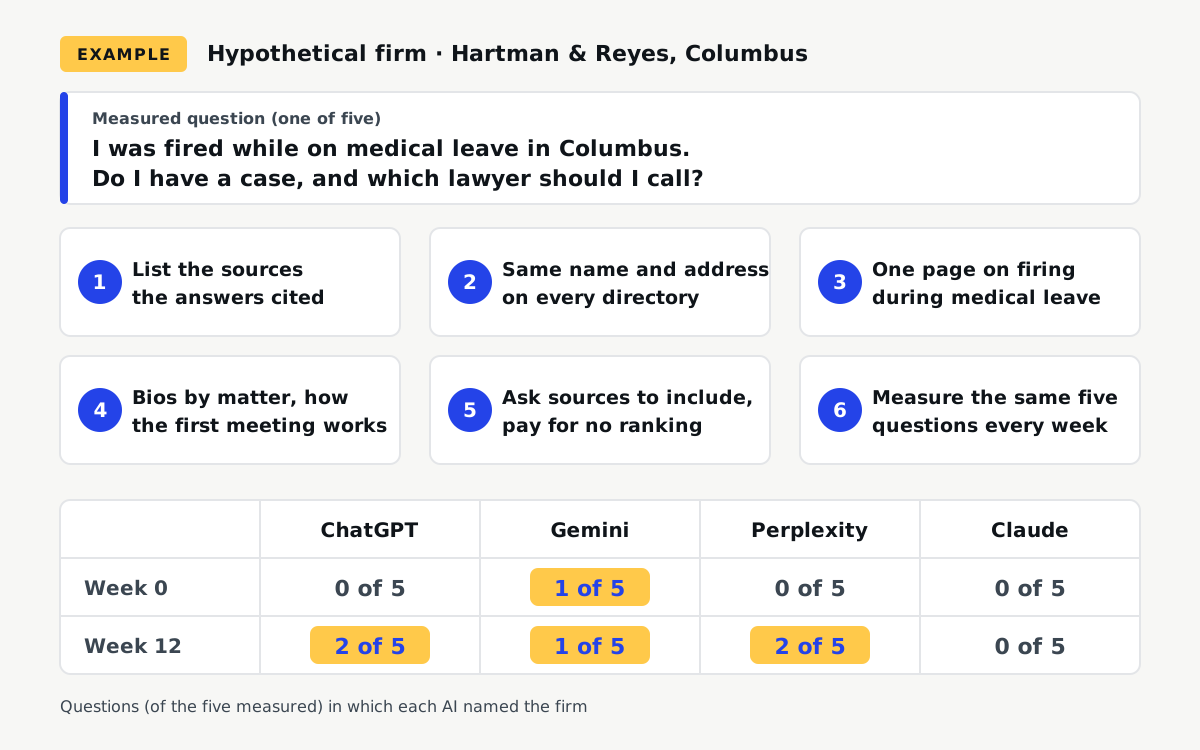
This is an illustration, not a client. Picture Hartman & Reyes, a four-lawyer employment firm in Columbus, Ohio, eleven years old, with 41 Google reviews averaging 4.7. About 70% of its roughly 20 new matters a month come from referrals by other lawyers and former clients. The website had one "Employment law" page of 180 words with a bulleted list of twelve topics, bios that listed only law schools and admissions, and directory profiles under two different names.
They picked five questions their clients actually ask, among them "I was fired while on medical leave in Columbus, do I have a case?", and asked all four assistants. At week 0 the firm appeared in 1 of the 20 question-and-assistant pairs: Gemini named it once for "employment lawyer in Columbus", reading its Super Lawyers listing. For the medical-leave question, ChatGPT explained FMLA retaliation and named three other firms; Perplexity cited a Justia guide and a competitor page titled "Fired during FMLA leave in Ohio".
- Saved the full starting answers and listed every source they cited: the Justia guide, two competitor pages, Avvo profiles and the state bar's lawyer search.
- Made the firm's name, address, phone and practice description identical on the site, the Google Business Profile, Avvo, Justia, Martindale-Hubbell and the state bar listing, and removed a partner who had left three years earlier.
- Published "Fired during medical leave in Ohio: what counts as retaliation and what to gather before you call a lawyer", 1,400 words by the partner who handles those cases, with the FMLA's two-year filing deadline (three if the violation was willful), the documents to keep and a short FAQ.
- Rewrote the four bios around the matters each lawyer handles, with the year of bar admission and a link to the bar's record, and added a page on how the first consultation works: who the person meets, what to bring and how long it takes.
- Asked for the firm's inclusion where there was a path: completed the free Justia and Avvo profiles with the new page, requested a correction on the directory that still carried the old name, and offered the medical-leave guide to a local business journal. Paid for no ranking and no premium placement.
- Measured the same five questions every week in the four assistants, and compared each page the answers cited with the firm's own to decide what to write next.
In week 6 Perplexity began citing the new page as a source. In week 10 ChatGPT named the firm for the medical-leave question. At week 12 the firm appeared in 5 of the 20 pairs, against 1 at week 0: the medical-leave question in Perplexity, ChatGPT and Gemini, and a severance question in Perplexity and ChatGPT. Claude still named no firm for any of the five.
What did not move: the generic "wrongful termination lawyer in Columbus" stayed at 0 of 4, held by large firms and directories, and the business journal never ran the piece. Nobody controls the timing; another firm, city or question could see none of this in twelve weeks.
What a law firm should publish
One page per problem, not per practice area. For an employment firm that means pages like "Fired after reporting harassment: what retaliation looks like", "Unpaid overtime: how to tell if you are exempt" or "Severance agreement: what to check before you sign". Each one opens with the direct answer in two or three sentences, then explains the steps, the documents and the mistakes people make.
Attorney profiles written around the matters each lawyer handles, with articles, talks and the questions they answer most often, not just schools and admissions. A plain explanation of how the first consultation works and what it costs, because that is one of the most asked questions and almost nobody answers it. The cities and neighborhoods you actually serve. And the same firm name, address and description everywhere you appear.
Written for your bar's advertising rules
Legal advertising is regulated, and the content we write is informative by design. It explains rights, steps and deadlines in general terms, does not promise outcomes, does not solicit specific cases and does not compare your firm with named competitors. In the United States it is written with the ABA Model Rules 7.1 to 7.3 and your state's version of them in mind. The final review of anything that speaks for the firm stays with you.
We do not pay, or suggest paying, for a place in a ranking, a directory tier or a "best lawyers" list, and we do not give anything of value for a recommendation, which Rule 7.2 restricts. Inclusion requests go to free profiles, corrections of wrong listings and editorial pitches the firm approves; whether a source accepts them is its own decision.
When this is not worth it
If almost all of your work comes from other lawyers or from corporate panels, or your clients are general counsel who pick firms through rankings and relationships, being named by an assistant matters little. The same is true if no one at the firm can review a page a month, or if the website cannot be edited. In those cases the free test is still a useful look at how AI describes you, and that may be all you need.
Then start smaller: correct the Google Business Profile and the directory listings, keep one firm name everywhere, and come back when someone at the firm can publish one page that answers a question a real client asks.
How it starts
Start with the free test: one question a client would ask, the full answers from ChatGPT, Gemini, Perplexity and Claude, and that result saved as your starting point. Subscribed, we measure up to 10 questions every week in the four assistants, fix the base of the site so each problem page can be read, find out where the AI gets the answer to your questions and ask for your inclusion wherever there is a path: Avvo, Justia, Martindale-Hubbell, your state bar's lawyer search, local news. Some of those sources are editorial or paid, so we promise the request, not the listing, and you see what was asked and what got in. We also publish content that answers the measured questions.
The service is $299 a month with no lock-in. A one-time $599 bonus is charged only when an AI starts naming your firm on a question where it did not appear before, checked by a person on our team, or Google Analytics shows a visit from an AI, with the full answer saved as proof. Nobody controls AI answers, so there is no guarantee of being named.
Questions
Can you guarantee AI will recommend my firm?
No. Nobody controls what an AI answers. We work on what makes your firm easier to find, understand and match to a client's problem, and we measure the same questions every week so you can see whether the answers move.
Which practice areas benefit most?
The ones where clients describe a personal problem and choose a lawyer themselves: employment, family, immigration, personal injury, landlord and tenant, estates, criminal defense. Work that comes through referrals or corporate panels benefits much less.
Will the content respect bar advertising rules?
It is written to. It informs in general terms, does not promise results and does not solicit cases. You review anything that speaks for the firm before it goes out.
How long until an AI names my firm?
There is no honest date. It depends on how clearly the web already describes your firm, how many firms compete for the same question and how steadily you publish. Weekly measurement shows progress before the first recommendation: more citations of your pages and a more accurate description of what you do.
Is the free test really free?
Yes: one question, four AIs, no card. The full answers are saved as your starting point.