

The question patients actually type
A clinic owner asks ChatGPT about the clinic, then asks it to answer as for a stranger, and the name disappears: the first answer leaned on the conversation. Another opens three private windows and gets three different lists. Both expose the mechanism: the answer is assembled anew from what the assistant retrieves, and a clinic faintly present in those sources appears by chance.
Patients rarely ask for “the best clinic”. They combine a procedure, a place and a constraint: “dermatologist in Austin who does Mohs surgery on the face and takes Aetna”, “pediatric dermatologist near Round Rock who can see my son for eczema within two weeks”, “skin checks on Saturdays in South Austin”. The constraint decides the answer, and it is exactly the fact a typical clinic website never states.
How assistants answer medical questions, and from what
With web search on, the four assistants build a “who should I see” answer from a recognizable set of sources: the Google Business Profile (categories, review volume, the words patients use), physician directories such as Healthgrades, Zocdoc and Vitals, specialty society finders such as the American College of Mohs Surgery’s, the state medical board’s license lookup, Reddit threads, and the clinic’s own pages when they state the specific thing asked.
Health is high-stakes, so assistants prefer facts confirmed in two or three independent places, and with thin signals they fall back on an academic center. Retrieval works page by page: a search for “Mohs surgery Austin face” returns pages about exactly that, and a homepage promising “comprehensive dermatology care” does not match. Answers differ between assistants, each with its own search backend, and between runs, so one screenshot proves little. Fame is not the criterion: the famous hospital group wins broad questions and loses narrow ones to a small practice whose page answers them.
The most common mistake: one services page for everything
The typical clinic site has one Services page listing thirty procedures as bullets, and the useful details (wait times, insurance, who does what) live only on the booking platform. For the narrow question there is then no page to retrieve, and the assistant fills the gap with whoever has one. If directories contradict each other, the assistant describes the practice wrongly or drops it.
Reconcile directory and board data first, then write one page per procedure the practice actually wants more of: who performs it, for which cases and not which, how the process runs, which insurance applies. Start where the advantage is specific and checkable, such as a fellowship-trained surgeon or a short wait, because that is where a narrow question can be won.
A worked example, step by step
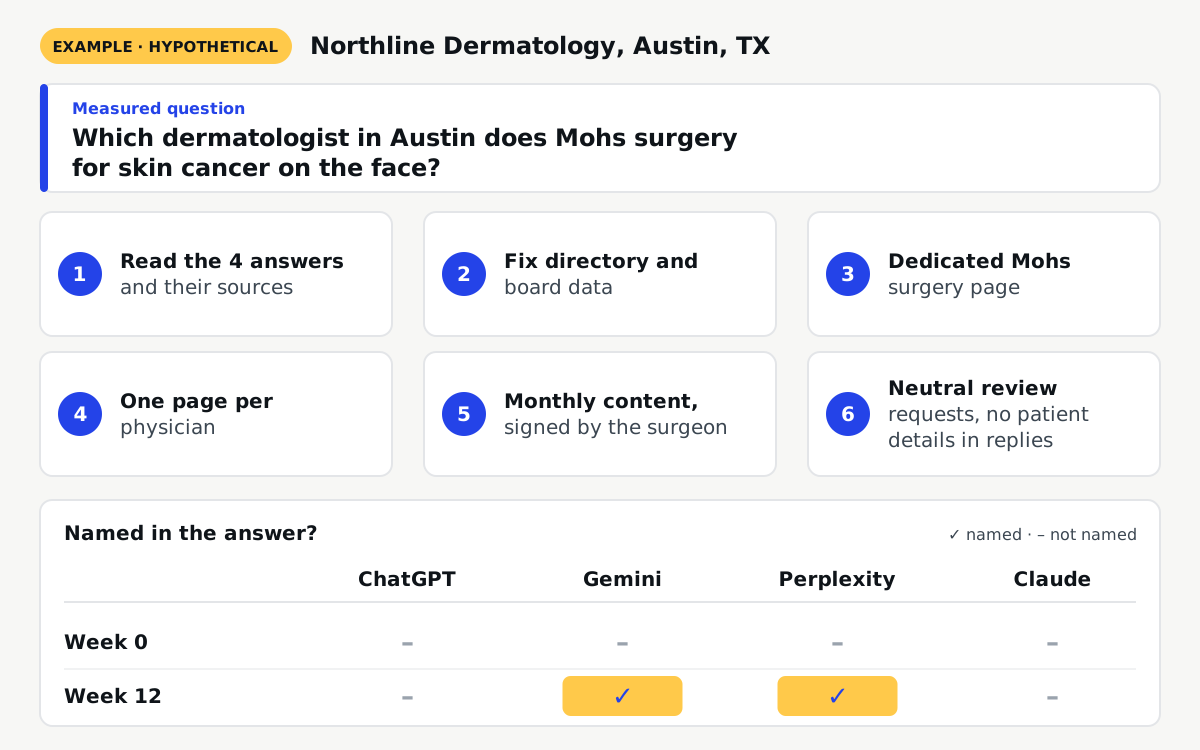
Example, hypothetical: Northline Dermatology, an imagined North Austin practice open since 2011, with three board-certified dermatologists, one physician assistant and eleven staff. One dermatologist is fellowship-trained in Mohs surgery and operates about 25 cases a week; a self-pay skin check costs $185; the practice had 214 Google reviews averaging 4.8. Measured question: “Which dermatologist in Austin does Mohs surgery for skin cancer on the face?” In week 0 it was named by 0 of 4 assistants, which named two practices with Mohs pages and an academic center. On the site, Mohs was one bullet among 36 and the surgeon’s bio omitted her fellowship.
- Read the four week-0 answers and their sources, and listed what the named practices shared: a dedicated Mohs page, the fellowship stated plainly, one address everywhere.
- Fixed identity data first: the pre-2022 address on Healthgrades, the surgeon’s society directory entry still pointing to her San Antonio training clinic, and a physician who left in 2023 but remained on Zocdoc.
- Published a Mohs page that answers the question as patients ask it: surgeon, certification and fellowship year, which cancers and locations it is used for, what a surgery day looks like, the usual three-week wait and accepted insurance.
- Turned the three bios into pages of their own, each with license number, board certification, training, conditions seen and not seen, and languages, since two doctors see patients in Spanish.
- Started monthly content with questions the surgeon actually hears, each signed by her: Mohs versus excision, preparing for surgery day, nose reconstruction, with no outcome promises.
- Changed the review process, not the reviews: one neutral request to every patient, no incentive, and no reply ever mentioning patient details, which HIPAA forbids even when the patient disclosed them.
In week 6 Perplexity named Northline, citing the new page and the corrected directory entry. In week 9 Gemini followed, apparently drawing on reviews that now mentioned Mohs (214 became 251). In week 12 ChatGPT and Claude still did not; ChatGPT’s single mention in week 11 vanished a week later, which counts as variation, not a result.
A “Why choose Northline” article and a paid newswire release produced nothing, and “best dermatologist in Austin” stayed at zero of four. This illustrates, it does not forecast: another practice could see no change in a quarter.
What to publish
Three pages would carry most weight: “Mohs surgery in North Austin: who performs it, which cases, what to expect”, “Pediatric eczema appointments: ages, wait times, what to bring”, “Dr. Elena Ruiz, MD: dermatologist and Mohs surgeon”. The first could open like this: “Mohs surgery at Northline is performed by Dr. Elena Ruiz, board-certified in dermatology and fellowship-trained in Mohs micrographic surgery (2014). We use it mainly for basal and squamous cell carcinomas on the face, ears and hands. Most patients are seen within three weeks of referral.”
A medical page is citable when its facts can be checked elsewhere: a named physician whose credentials match the board lookup, conditions treated and those referred out, process and timing, insurance and self-pay ranges where prices are allowed, and the date of the last review. Superlatives, testimonials and promised outcomes make a page uncitable, and boards object to them anyway.
When it is not worth it
If the schedule is booked three months ahead, more patients only lengthen the list. In referral-only specialties, such as interventional cardiology, another physician chooses, not the patient. A hospital-employed doctor cannot change the system’s pages, and in a town with two clinics patients ask a neighbor, not an assistant.
Instead: a complete Google Business Profile, consistent directories and a current address in the board lookup are free and fix most wrong descriptions. Referral-only practices gain more from referring doctors.
How the work runs, and your medical board
It starts with the free test: one question, four assistants, full answers saved as your starting point. Onboarding is online, with no call. We measure up to 10 questions weekly in the four assistants, fix the site’s base so assistants can read and understand its pages, find out where the AI gets each answer and ask for the practice’s inclusion wherever there is a path: Healthgrades, Zocdoc, Vitals, the American College of Mohs Surgery’s finder. Some of those are paid or limited to members, so we promise the request, not the listing; you see what was asked and what got in. We also publish content that answers the measured questions. Content goes live on a subdomain via DNS, or we deliver it for you to publish. The price is $299/month with no lock-in, plus a one-time $599 bonus charged only when an assistant starts naming the practice for a measured question, checked by a person, or Google Analytics shows a visit from an AI. Nobody can guarantee a recommendation, and we do not.
Everything we publish is informative and follows the advertising rules of your state medical board: no promised outcomes, no testimonials where restricted, no claims of superiority, no solicitation of patients, and credentials exactly as in the license record. A physician from the practice approves each piece, and no patient information appears anywhere.
Questions
Do reviews matter more than my website?
They do different jobs. Reviews tell the assistant the practice is real and trusted; the site tells it what you treat, for whom and where. With no page on the procedure, 400 reviews still lose the narrow question.
Can I just pay to be listed or featured?
A paid directory upgrade can complete your profile, but it buys the profile, not the answer. We know of no fee that places a name inside an assistant’s recommendation.
Is this allowed by my medical board?
Informative content about what the practice does, within the board’s advertising rules, is what boards expect physicians to publish. We avoid restricted testimonials, promised results and solicitation, and a physician approves every piece.
How long until anything changes?
Directory fixes are usually picked up within weeks; new pages take longer. Some practices see nothing for a quarter, so we report the weekly trend, not a date.
What if the AI says something wrong about my practice?
Wrong answers nearly always trace back to a source: an old address, a physician who left, a procedure listed by mistake. The weekly measurement shows the statement and its source, and the fix is made there.