

The question a person actually asks
Movers usually meet this as a phone call that wants a number in thirty seconds. They ask an assistant about their own company and it praises them, because the question already contained the name. A stranger then asks the way a person asks before they will book a Saturday: the size of the home, the floor, and whether the price is written before the truck. The company is gone. The only reading that matters is that stranger’s question, asked the same way every week.
Almost nobody types “best movers near me” and stops. They add the thing that made the last move expensive. A third-floor walk-up. A piano. A binding price, not an hourly rate that starts when the crew is already in the stairwell. What the valuation covers if a mirror breaks. Each constraint sends the assistant to a different page. “Fully insured” is not the criterion. The assistant cannot verify a slogan. It can verify a written price, what is excluded, the floor, and the valuation the customer can choose.
Where the answer about a mover comes from
With web search on, each assistant runs a few searches and summarizes what the pages agree on. For local moves the sources are Google, reviews that mention stairs and a final bill, the state or city’s mover registration when one exists, and the company’s own site. A national van line ranks for a broad question because many pages repeat its name. A local crew ranks for the walk-up question only if a page states the written price, how it is built, and what is not in it.
The mechanism is a number a stranger can hold the company to. An hourly rate with no inventory is a guess. A price after a video walk-through, listing rooms, floors and exclusions, is a fact. The four assistants disagree because each searches a different index, and the same one changes between runs, so one screenshot proves little. Fame is not the criterion: the company with 1,000 reviews wins “movers in [city]”, and the third-floor question goes to whoever publishes the written price and the valuation choice.
The most common mistake: “fully insured, we move anything”
Almost every local mover’s site says fully insured, any size, free estimate, then a phone number. It happens because the real price depends on the stairs, and the owner does not want a number on a page that a one-room studio will treat as a promise. To an assistant, the slogan is identical on fifty sites. It cannot match “third floor, no elevator, written price” to a sentence that names no floor and no price.
The cost is concrete. The person books the van line whose page shows a written range for a two-bedroom walk-up. The local crew may be the better job, and it never enters the answer. The remedy is not a lower hourly rate in the footer. It is a page that says how the written price is made: a video or in-home survey, the rooms, the floor, what is excluded (a piano, a safe, packing the kitchen if the customer packs it), the price band for that job, and the valuation included versus the one that costs more. The trade-off is that a published band can be used against you if the survey was sloppy. Do the survey before you print the number, and say the number is for the inventory you saw.
A worked example, step by step
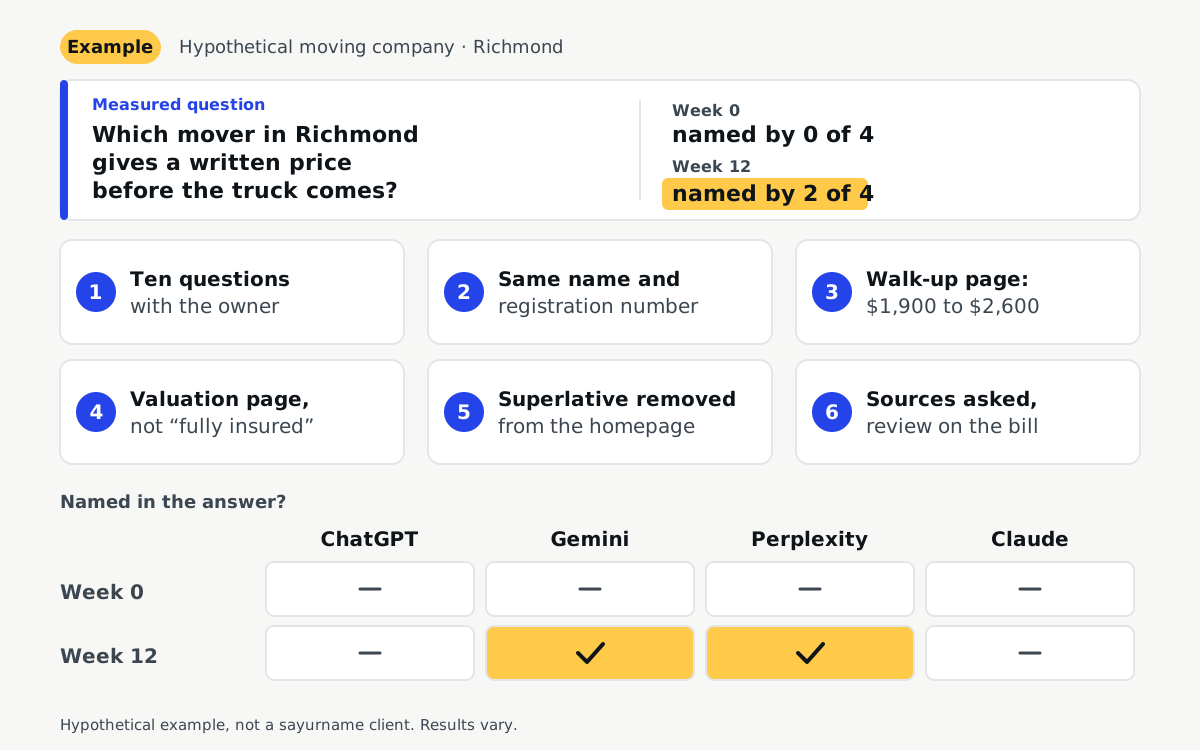
Example: a hypothetical company, not a sayurname client. Imagine James River Movers in Richmond, Virginia: the owner and six movers, two trucks, 11 years, 240 Google reviews averaging 4.7. A two-bedroom on a third floor with no elevator, after a video survey, is a written price of $1,900 to $2,600 if the customer packs the kitchen. A piano is quoted separately and is not in that band. Basic released-value coverage is included; full replacement is a separate line. The site said “fully insured, any size” and an hourly rate of $149, with no floor and no exclusions.
The measured question was “Which mover in Richmond gives a written price for a two-bedroom on a third floor with no elevator, before the truck comes?”. At week 0 the company was named by 0 of 4. ChatGPT named two national van lines. Gemini listed the most-reviewed movers on Maps. Perplexity cited a forum thread about a bill that doubled. Claude explained how to compare estimates and named nobody.
- Read the four answers with the owner and chose ten questions callers had asked that year: a third-floor two-bedroom, a piano, a written price, packing, a one-room studio, and what happens if a mirror breaks.
- Fixed the base: the same legal name, address, phone and USDOT-style local registration number where the city posts one, on the site and on Google.
- Replaced the slogan with a walk-up page: video survey first, third floor with no elevator, two-bedroom written band of $1,900 to $2,600 when the customer packs the kitchen, piano excluded.
- Wrote a valuation page: what the included coverage pays, what full replacement costs, and that “fully insured” is not a promise to replace everything at today’s price.
- Removed “Richmond’s most careful movers”. It moved nothing, and no source can confirm a superlative.
- Asked review sites to list the company, published a page for each measured question, each read by the owner, and asked customers for a review that mentioned whether the final bill matched the written price, with no discount and no suggested wording.
The bill-surprise question moved first. In week 5 Perplexity began citing the valuation page when people asked why a move cost more than the phone quote. In week 9 Gemini named the company for the third-floor question, once several reviews said the written price matched the bill. At week 12 ChatGPT still led with the van lines, and Claude named the company in one run of four, which does not count.
What did not work: a paid lead site brought calls and no change in any answer. The long-distance question never moved, because the company does not run interstate loads and two van lines publish that work in detail. Results depend on the city, the question and the competition. Another company doing the same work might see none of this in twelve weeks.
What to publish
A citable moving page answers one home with a number a stranger could compare. Titles that work: “A two-bedroom on a third floor in Richmond: how the written price is built”; “What is not in the price: piano, safe, and a kitchen you did not pack”; “Valuation: what is included, and what full replacement costs”; “Why the phone quote and the bill were different”.
An excerpt from the first: “For a two-bedroom on a third floor with no elevator, after we see the home on video, the written price is $1,900 to $2,600 if you pack the kitchen. A piano is not in that number. The included valuation is not full replacement. We say which one you are buying before the truck is booked.” What makes it citable: the floor, the inventory, the band, the exclusions, and the valuation. Leave out “we never break anything”.
When it is not worth it
If every Saturday is booked eight weeks out, more inquiries only fill a calendar the owner cannot honor. Hire or raise the price first. A company that only hauls for one apartment complex, and never for a person comparing two estimates, will not be chosen by this question. The same goes for a broker that owns no truck and cannot publish a crew or a price it controls.
Nor does it pay when the name on the truck, the Google profile and the estimate are three different companies. An assistant that sees the mismatch names someone whose three names agree. Start there, and come back when the written price is one you will print.
How the work runs
It starts with the free test: one person’s question sent to the four AIs, with the full answers saved as the starting point. Once subscribed, we measure up to 10 questions every week in ChatGPT, Gemini, Perplexity and Claude, fix the site’s base so the assistants can read the estimate pages, find out where the AI gets the answer to each question and ask for the company’s inclusion wherever there is a path: review sites, the state or city mover registration where one exists. Some of those sources are official or curated, so we promise the request, not the listing; you see what was asked and what got in. We also publish content that answers the measured questions. Publishing happens on a subdomain connected by DNS, or we deliver the pieces and you publish them. Onboarding is online, with no call.
It costs $299/month, with no lock-in. A one-time $599 bonus is charged only when an AI starts naming your company for a measured question, checked by a person on our team, or Google Analytics shows a visit coming from an AI. Nobody controls AI answers, so there is no guarantee of being recommended. The content states only prices and coverage you will honor, and the owner approves every piece. It promises no booking.
Questions
Won’t a published price be used against us?
A band for a job you have seen is safer than an hourly rate with no inventory. In the example, the page says the number is for the home on the video, with the kitchen packed by the customer and the piano excluded.
Is “fully insured” enough?
No. Say what the included valuation pays and what full replacement costs. The slogan is the sentence an assistant cannot check, so it drops it or repeats it as a promise.
Should a national van line be the better answer sometimes?
Yes, for an interstate load, if that is the work they publish and you do not. In the example the company stopped writing around long-distance moves it does not run.
How long until anything changes?
In the example, a billing question moved in week 5 and a second assistant named the company for the walk-up in week 9. Two had not by week 12.
Does a lead site buy the answer?
It can buy calls. In the example it changed no assistant. The answer is written from a page with a floor, a price and an exclusion, not from a paid listing.