

What clients really type into the assistant
One owner asks ChatGPT for a dietitian in town and sees her name, then asks again in a fresh session, as a stranger, and it is gone: the first answer leaned on her earlier questions. Another had the assistant optimize her site and saw no result. One answer is an anecdote; what counts is the same question, asked the same way, over weeks.
Clients name a condition, a place and a constraint, and the constraint decides the answer: a diagnosis (“dietitian in [city] for IBS who knows low-FODMAP”), payment (“dietitian that takes Aetna”, “does Medicare cover a dietitian for diabetes”), a stance (“PCOS dietitian who does not focus on weight”) or format (“telehealth dietitian anywhere in North Carolina”). Payer directories and telehealth networks decide the insurance question, protocol pages the diagnosis question, so a practice can win one and miss the other.
Where the assistants’ list of dietitians comes from
With web search on, the assistants run a few searches and summarize what the pages found agree on. In nutrition those pages are predictable: the Google Business Profile (its category and the conditions reviews mention), Zocdoc, insurer directories, the Academy of Nutrition and Dietetics’ Find a Nutrition Expert, the state license lookup, telehealth networks such as Nourish and Fay, and the practice’s own service pages.
Health questions make the assistants cautious: they add “look for a registered dietitian” and favor sources stating credentials and scope, so a practice that publishes its license and the cases it refers back to a physician beats a coach with more followers. And “nutritionist” is unprotected in many states while “registered dietitian” is protected, so a site using only the vaguer word matches fewer questions. The four assistants disagree, each searching a different index and varying between runs; 40,000 Instagram followers do not answer “who treats IBS in Raleigh and takes Blue Cross”.
The most common mistake: selling the transformation
Nutrition sites are often written like a coaching funnel: “heal your gut and feel like yourself again”, a free seven-day reset, and a “Gut health” card naming no condition, protocol or credential. The copy comes from wellness marketing, where the transformation is the product, and from fear that naming diagnoses will scare people off.
An assistant testing the practice against “IBS, low-FODMAP, takes insurance” finds no sentence answering any of the three, and outcome language (“lose 15 pounds”, “reverse your diabetes”) is what dietetics advertising rules restrict and cautious assistants avoid repeating. Describe the care instead: conditions, protocol, number of visits, who provides it under which license, the fee, and when the client sees a doctor first.
A worked example, step by step
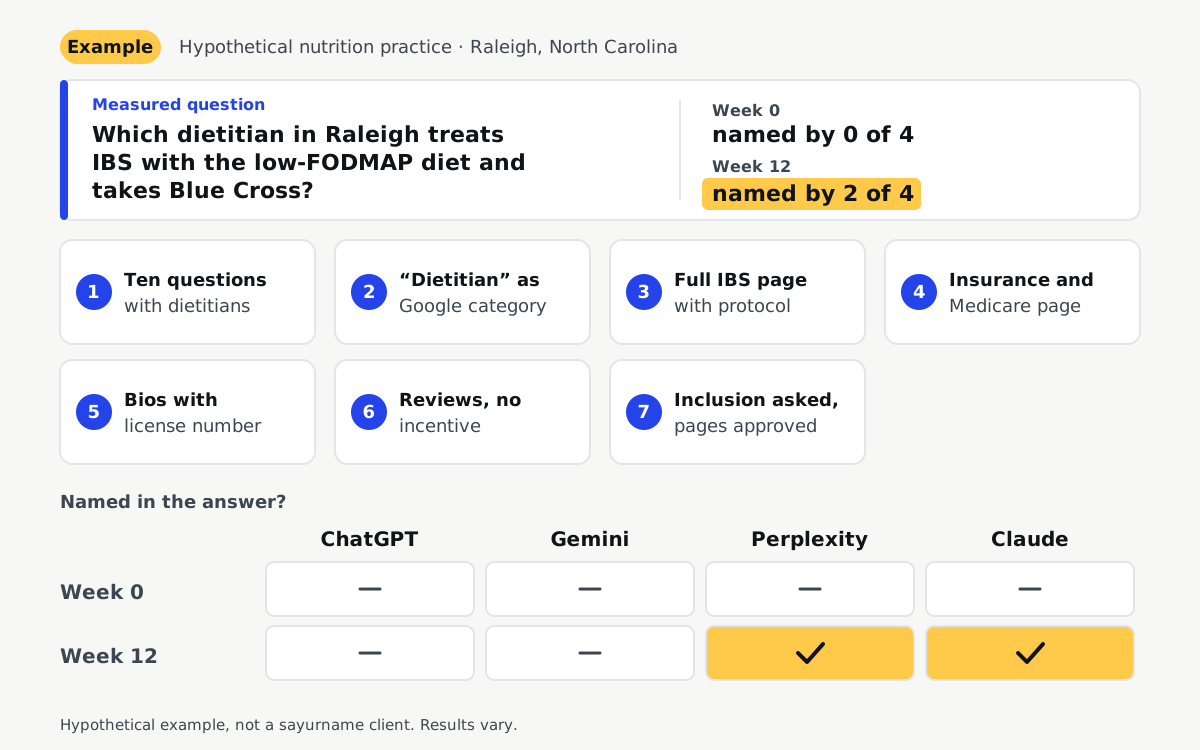
Example: a hypothetical practice, not a sayurname client. Imagine Five Points Nutrition in Raleigh, North Carolina: three registered dietitians, nine years open, 71 Google reviews averaging 4.9, in network with Blue Cross NC and Aetna, $180 for a self-pay first visit. One dietitian completed Monash University’s low-FODMAP training and sees about 200 IBS clients a year. The site had a 60-word “Gut health” card.
The measured question was “Which dietitian in Raleigh treats IBS with the low-FODMAP diet and takes Blue Cross?”. At week 0 it was named by 0 of 4: ChatGPT named telehealth networks, Gemini the most-reviewed practices, Perplexity a hospital GI clinic, Claude nobody.
- Chose ten questions with the dietitians, among them IBS, accepted insurance, Medicare and diabetes, PCOS and eating on GLP-1 medication.
- Fixed the base: “Dietitian” became the primary Google category instead of “Nutritionist”, and name, address and phone now match on the site, Zocdoc and every directory.
- Replaced the card with an IBS page: who sees these clients and her training, the diet’s three phases, four to six visits, coordination with the gastroenterologist, and symptoms that go to a physician first.
- Published an insurance page: plans in network, what Medicare covers (nutrition therapy for diabetes and kidney disease) and how self-pay clients get a superbill.
- Rewrote the three bios with degree, RDN credential and state license number, and removed a “certified gut-health coach” badge that verified nothing.
- Asked for reviews after the third visit, with no incentive or suggested wording, and replied without confirming that anyone was a client.
- Asked Find a Nutrition Expert and two insurer directories to list the practice, and published one page per situation, each approved by a dietitian, such as low-FODMAP eating for vegetarians.
The insurance question moved first, on Perplexity in week 3. In week 6 Perplexity named the practice for the IBS question, citing the new page, and in week 10 Claude followed, citing the page and the Find a Nutrition Expert listing. At week 12 Gemini still preferred practices with more Maps reviews, and ChatGPT still led with telehealth networks.
What did not work: thirty Instagram reels changed nothing; the seven-day reset was removed because it promised too much; the GLP-1 question never moved, held by national programs. Results vary by city, question and competition; another practice could see none of this in twelve weeks.
What to publish
A citable nutrition page answers one client situation with facts a stranger could check. Titles that work: “IBS and the low-FODMAP diet in Raleigh: who guides it, how many visits, what it costs”; “Insurance we accept, and what Medicare covers”; “PCOS care that does not start with the scale”.
An excerpt from the first: “Maya Chen, RDN, completed Monash University’s low-FODMAP training in 2019 and sees most of our IBS clients. The diet has three phases: two to six weeks of elimination, a structured reintroduction, then a personal long-term plan, usually over four to six visits. We ask for your physician’s diagnosis first, and unexplained weight loss goes back to them.” It names a licensed professional, one condition, the protocol and the boundary with medicine, and promises nothing, since responses to diets vary.
When it is not worth it
If new clients already wait six weeks, more visibility produces frustration, not revenue; hire first. A renal dietitian in a dialysis unit is reached through physician referral, so prescribers matter more than any assistant. A sports dietitian on contract with teams is chosen by coaching staff, not by athletes asking ChatGPT.
It also does not pay when the real offer is what the rules forbid advertising: guaranteed weight loss, before-and-after photos, supplements sold as cures. No page makes that citable, and publishing it invites a board complaint. If the dietitians will not name conditions, protocols or fees, start smaller: fix the Google category and directory listings first.
How the work runs, within your board’s rules
It starts with the free test: one client question to the four AIs, full answers saved as the starting point. Subscribed, we measure up to 10 questions every week in the four assistants, fix the base of the site, find out where the AI gets the answer to each question and ask for the practice’s inclusion wherever there is a path: Zocdoc, insurer directories, the Academy’s Find a Nutrition Expert, telehealth networks such as Nourish and Fay. Some of those are paid, selective or up to an insurer, so we promise the request, not the listing; you see what was asked and what got in. We also publish content that answers the measured questions. Pages go on a subdomain through DNS, or we deliver and you publish.
It costs $299/month, with no lock-in, plus a one-time $599 bonus charged only when an AI starts naming the practice for a measured question, checked by a person on our team, or Google Analytics shows a visit from an AI. Nobody controls AI answers, so nothing is guaranteed. Content is informative and follows your state dietetics board’s advertising rules and your profession’s code of ethics: no promise of weight loss or cure, no before-and-after images, no testimonials where forbidden, no solicitation, no client health information, and a dietitian approves every piece.
Questions
Do Google reviews matter more than my website?
Reviews tell the assistant the practice is real and trusted; they rarely say what it treats, and clients should not describe their condition in public. In the example, 71 reviews were not enough until a page stated IBS, the protocol and the insurance.
Should I just join a telehealth network?
A network can fill a schedule and often wins the broad insurance question. Its listing describes the network, not your practice; specific questions go to a local page with your protocol and address.
Is this allowed by my state board?
Informative content about conditions, process, credentials and fees is generally allowed; the rules restrict promised results, misleading titles, solicitation and, in some states, testimonials. A dietitian approves every piece, under your board’s restrictions.
How long until anything changes?
In the example, the insurance question moved in week 3, the IBS question in week 6, and two assistants had not moved by week 12. Broad questions such as “best nutritionist in [city]” may never move.
What if an AI says something wrong about my practice?
It repeats what it read: an old address, a dietitian who left, a plan you dropped. Correct the source, usually a directory, and state the right fact on your own site.