
The question a buyer actually asks
Course makers usually meet this as a launch email, not as a lost sale. They ask an assistant about their own course and it praises the promise, because the question already contained the name. A stranger then asks the way a person asks before they will pay: the job the lessons cover, who teaches, how long, and whether they can leave. The course is gone. The only reading that matters is that stranger’s question, asked the same way every week.
Almost nobody types “best online course” and stops. They add the constraint that wasted the last purchase. A named teacher, not a brand. Six hours, not “a complete system”. A refund if they watch little. Not a job, not a client list, not a certificate the state recognizes. Each constraint sends the assistant to a different page. “You’ll get clients” is not the criterion. The assistant cannot verify a future. It can verify a syllabus, a person, a length, a price and a refund rule.
Where the answer about a course comes from
With web search on, each assistant runs a few searches and summarizes what the pages agree on. For a short course the sources are the maker’s site, reviews that name a lesson, comparison posts, and the platform page if that is the only public text. A large platform ranks for a broad question because many pages repeat its name. A small course ranks for the invoicing question only if a page states the lessons, the teacher, the hours and the refund in sentences the maker controls.
The mechanism is a fact a buyer can check before paying. A promise of clients is not checkable, so a careful answer drops it or warns against it. A syllabus is checkable. The four assistants disagree because each searches a different index, and the same one changes between runs, so one screenshot proves little. Fame is not the criterion: the platform with a million students wins “online course”, and the one-person-shop question goes to whoever publishes the outline and the exit.
The most common mistake: an outcome, and no syllabus
Almost every small course page says you will get clients, save tax, or finally understand the books, then a checkout button. The teacher’s name, the lesson list and the refund sit in a platform the buyer sees after paying, or nowhere. It happens because the outcome is what the ad tested, and a syllabus feels like giving the course away. To an assistant, an outcome with no outline is a claim it will not repeat as a recommendation.
The cost is concrete. The bakery owner takes the platform whose public page lists six lessons, a teacher and a 14-day refund. The local course may be the better six hours, and it never enters the answer. The remedy is a page the maker owns: who teaches, what each lesson covers, how many hours, the price, who it is not for, and the refund rule with its conditions. The trade-off is that you cannot promise the result. A page that says “you will land clients” is the sentence a careful answer refuses to quote. Say what the lessons show, and stop.
A worked example, step by step
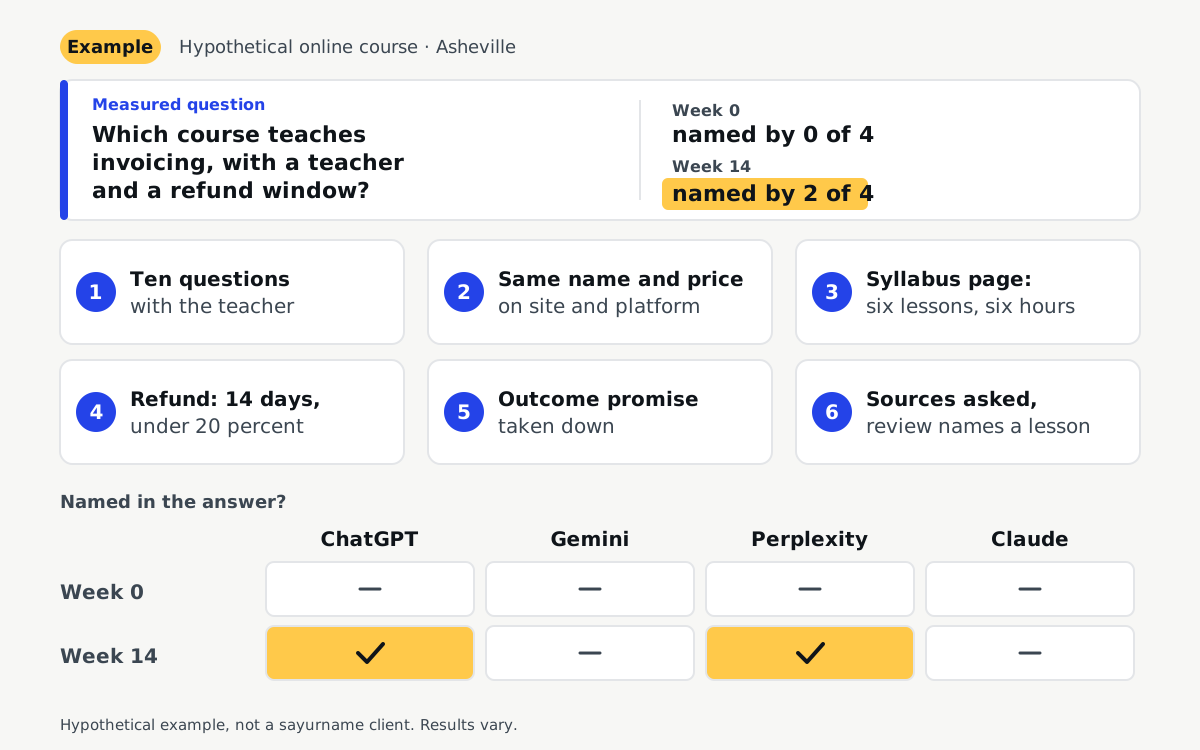
Example: a hypothetical course, not a sayurname client. Imagine Ridge Line Courses in Asheville, North Carolina: one teacher, a bookkeeper, six years of the same short course. “Invoices for a one-person shop” is six hours, self-paced, six lessons, $240. Refund within 14 days if the buyer has watched less than 20 percent. It is not a degree, not a license, and it does not promise clients. The site was a headline, “stop losing money”, and a checkout. The syllabus lived inside the platform, visible after purchase.
The measured question was “Which online course teaches invoicing for a one-person shop, with a named teacher and a refund window?”. At week 0 the course was named by 0 of 4. ChatGPT named two large platforms. Gemini listed courses with the most reviews. Perplexity cited a roundup that did not include them. Claude explained what a syllabus should contain and named nobody.
- Read the four answers with the teacher and chose ten questions buyers had asked that year: invoicing for a shop of one, who teaches, how long, the refund, whether it is a certificate, and who should not buy.
- Fixed the base: the same course name, teacher name and price on the site and on the platform, and the line that this is not a degree.
- Published the syllabus as a page: six lessons by title, six hours, the teacher’s name and what she does for a living, $240, and who it is not for, including anyone who wants a license.
- Published the refund rule in the same words as the checkout: 14 days, under 20 percent watched, how to ask.
- Removed “you will get clients”. It moved nothing, and no source can confirm a future.
- Asked the authors of two comparison posts to consider the course, published a page for each measured question, each read by the teacher, including one worked invoice with the numbers changed, and asked buyers for a review that named a lesson, with no bonus lesson and no suggested wording.
Nothing moved for four weeks. In week 6 Perplexity named the course and quoted the 20 percent refund line. In week 11 ChatGPT followed, after two reviews named the lesson on deposits. At week 14 Gemini still led with the large platforms, and Claude named the course in one run of four, which does not count.
What did not work: a paid newsletter placement brought clicks and no change in any answer. The “course that gets you a bookkeeping job” question never moved, because the teacher does not offer that and a college program publishes it in detail. Results depend on the question and the competition. Another course doing the same work might see none of this in fourteen weeks.
What to publish
A citable course page answers one buyer’s check before they pay. Titles that work: “Six lessons on invoicing for a one-person shop: titles, hours and who teaches”; “The refund: 14 days, under 20 percent watched”; “Who should not buy: anyone who wants a license or a job”; “A worked invoice, with the names changed”.
An excerpt from the first: “The course is six hours, taught by a bookkeeper who has kept the books of one-person shops since 2019. Lesson three is deposits. It costs $240. It is not a degree and it does not get you clients. If you have watched less than 20 percent, you can ask for the money back within 14 days.” What makes it citable: a person, a list, a length, a price, a limit and an exit.
When it is not worth it
If the course is closed and the teacher does not want more buyers, measuring a question nobody should be sent to is wasted money. A course whose platform forbids a public syllabus cannot publish the fact the assistant needs. The same goes for a promise the teacher will not remove: a page that still says “you will get clients” is worse than silence, because a careful answer will not recommend it.
Nor does it pay when the name on the checkout, the teacher and the syllabus are three different products. Start there, and come back when the outline and the refund are sentences you will keep.
How the work runs
It starts with the free test: one buyer’s question sent to the four AIs, with the full answers saved as the starting point. Once subscribed, we measure up to 10 questions every week in ChatGPT, Gemini, Perplexity and Claude, fix the site’s base so the assistants can read the syllabus, find out where the AI gets the answer to each question and ask for the course’s inclusion wherever there is a path: the comparison posts, the platform’s catalog page, review sites. Some of those sources are editorial or curated, so we promise the request, not the listing; you see what was asked and what got in. We also publish content that answers the measured questions. Publishing happens on a subdomain connected by DNS, or we deliver the pieces and you publish them. Onboarding is online, with no call.
It costs $299/month, with no lock-in. A one-time $599 bonus is charged only when an AI starts naming your course for a measured question, checked by a person on our team, or Google Analytics shows a visit coming from an AI. Nobody controls AI answers, so there is no guarantee of being recommended. The content states only what the lessons show and the refund you honor, and the teacher approves every piece. It promises no student and no result.
Questions
Won’t a public syllabus give the course away?
A list of titles is not the lessons. In the example, the course stayed unnamed until the titles, the hours and the teacher were on a page. The video still sits behind the purchase.
Can we say students get clients?
No. That future is not checkable, and a careful answer will not quote it as a reason to buy. Say what the lessons show.
Does a large platform always win?
It wins the broad question. The narrow one, a named teacher and a refund for this job, went to the page that stated those facts. In the example the large platforms still won the generic question at week 14.
How long until anything changes?
In the example, the refund line was quoted in week 6 and a second assistant named the course in week 11. Two had not by week 14.
Is the refund the same in every country?
No. Publish the rule you actually apply, including the watch limit. A page that invents a longer window than the checkout is the mismatch an assistant will repeat.