

The question future clients actually ask
Trainers usually meet the problem by accident. One saw the studio named by ChatGPT, until a new chat with no history left it out: the first answer had remembered earlier questions. Another opened three private windows and got three different lists. What counts is the answer a stranger gets, asked the same way every week.
Almost nobody types “personal trainer in [city]”. People type a person, a place and a constraint, and the constraint decides who is named. Starting point: “trainer in [city] for someone over 60 who has never lifted”, where most trainers say nothing explicit and one page can settle it. Condition: “trainer after a knee replacement”, where the assistant wants someone who names the case and says where physical therapy takes over. Logistics: “in-home trainer in [neighborhood]”. Each shape draws on different sources.
Where the AI’s answer about trainers comes from
With web search on, each assistant runs a few searches and summarizes what the pages agree on. For trainers the pool is predictable: the Google Business Profile (category, service area, review wording), Yelp and Thumbtack, city subreddits recommending “the trainer who didn’t make me feel stupid”, local “best trainers” roundups, gym staff pages, the ACE and NSCA credential lookups, and the trainer’s own service pages. Instagram is nearly invisible, its posts behind a login.
Three features set this sector apart. Trainers inside a big-box gym are absorbed into its name, so the assistant names the chain. Health-adjacent questions make assistants cautious: they favor stated credentials and a referral boundary over promised results. And the four disagree because each searches a different index and varies between runs, so one answer proves nothing. Fame is not the criterion: a trainer with 80,000 followers can lose the over-60 question to a two-person studio whose page says whom it trains and when it refers out.
The most common mistake: a transformation gallery instead of a description
The typical trainer site is a hero photo, “Transform your body”, a before-and-after gallery, “lose 20 pounds in 12 weeks” and a booking button: an extension of the Instagram feed. To an AI it offers no specialty, client type, place, process or credential, only the kind of claim assistants distrust. The FTC’s endorsement rules also expect testimonials to reflect typical results, which a hand-picked best case rarely does.
The cost is double: the site is not retrieved for constraint questions, and the one it might match, weight loss, is the most crowded and the one where a small studio’s own word counts least. Describe instead: whom you train and decline, what the first assessment checks, how load progresses, session format and price, and when you refer to a physician or physical therapist. Client stories, with consent, should be about what people can now do, not what they weighed.
A worked example, step by step
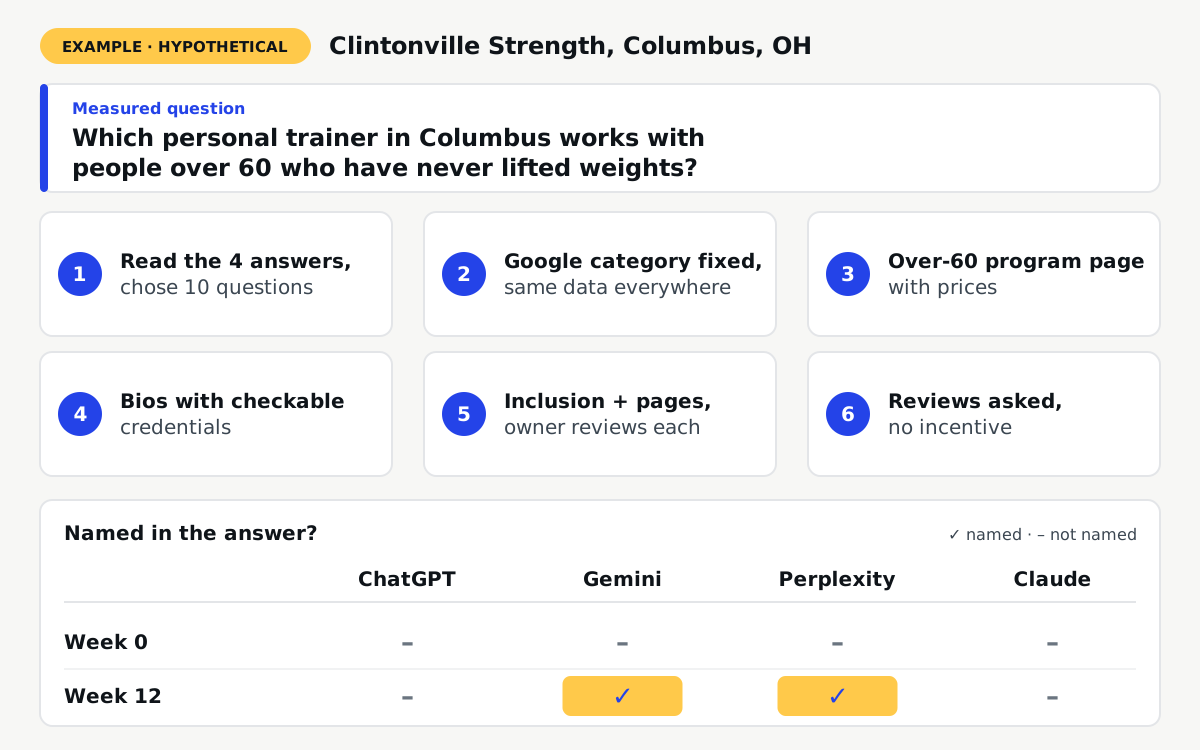
Example: a hypothetical studio, not a sayurname client. Imagine Clintonville Strength in Columbus, Ohio: two trainers, the owner with 14 years of coaching and an NSCA-CSCS; 52 active clients, half over 60; 118 Google reviews averaging 4.9; $90 for a 55-minute session, $55 each for a pair. The site was a before-and-after gallery, and Google listed the studio as a gym.
The measured question was “Which personal trainer in Columbus works with people over 60 who have never lifted weights?”. At week 0 the studio was named by 0 of 4: ChatGPT named gym chains and a physical therapy clinic, Gemini the most-reviewed gyms, Perplexity a Reddit thread, Claude no one.
- Read the four answers and their sources with the owner, and chose ten questions, including training after a joint replacement and one weight-loss question as a control.
- Fixed the base: Google category changed from Gym to Personal trainer, services added, and identical name, address, phone and hours on the site, Yelp and Thumbtack.
- Wrote the over-60 page: who it is for, the first assessment, how loads progress, sessions for one or two, prices, and what goes to a physician first.
- Replaced the gallery and the “lose 20 pounds” banner with bios stating certification, issuing body, year and a credential number anyone can check.
- Asked Thumbtack and a local “best trainers” roundup to include the studio, and published one page per question new clients ask in their first session, each reviewed by the owner.
- Asked for Google reviews with no incentive or suggested wording; several mentioned starting at 68 or 71.
Perplexity moved first, naming the studio in week 6 and citing the new page. Gemini followed in week 9, after the category change and reviews from first-time lifters. At week 12 ChatGPT still named the chains; one Claude run in four named the studio, which does not count. The joint-replacement question moved in week 10 on Perplexity only, quoting the referral line, which is correct for a studio without rehabilitation.
What did not work: a “Columbus’s most trusted trainer” headline moved nothing; a paid Thumbtack placement brought inquiries there but changed no AI answer; the weight-loss question never moved, since the studio would not make the promises that crowd it. Results vary by city, question and competition.
What to publish
A citable trainer page answers one client’s question with checkable facts. Titles that work: “Strength training after 60 for people who have never lifted: the first month in Columbus”; “After a knee replacement: what we do and what stays with your physical therapist”; “Semi-private sessions and what they cost”; “Who we are not the right fit for”.
From the first: “Most clients over 60 start with a 45-minute assessment: balance on each leg, getting up from the floor and a talk about medications and past injuries. The first four weeks use machines and dumbbells under 15 pounds, twice a week; after recent surgery, we ask for your physician’s clearance first.” Citable means a named trainer with a checkable credential, a client type, the line between what you do and what you refer, prices, and no promise about weight, looks or health.
When it is not worth it
If the waiting list already runs for months, more demand only lengthens it; raise prices or hire first. A trainer working only inside one gym, booked through its front desk, will be named as the gym. Online-only coaching sold nationwide competes with apps and influencers on questions that rarely name individuals.
Nor does it pay if the business rests on a claim you cannot put in writing: if the only offer is rapid weight loss, an honest page has little an assistant would repeat. And if nobody will commit to specifics, start smaller: fix the Google category, write one page for the client you most want, and come back later.
How the work runs, without promising results
It starts with the free test: one client’s question sent to the four AIs, full answers saved as the starting point. Subscribed, we measure up to 10 questions weekly in the four assistants, fix the site’s base so the AI can read the service pages, find out where the AI gets the answer to each question and ask for your inclusion wherever there is a path: Yelp, Thumbtack, local “best trainers” roundups. Some of those are editorial or paid, so we promise the request, not the listing; you see what was asked and what got in. We also publish content that answers the measured questions.
It costs $299/month, with no lock-in. A one-time $599 bonus is charged only when an AI starts naming the studio for a measured question, checked by a person on our team, or Google Analytics shows a visit from an AI. Nobody controls AI answers, so there is no guarantee. The content promises no weight loss or health result and uses client stories only with consent. Personal training is largely unregulated in the United States; where a license is required, as in Brazil or France, the content follows those rules.
Questions
Do reviews matter more than my website?
Reviews tell the AI you are real and well regarded; the service page tells it whom you train. In the example, 118 reviews were not enough until a page described the over-60 program.
Can I pay Thumbtack to be listed first?
A featured listing can bring inquiries from that platform, not a place in an AI answer, which draws on several independent sources. In the example it changed nothing.
My clients find me on Instagram. Why is that not enough?
Assistants read pages, and Instagram posts mostly sit behind a login. Keep posting, but put specialty, place, credentials and prices on pages a search can return.
How long until anything changes?
In the example, the first assistant named the studio in week 6 and a second in week 9; ChatGPT had not by week 12. Some questions never move.
Can you write content that promises results?
No. We do not promise weight loss, body changes or health outcomes, and assistants trust such pages least. We describe whom you train, how and at what price.