
The question a caller actually asks
Owners usually meet this as a frightened call that wants the pests gone tonight. They ask an assistant about their own company and it praises the guarantee, because the question already contained the name. A stranger then asks the way a health inspector’s fear asks: which pest, which room, and when people can return. The company is gone. The only reading that matters is that stranger’s question, asked the same way every week.
Almost nobody types “best pest control near me” and stops. They name the insect. German cockroaches in a kitchen are not bed bugs in a bedroom and not termites in a sill. Then they add the constraint that decides the job: a commercial kitchen, a re-entry time, a method that is not a fog through the dining room. “Safe for kids and pets” is not the criterion. The assistant cannot verify safe. It can verify a pest, a license, a method and a time before people return.
Where the answer about pest control comes from
With web search on, each assistant runs a few searches and summarizes what the pages agree on. For this trade the sources are the state applicator lookup, the product label, health-department pages about commercial kitchens, reviews that name the pest, and the company’s site. A national brand ranks for a broad question because many pages repeat its name and a phone number. A local company ranks for the cockroach question only if a page names the pest, the method, the license and the re-entry time.
The mechanism is the label, not a mood. A gel bait and a broadcast fog are different jobs, different re-entry, different risk in a kitchen. An assistant that cannot tell them apart names the brand whose page states one method clearly, or describes the difference and names nobody. The four assistants disagree because each searches a different index, and the same one changes between runs, so one screenshot proves little. Fame is not the criterion: the company with 2,000 reviews wins “pest control in [city]”, and the kitchen question goes to whoever states the pest, the bait, the license and the hours before staff return.
The most common mistake: “guaranteed, safe for kids and pets”
Almost every local site says guaranteed elimination, safe for children and pets, eco-friendly, then a phone number. It happens because the owner does not want to scare a caller, and because “safe” tested well in an ad. To an assistant, the slogan is identical on fifty sites, and it conflicts with any label that has a re-entry time. A careful answer drops it.
The cost is concrete. The restaurant owner takes the national brand whose page says gel bait, a license number and four hours before the line opens. The local company may be the one that already knows the kitchen, and it never enters the answer. The remedy is not a greener adjective. It is a page for one pest: what is inspected, the method (bait, not a fog of the dining room), the license the state lookup can match, the re-entry time, and what this visit does not treat. The trade-off is that you will lose callers who wanted a promise of zero insects forever. That promise was going to fail at the follow-up anyway.
A worked example, step by step
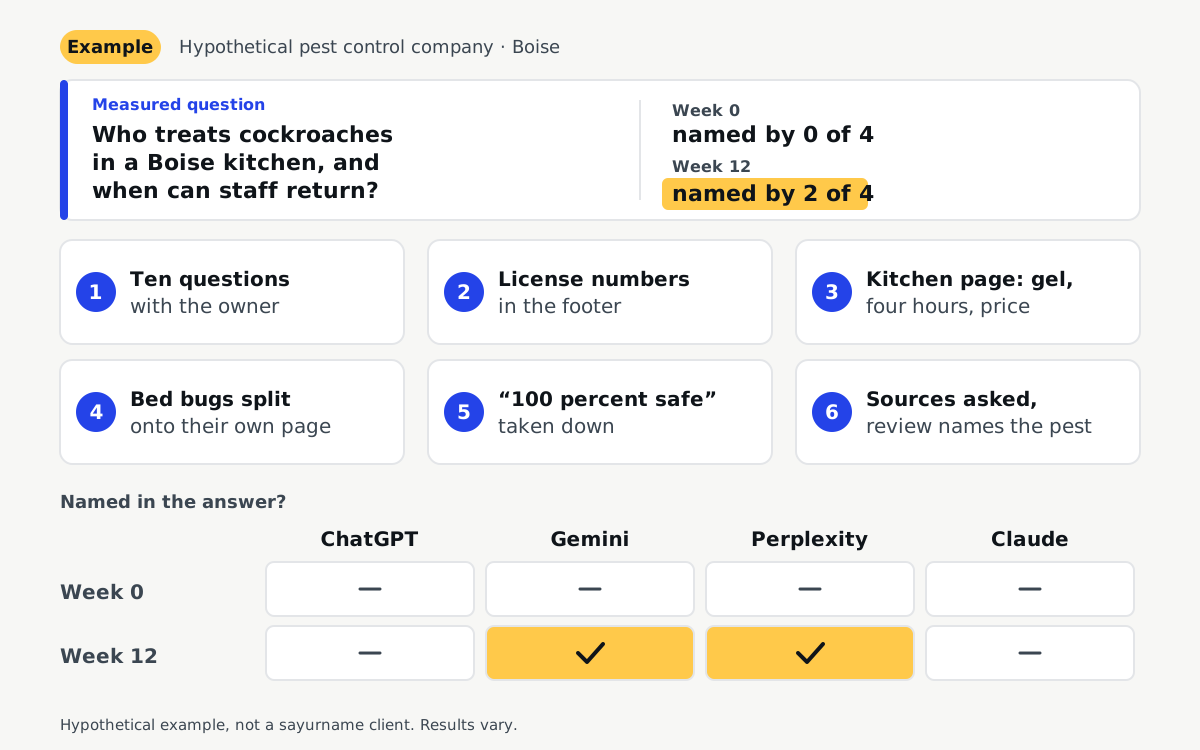
Example: a hypothetical company, not a sayurname client. Imagine Bench Pest Co. in Boise, Idaho: the owner and three licensed applicators, nine years, 130 Google reviews averaging 4.8. A German-cockroach job in a restaurant kitchen is an inspection, gel bait in cracks, no fog of the dining room, and staff stay out of the treated line for four hours. A first visit is $280 to $420. Bed bugs are a different visit and a different price, and they say so. The site said “guaranteed, safe for kids and pets” and listed every pest in one paragraph. The license numbers were on the truck and not online.
The measured question was “Who treats German cockroaches in a restaurant kitchen in Boise, and how long before staff can go back in?”. At week 0 the company was named by 0 of 4. ChatGPT named two national brands. Gemini listed the most-reviewed companies on Maps. Perplexity cited a health-department page and a forum thread. Claude explained why a fog in a kitchen is a poor idea and named nobody.
- Read the four answers with the owner and chose ten questions callers had asked that year: German cockroaches in a kitchen, bed bugs, a re-entry time, a home with a dog, ants, and what a guarantee does not mean.
- Fixed the base: the same legal name, address and phone on the site and on Google, and each applicator’s license number in the footer, matching the state lookup.
- Replaced the one paragraph with a kitchen page: inspection, gel bait, no fog of the dining room, four hours before staff return, $280 to $420 for a first visit.
- Wrote a separate bed-bug page that says this is not the kitchen visit, with its own price band, so the two jobs stop sharing one slogan.
- Removed “100 percent safe” and “guaranteed gone forever”. No label and no source can confirm either.
- Asked review sites to list the commercial service, published a page for each measured question, each read by a licensed applicator, and asked commercial customers for a review that named the pest, with no discount and no suggested wording.
The re-entry question moved first. In week 5 Perplexity named the company and quoted the four hours and the gel bait. In week 10 Gemini followed for the kitchen question, after two reviews mentioned cockroaches and not a general spray. At week 12 ChatGPT still led with the national brands, and Claude named the company in one run of four, which does not count.
What did not work: a “green” badge on the homepage moved nothing. The termite question never moved, because the company does not offer that work and two firms publish it in detail. Results depend on the city, the question and the competition. Another company doing the same work might see none of this in twelve weeks.
What to publish
A citable pest page answers one pest in one kind of room. Titles that work: “German cockroaches in a Boise restaurant kitchen: bait, license and four hours”; “What this visit is not: bed bugs, termites, a fog of the dining room”; “What “guaranteed” does not mean on a follow-up”; “The license number, and where to look it up”.
An excerpt from the first: “We inspect the kitchen and place gel bait in cracks. We do not fog the dining room. Staff stay off the treated line for four hours. A first visit is $280 to $420. The applicator’s license number is in the footer, and it matches the state lookup. This visit is not a bed-bug job.” What makes it citable: the pest, the method, the time, the price, the license, and the refusal. Leave out a recipe for mixing a concentrate at home.
When it is not worth it
If the licensed applicators are booked for three weeks, more kitchen calls only create a wait a restaurant cannot use. Hire or narrow the pests first. A company whose supplier contract forbids naming the method cannot publish the fact an assistant needs. The same goes for a franchise whose head office writes “safe for pets” on every page and will not take it down.
Nor does it pay when the license has lapsed or the number on the site is not the person who does the work. An assistant that checks the lookup will find the mismatch. Start there, and come back when the pest, the method and the license agree.
How the work runs, inside the license you hold
It starts with the free test: one caller’s question sent to the four AIs, with the full answers saved as the starting point. Once subscribed, we measure up to 10 questions every week in ChatGPT, Gemini, Perplexity and Claude, fix the site’s base so the assistants can read the pest pages, find out where the AI gets the answer to each question and ask for the company’s inclusion wherever there is a path: the state applicator lookup, review sites. Some of those sources are official or curated, so we promise the request, not the listing; you see what was asked and what got in. We also publish content that answers the measured questions. Publishing happens on a subdomain connected by DNS, or we deliver the pieces and you publish them. Onboarding is online, with no call.
It costs $299/month, with no lock-in. A one-time $599 bonus is charged only when an AI starts naming your company for a measured question, checked by a person on our team, or Google Analytics shows a visit coming from an AI. Nobody controls AI answers, so there is no guarantee of being recommended. The content states only pests and methods your license covers, and a licensed applicator approves every piece. It promises no elimination and does not describe how to mix a product.
Questions
Can we say the treatment is safe for pets?
Only in the words the label allows, with the re-entry time. “100 percent safe” is the sentence a careful answer will not quote. In the example, the four hours did the work the slogan could not.
Is one page for every pest better?
No. One paragraph that lists every pest reads as one method. In the example, splitting the kitchen job from bed bugs is what let an assistant name the company for cockroaches.
Should a national brand be the better answer sometimes?
Yes, when the question is broad and that brand states a method plainly. The local company wins the pest, the room and the re-entry time it actually does.
How long until anything changes?
In the example, the re-entry line was quoted in week 5 and a second assistant named the company for the kitchen in week 10. Two had not by week 12.
What does a guarantee mean on the page?
Say the follow-up you actually do, and stop. “Gone forever” is not a label claim. In the example, removing it did not hurt the kitchen question.