The question your clients actually ask
Photographers usually meet the problem by testing it themselves. One saw her studio in ChatGPT’s list, asked it to answer as if for a stranger, and the name vanished: it had named her only because she had asked about her business earlier. Another got three different shortlists in three private windows. The useful reading is the same question, asked the same way, in all four assistants, every week.
Clients rarely type “photographer in [city]”. They type an occasion, a place and a constraint, and the constraint decides who is named. Style: “documentary wedding photographer in [city], not much posing”, matched on the words a site uses for its approach. Venue: “photographer who has shot at [venue]”. Budget: “wedding photographer in [city] under $4,000 with a second shooter”, which only a page with prices can answer. Culture or format: “photographer for a multi-day Indian wedding”. Each shape pulls on different sources.
Where the AI’s answer about photographers comes from
With web search on, each assistant summarizes what a few searches return. For photographers the sources are predictable: The Knot and WeddingWire listings and review text, the Google Business Profile, r/weddingplanning and city subreddits where couples name who they hired, venues’ preferred-vendor lists, wedding blogs that credit every vendor, directories such as Fearless Photographers, and the studio’s own pages. Instagram is largely closed to these searches, so 30,000 followers rarely reach the answer.
What sets this sector apart: answering with web search, the assistant reads text, not your photographs. It reads the title, headings, captions, alt text and paragraphs around the images. A gallery called “Sarah + Dev” with forty images and no words says nothing about an Indian wedding, a venue or a style. The four disagree because each searches a different index and varies between runs. Fame is not the criterion: the most-reviewed studio wins the broad question, but narrow ones go to whoever states the specifics in plain text that an independent source confirms.
The most common mistake: letting the work speak for itself
Photographers are trained to show rather than tell, and many sites follow suit: a full-screen slideshow, a gallery menu, a short about page and a contact form that hides prices. To an assistant reading text it is an almost empty page with a phone number, so it falls back on sources with words: directories where placement is partly bought and review counts favor volume over fit. The cost never shows in analytics: those couples simply never arrive.
The fix is not keywords stuffed into alt text, which search engines ignore or penalize. It is 150 to 300 words for each gallery that represents work you want more of: venue and month, events covered, guests and hours, the light and how you handled it, what the couple received and when. Add a prices page with real ranges, and get the couple’s written consent before naming them or the venue.
A worked example, step by step
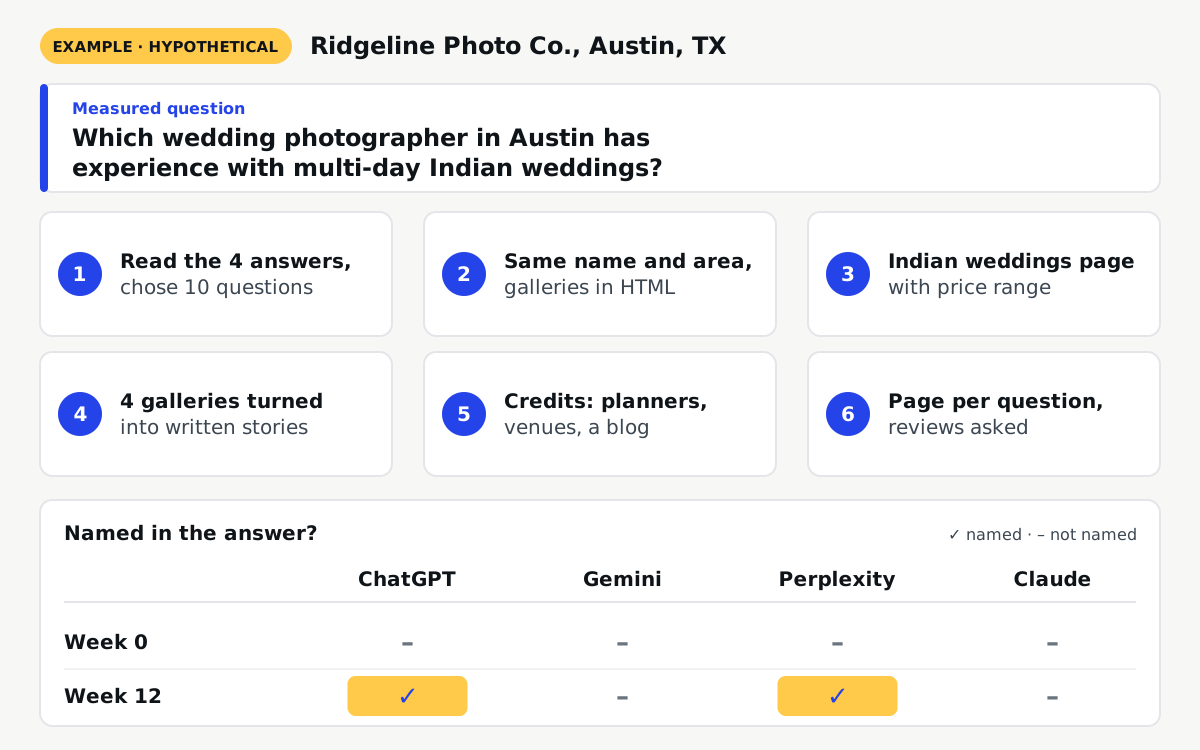
Example: a hypothetical studio, not a sayurname client. Imagine Ridgeline Photo Co. in Austin, Texas: two photographers, nine years open, about 30 weddings a year, eight of them multi-day Indian weddings. Packages run $3,800 to $6,500, or $7,500 to $11,000 multi-day; 95 Google reviews average 4.9. The site held 14 galleries titled with couples’ names, images named IMG_4471, a one-paragraph about page and “contact us for pricing”.
The measured question was “Which wedding photographer in Austin has experience with multi-day Indian weddings?”. At week 0 the studio was named by 0 of 4: ChatGPT named two Houston studios, Gemini top-rated The Knot listings, Perplexity a Reddit thread, Claude nobody.
- Read the four answers and their sources with both photographers, and chose ten questions, from Indian weddings to elopements and price.
- Fixed the base: the same name, area and phone on the site, Google and The Knot, and galleries rebuilt so their text loads as plain HTML.
- Wrote a page on multi-day Indian weddings: events covered, 26 such weddings since 2019, team, hours, delivery time and price range.
- Turned four galleries into written stories, with the couples’ consent: venue, month, events, guests, and every vendor credited.
- Asked partner planners and venues to update their vendor credits, and submitted one wedding to a blog that publishes real weddings with full credits.
- Published one page per measured question, such as venue guides, and asked past couples for reviews saying what was photographed, with no incentive.
In week 6 Perplexity named the studio, citing the new page and the blog feature; in week 9 ChatGPT listed it beside a Houston studio, after three new reviews described sangeet coverage. At week 12 Gemini still led with The Knot’s top-rated listings, and Claude named the studio in one run of four, which does not count.
What did not work: 300 alt texts rewritten as “best Austin wedding photographer” changed nothing; doubling Instagram posts moved no answer. The elopement question never moved: a dozen specialists document that work in more detail, and they are the better answer. Results vary by city, question and competition; another studio might see none of this.
What to publish
A citable photography page answers one client’s question with facts a planner could check. Titles that work: “Photographing multi-day Indian weddings in Austin: events, team and price”; “Hill Country venues in summer: light and the rain plan”; “What our wedding packages cost, and what changes the price”.
An excerpt from the first: “Since 2019 we have photographed 26 multi-day Indian weddings around Austin, most of them three days from mehndi to reception. Both photographers cover the baraat and ceremony. Coverage runs from $7,500 for two days to $11,000 for three, with the gallery delivered in eight weeks.” Citable means named photographers, kinds of events and how many, venues, hours, a price range and delivery times.
When it is not worth it
If your calendar is booked 18 months ahead and you already turn couples away, more inquiries only lengthen the list; raise prices first. At the luxury end the planner’s referral decides; in agency-led commercial work or school photography, the contract does.
Nor does it pay when the studio will not put words or numbers on its site: no prices, no account of how it works, no consent to write about real weddings. The site then stays a slideshow, and publishing elsewhere cannot compensate. Start smaller: correct the Google profile, ask past couples for permission to write about their day, and return with something concrete.
How the work runs
It starts with the free test: one client’s question sent to the four AIs, full answers saved as the starting point. Subscribed, we measure up to 10 questions every week in the four assistants, fix the base of the site so the AI can read the pages about your work, find out where the AI gets the answer to each question and ask for your inclusion wherever there is a path: The Knot, WeddingWire, venues’ preferred-vendor lists, wedding blogs. Some of those are editorial or paid, so we promise the request, not the listing; you see what was asked and what got in. We also publish content that answers the measured questions.
It costs $299/month, with no lock-in. A one-time $599 bonus is charged only when an AI starts naming the studio for a measured question, checked by a person on our team, or Google Analytics shows a visit coming from an AI. Nobody controls AI answers: there is no guarantee of being recommended. Photography is not a regulated profession, but the people in your photos have rights: we publish names, faces and venues only with the client’s consent, and you approve every piece.
Questions
Can’t the AI just look at my portfolio?
With web search it reads the text of pages, not the photographs. In the example the studio’s best work was already online; what changed was the text around it.
Do The Knot and WeddingWire reviews matter more than my site?
They tell the AI you are real and well regarded. But they rarely say what kind of weddings you photograph, so specific questions depend on your own pages and on credits from planners and venues.
Can I pay to be listed first?
A featured directory placement can bring inquiries from that directory, but it does not buy a place in an AI answer, which is written from what several independent sources say.
Should I post more on Instagram?
Post for your followers, not for the AI. Most Instagram content is closed to the searches assistants run; in the example, doubling the posting rate moved nothing, while one written page did.
How long until anything changes?
In the example, the first assistant named the studio in week 6 and two had not by week 12. Some questions never move, because another photographer documents that work better and is the right answer.