

What patients type, and why the wording decides the answer
Owners meet the problem in one of two ways. One opens three private windows, asks the same question and gets three different lists, only one with the clinic in it. Another asks the AI itself to optimize the website and feels no result. One answer is a sample; what counts is the same question, asked the same way, over weeks.
Patients rarely ask for “a physical therapist in Denver”. They name an injury and a stage (“rehab after ACL reconstruction”), a way of being treated (“one-on-one, not a therapist juggling three patients”), a niche (“pelvic floor PT after pregnancy”) or access (“PT that takes Cigna”). Insurer directories answer the last; only a clinic that says how long a visit lasts and who is in the room can answer the one-on-one question. So a clinic can be named for one shape and absent from the next.
Where the assistants get the names of physical therapists
With web search on, the assistants do not consult a ranking; they run a few searches and summarize what the sources agree on. In physical therapy: the Google Business Profile and its reviews, Yelp and Zocdoc, insurer directories, the APTA’s Find a PT directory, the state board’s license lookup, Reddit threads, surgeons’ pages saying where patients do rehab, and the clinic’s own pages.
Two traits of this sector matter. The strongest outside signal is often a referral, not a review: a surgeon’s page naming a clinic for ACL rehab is the agreement an assistant looks for. And the facts a narrow question needs (visit length, who treats, which tests clear an athlete) exist only on the clinic’s site. The four disagree because each searches a different index and varies between runs. Fame is not the criterion: a hospital system wins the broad question; the narrow one goes to whoever answers it plainly.
The most common mistake: the conditions grid
Many clinic websites come from a vendor template: a grid of 30 or 40 conditions, each linking to a 150-word definition that often appears word for word on hundreds of other clinics’ sites. To an assistant this says the clinic has heard of the condition, not what it does differently, and gives no reason to cite it over the clinic across town.
The cost never shows in a report: the clinic is missing for exactly the conditions it treats best. Rewriting the pages as “Denver’s leading sports rehab experts” adds noise and collides with advertising rules; “specialist” also implies board certification by the American Board of Physical Therapy Specialties. Cut the grid to four or five things and write each as a page a stranger could check: who leads it, visit format, phases, discharge criteria, price or insurance, and when to see the physician.
A worked example, step by step
Example: a hypothetical clinic, not a sayurname client. Imagine Berkeley Park Physical Therapy in Denver: three physical therapists, nine years open, 164 Google reviews averaging 4.9, every visit 60 minutes and one-on-one. The owner, board-certified in sports physical therapy, sees about 45 ACL patients a year. A cash visit costs $165, a return-to-sport test $220. The site was a template; ACL rehab was a 140-word stub.
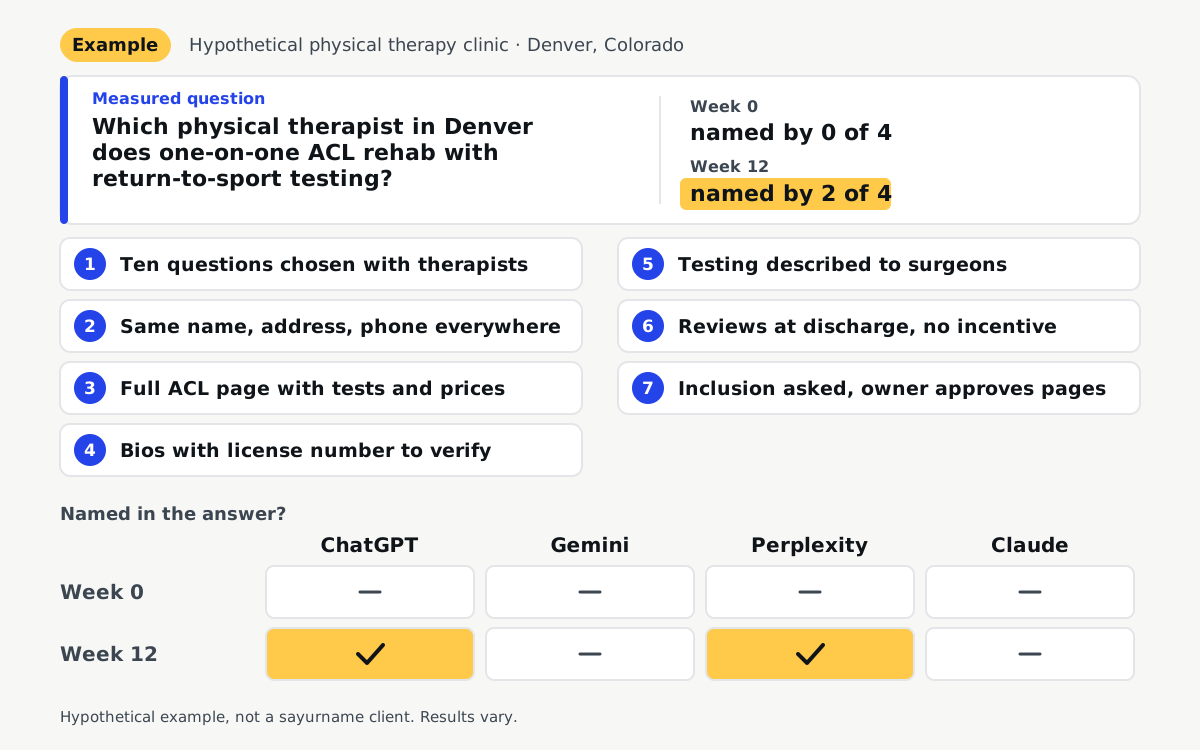
The measured question was “Which physical therapist in Denver does one-on-one ACL rehab with return-to-sport testing?”. At week 0 it was named by 0 of 4: ChatGPT named two chains and a hospital program, Gemini the most-reviewed clinics, Perplexity a Reddit thread, and Claude gave general advice.
- Chose ten questions with the therapists, among them ACL rehab, running injuries and the cash price, each tied to patients the clinic wanted more of.
- Fixed the base: the same name, address and phone on the site, Google, Yelp, Zocdoc and the APTA directory; dropped a “massage therapist” category on Google.
- Replaced the ACL stub with a full page: who leads the program, the one-on-one format, the phases, the hop and strength tests with their symmetry threshold, prices, and when the patient returns to the surgeon.
- Rewrote the bios with school, year licensed and Colorado license number, checkable on the state lookup, and the board certification as the certifying body lists it.
- Sent the two orthopedic practices that already referred patients a factual description of the testing, so their rehab pages could describe it accurately.
- Asked ACL patients for a review at discharge, with no incentive or suggested wording, and answered without confirming anyone was a patient.
- Asked the APTA’s Find a PT and the referring surgeons’ pages to list the clinic, and published pages approved by the owner: one per rehab phase, what each test measures, what a cash visit includes.
The cash price question moved first, in week 3. In week 5 Perplexity named the clinic for the ACL question, citing the new page and a surgeon’s page; in week 10 ChatGPT did, in three runs of four. Gemini kept the hospital program through week 12; Claude still gave general advice.
What did not work: “10 exercises after ACL surgery” was never cited; it competed with large health publishers and said nothing about the clinic. The running question never moved against two runner-only clinics. Step 5 has a limit: describing a protocol is fine, offering anything of value for a referral can breach anti-kickback rules. Results vary; another clinic could see none of this in twelve weeks.
What to publish
A citable page answers one patient situation with facts others can check. Titles that work: “ACL rehab in Denver: one-on-one visits, return-to-sport testing and cost”; “Do you need a referral for physical therapy in Colorado?”; “Back to running after a stress fracture”.
An excerpt from the first: “Every ACL patient sees the same physical therapist for 60 minutes, one-on-one. Before we clear you for pivoting sports you complete hop tests and a quadriceps strength test, and we look for at least 90% symmetry with the other leg. Most patients get there nine to twelve months after surgery.” It gives a format the patient can verify, a measurable criterion and a realistic timeline. “Most patients get there” is information; “we get you back on the field” is a claim.
When it is not worth it
If new patients already wait three weeks for a first visit, more demand adds nothing; hire first. Clinics that live on hospital and surgeon referrals gain more from those relationships. The only clinic in a small town is already the answer; a complete Google profile is enough.
It also does not pay when the clinic cannot edit its own website, common on franchise sites, or when nobody will commit to specifics: no named therapists, no visit format, no discharge criteria. Then correct the Google profile and insurer directories, and come back when there is something concrete to say.
How the work runs, within your state board’s rules
It starts with the free test: one patient question sent to the four AIs, full answers saved as the starting point. Subscribed, we measure up to 10 questions weekly in the four, fix the base of the site, find out where the AI gets the answer to each question and ask for the clinic’s inclusion wherever there is a path: Zocdoc, insurer directories, the APTA’s Find a PT, surgeons’ pages saying where patients do rehab. Some of those are paid or up to someone else, so we promise the request, not the listing; you see what was asked and what got in. We also publish content that answers the measured questions.
It costs $299/month, with no lock-in. A one-time $599 bonus is charged only when an AI starts naming the clinic for a measured question, checked by a person, or Google Analytics shows a visit from an AI. There is no guarantee. The content is informative and follows your state physical therapy board’s advertising rules: no promised outcomes, no testimonials where restricted, no misleading “specialist”, no solicitation, no patient information, and a licensed therapist approves every piece.
Questions
Do reviews matter more than my website?
Reviews show the clinic is well regarded; service pages say what it does. In the example, 164 reviews were not enough until a page stated the one-on-one format and the testing.
Can I just pay for a premium directory listing?
A paid listing can bring bookings from that directory. It does not buy a place in an AI’s answer, which is written from what several independent sources say.
Is this allowed by my state physical therapy board?
Informative content about services, credentials and process is generally what advertising rules allow; they restrict misleading claims, improper titles and solicitation. A licensed therapist approves each piece, and your board’s restrictions apply to everything we publish.
How long until anything changes?
In the example the first assistant named the clinic in week 5, and two had not by week 12. Narrow questions such as cash price usually move sooner; some never move.
What if the AI says something wrong about my clinic?
It happens: a therapist who left, an insurer you dropped. The assistant repeats what it read, so correct the source and state the right fact on your site.