
The question your customers actually ask
Owners usually discover the problem sideways. One asks ChatGPT about plumbers in town, sees the company named, then asks it to answer as it would for a stranger and the name disappears: the first answer had leaned on his earlier questions, not on anything the assistant found. Another opens three private windows, asks the same thing and gets three lists with different names. A single answer is an anecdote; the useful measure is the same question, asked the same way, every week.
Plumbing questions carry a job, a place and a constraint, and the constraint does most of the selecting. Urgency (“plumber in [city] who can come tonight for a burst pipe”) is answered from stated hours and service areas. Risk (“licensed plumber in [city] to move a gas line for a new range”) sends the assistant toward license lookups and permit language. Diagnosis (“who does slab leak detection in [neighborhood] without tearing up the floor”) rewards pages that name the method and the equipment. Price (“what does a 50-gallon water heater replacement cost in [city], installed”) goes to whoever publishes a range. A company can be named for one shape and absent from the other three.
Where the AI’s answer about plumbers comes from
With web search on, the assistants do not consult a ranking of plumbers; they run a few searches and summarize what the pages they find agree on. For plumbing the sources are predictable: the Google Business Profile and Maps listing, especially its hours, categories and service area; Yelp, Angi, Thumbtack, Nextdoor and the BBB; city subreddits where someone asked the same thing after a freeze; the state plumbing board’s license lookup; water heater makers’ installer locators; local news when a cold snap bursts pipes across town; and the company’s own service pages.
Urgent questions behave differently from planned ones. For “tonight”, the assistant needs evidence that someone answers after hours in that area, and it looks for agreement between the hours on the profile, the hours on the site and what reviews describe; when the sources disagree, the safe answer is a national franchise whose 24-hour service is stated everywhere. That is why fame is not the criterion: the company with 900 reviews wins “plumber in Denver”, while the constrained question goes to whoever states the fact plainly and consistently, with independent sources agreeing. The four assistants disagree because each searches a different index and weighs sources differently, and each varies between runs, so one sighting proves nothing.
The most common mistake: a “24/7” the sources contradict
Almost every plumbing site carries a red banner promising 24/7 emergency service. Behind it, the Google profile says 7 a.m. to 6 p.m., Yelp shows the company closed on Sundays, the after-hours line is a call-tracking number that appears nowhere else, and no page says what happens at 2 a.m.: who comes, to which ZIP codes, for what fee, and what waits until morning. Each piece was set up by a different person at a different time, which is why it happens. To an assistant checking whether a company can come tonight, these are four sources that disagree, and it resolves the conflict by naming someone else.
The cost is the most valuable call of the week: after-hours jobs carry a dispatch fee, are rarely price-shopped and often lead to the water heater or repipe that follows. The fix is not a louder banner. Decide what after-hours really means for the company, write it down once with its limits, make every listing say the same thing with one phone number, and drop the promise entirely if nobody answers at night. A company that honestly says “on call until midnight, emergencies only” is easier to cite than one claiming 24/7 that its own profile denies.
A worked example, step by step
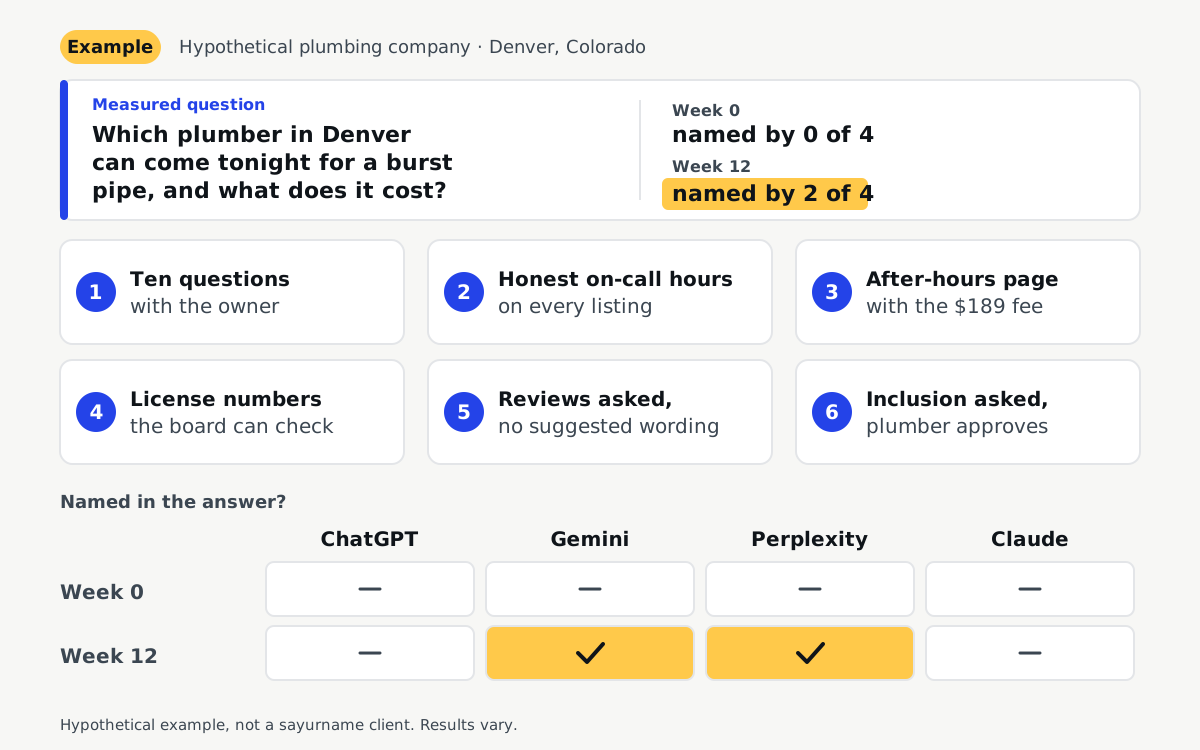
Example: a hypothetical company, not a sayurname client. Imagine Sloan Lake Plumbing in Denver, Colorado: 11 years in business, nine people including six licensed plumbers, a master plumber as owner, three trucks with a nightly on-call rotation, 186 Google reviews averaging 4.7. A daytime service call is $89, an after-hours dispatch $189, and a 50-gallon gas water heater replacement $1,900 to $2,600 installed with the city permit. The site had a “24/7 Emergency” banner and a single services page.
The measured question was “Which plumber in Denver can come tonight for a burst pipe, and what does an after-hours visit cost?”. At week 0 it was named by 0 of 4 assistants: ChatGPT named two national franchises and a drain-cleaning chain, Gemini the most-reviewed companies on Maps, Perplexity a Yelp list and an r/Denver thread from a January cold snap, and Claude gave sound advice about the main shutoff valve and named nobody.
- Chose ten questions with the owner: burst pipe at night, a gas line for a new range, slab leak detection, same-day water heater replacement, sewer camera inspection, backflow testing and four more.
- Defined after-hours honestly, as one on-call plumber from 6 p.m. to 7 a.m., a callback within 20 minutes and 14 ZIP codes, then set those hours and one phone number on the site, Google profile, Yelp, Angi, Nextdoor and the BBB, retiring three call-tracking numbers.
- Replaced the banner with an after-hours page: what the night plumber handles and what waits for morning, the $189 dispatch fee and what it covers, the ZIP codes served, and how to close the main shutoff before the truck arrives.
- Put the master plumber’s license number in the footer and each plumber’s license level on the team page, so the state board’s lookup confirms them, and stated that gas line work is done under that license with a city permit and a pressure test.
- Asked every after-hours customer for a review the next day, with no incentive and no suggested wording; in ten weeks 31 new reviews arrived, 12 of them describing a night or weekend visit.
- Asked two water heater makers to add the company to their installer locators, and published one page per measured question, each checked by the master plumber: slab leaks, freeze preparation, water heater sizing, what to do when a water heater leaks at night.
The water heater price question moved first, in week 4. In week 6 Perplexity named the company for the burst-pipe question, citing the after-hours page and its fee; in week 9 Gemini followed, once the Google hours and the site had agreed for several weeks and the new reviews mentioned night visits. At week 12 ChatGPT still named the franchises, and Claude named the company in one run of four, which does not count.
What did not work: a “fastest emergency plumber in Denver” headline moved nothing and was removed; a paid lead-gen listing produced calls but no change in answers; the sewer camera question never moved, probably because two drain specialists publish far more on it. Results vary by city, question and competition; another company could see none of this in twelve weeks, and a mild winter with few burst pipes changes demand more than any page does.
What to publish
A citable plumbing page answers one customer question with facts a stranger could check. Titles that work: “Burst pipe at night in Denver: what our on-call plumber does and what it costs”; “Moving a gas line for a new range: license, permit and pressure test”; “Slab leak detection without breaking the floor: how we find it and when we can’t”; “Replacing a 50-gallon water heater: same-day cases and price range”.
An excerpt from the first: “From 6 p.m. to 7 a.m. one licensed plumber is on call for 14 ZIP codes in central and north Denver and calls back within 20 minutes. The after-hours dispatch is $189 and includes the first half hour; we stop the water, make the repair safe and, if a fixture or the water heater must be replaced, quote it for the morning. Until we arrive, close the main valve in the meter box at the curb.” What makes it citable: who comes and under which license, where exactly, within what time, what is fixed now and what is not, a fee or range, one job per page. Avoid “best” and “cheapest”, which no source can confirm, and never list work, such as gas lines or backflow testing, for which the company does not hold the license or certification.
When it is not worth it
If the schedule is already full two weeks out and nobody wants to take night calls, more urgent demand only produces missed calls and bad reviews; hire or set up the on-call rotation first, and aim the work at planned jobs such as water heaters and repipes. New-construction plumbers are chosen by builders and general contractors, and commercial service contracts by facility managers through bids, not by someone asking an AI. In a county with two plumbers, a complete Google profile already does most of the work.
It also does not pay when the business lives on lead-gen platforms and franchise rules forbid changing the site, or when the owner will not publish anything specific: no hours, no fees, no license numbers, no limits. Then start smaller: fix the Google hours and the phone numbers in the directories, and come back when there is something concrete to say.
How the work runs
It starts with the free test: one customer question sent to the four AIs, with the full answers saved as the starting point. Subscribed, we measure up to 10 questions every week in the four assistants, fix the base of the site so the AI can read the service pages, find out where the AI gets the answer to each question, and ask for the company’s inclusion wherever there is a path: water heater makers’ installer locators, Angi, Thumbtack, the local news desk that covers freezes. Some of those are editorial or paid, so we promise the request, not the listing; you see what was asked and what got in. We also publish content that answers the measured questions. Publishing goes on a subdomain set up through DNS, or we deliver the pieces and you publish them; onboarding is online, with no call.
It costs $299/month, with no lock-in. A one-time $599 bonus is charged only when an AI starts naming the company for a measured question, checked by a person on our team, or Google Analytics shows a visit coming from an AI. Nobody controls AI answers, so there is no guarantee of being recommended. Everything we publish states only the licenses and certifications you hold, and a licensed plumber on your side approves technical content, especially anything about gas.
Questions
Do reviews matter more than my website?
Reviews tell the AI the company is real and that customers were satisfied; the service pages tell it what you do, where and when. In the example, 186 reviews were not enough until a page stated what after-hours meant, and reviews describing night visits then confirmed it.
Can I just pay Angi or a lead-gen site to be named?
A paid listing can bring calls from that platform. It does not buy a place in an AI’s answer, which is written from what several independent sources say, and in the example it changed nothing.
Should I say 24/7 if I use an answering service?
Only if a plumber can actually be dispatched at night. Say what happens: who answers, how fast someone calls back, which areas and what fee. A precise, limited promise is cited more often than a broad one that your own listings contradict.
How long until anything changes?
In the example, a price question moved in week 4, the first assistant named the company for the urgent question in week 6, and two had not by week 12. Some questions take months, and some never move.
What if the AI says something wrong about my company?
It happens: an old address, a former partner’s license number, hours from three years ago. The AI repeats what it read, so correct the source, usually a directory or an old page, and state the right fact on your own site.