
The question parents actually ask
School heads meet the problem sideways. One asked ChatGPT about her school and got a warm description; asked as a stranger, it was gone, because the first answer had echoed the earlier conversation. An admissions director kept hearing on tours that families had “asked the AI”, while analytics showed only direct traffic. What counts is the answer a stranger gets, asked the same way every week.
Parents rarely type “private school in [city]”. They type a child, a place and a constraint, and the constraint decides who is named. Learning needs: “private school in [city] with small classes for a child with dyslexia”, where most sites say only “we support every learner”. Logistics: “private school near [neighborhood] with after-care and a bus”, answered from published hours and routes. Budget: “private schools in [city] under $20,000 a year”, where a school without published tuition is skipped or quoted from a stale estimate. Each shape draws on different sources, so a school named for one can miss the next.
Where the AI’s answer about schools comes from
With web search on, each assistant runs a few searches and summarizes what the pages agree on. For private schools they are predictable: Niche, whose parent reviews and grades are quoted almost verbatim; Private School Review; the NAIS directory and accreditors’ member lists; the state registry of nonpublic schools; the Google Business Profile; city subreddits; and the school’s own pages.
Three things differ here. Much word of mouth lives in closed parent group chats no assistant can read, so a school admired at pickup can be invisible to it. Tuition filters most questions, and the AI fills gaps with any number it finds, often a stale directory figure. The four assistants disagree, each searching its own index and varying between runs; three anonymous windows can return three shortlists. Fame is not the criterion: the largest school wins “best private school in [city]”, but the dyslexia question goes to whoever describes its support specifically, confirmed independently.
The most common mistake: tuition and admissions behind a form
Most private school sites put the facts parents filter on behind a “request information” form or inside a PDF viewbook: tuition, fees, aid, class sizes, dates. Sales likes it: a download becomes a lead. But an AI does not fill in forms and reads PDFs poorly, so it answers the budget question from a directory with old tuition or none, and a school within budget is dropped unvisited.
The cost is invisible because those families never call. Publish an ordinary page with this year’s tuition by grade band, mandatory fees, aid awarded last year, maximum class size and admissions dates; keep the form for tours. Afraid of sticker shock? Put the aid figures next to the price rather than hiding it: the family that sees both stays on the list.
A worked example, step by step
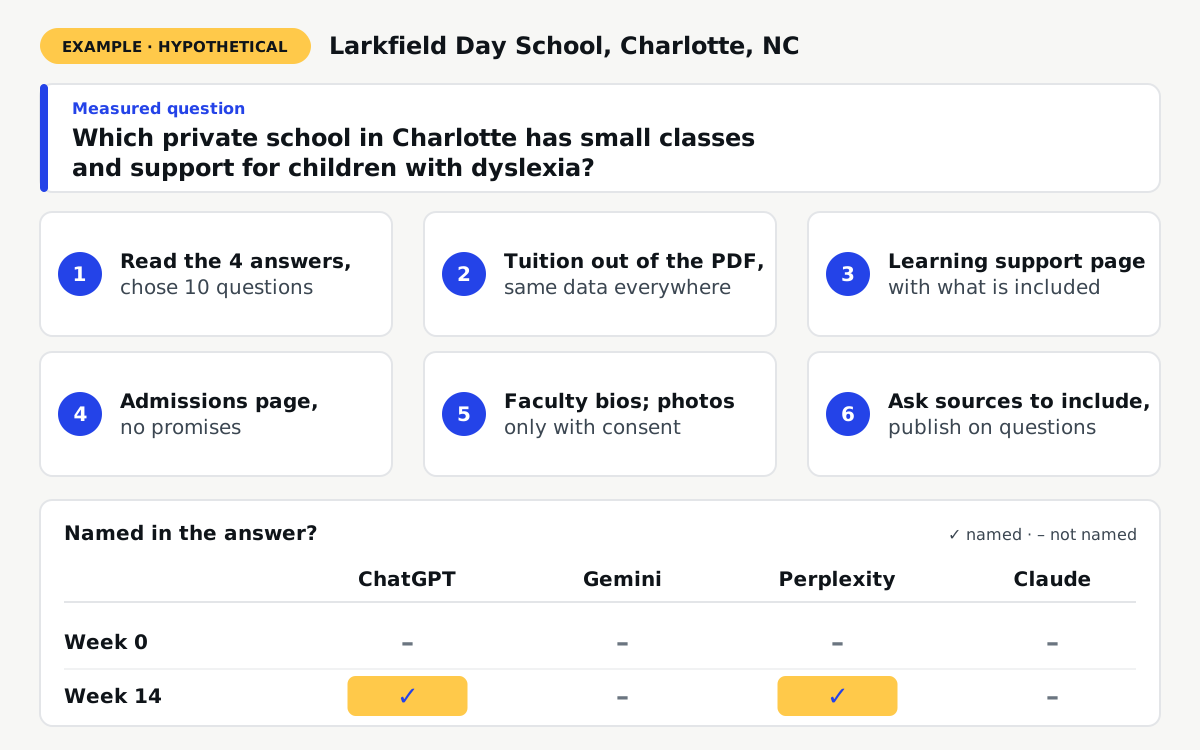
Example: a hypothetical school, not a sayurname client. Imagine Larkfield Day School in Charlotte, North Carolina: kindergarten to grade 8, 310 students, 19 years open, classes capped at 16, 210 Google reviews averaging 4.6 and 48 on Niche. Two teachers are trained in Orton-Gillingham; 38 students have a learning plan. Tuition ($19,400 to $24,800) sat in a PDF, and the reading program got one line: “we support diverse learners”.
The measured question was “Which private school in Charlotte has small classes and support for children with dyslexia?”. At week 0 the school was named by 0 of 4: ChatGPT named two large schools with high Niche grades, Gemini a school for learning differences, Perplexity a Reddit thread and a Niche list, Claude a generic set.
- Read the four answers and their sources with the head of school and admissions director, and chose ten questions, from dyslexia to tuition under $25,000.
- Fixed the base: tuition, fees and admissions dates moved from the PDF to a web page, and name, address and grades made identical across the site, Google and directories, stating SAIS accreditation and state registration.
- Replaced the one-line mention with a learning support page: who teaches, which method, how many have a plan, what small-group help is included, what one-to-one tutoring costs ($3,200 a year), and which needs the school cannot meet.
- Rewrote the admissions page with dates, openings and how decisions are made, promising neither a place nor outcomes.
- Rewrote faculty bios with degrees, years at the school and training, and removed every student photo and name without written parental consent.
- Asked Niche and Private School Review to correct and complete the school’s profile, published one page for each measured question, each approved by the head of school, and asked families for reviews without incentives or suggested wording.
The budget question moved first: by week 3, Perplexity and ChatGPT quoted the published tuition, not $14,000 from an old listing. In week 6 Perplexity named the school for the dyslexia question, citing the new page; in week 11 ChatGPT followed, after two Niche reviews described the reading program. At week 14 Gemini still led with the learning-differences school, fair for severe needs, and one Claude run in four named Larkfield, which does not count.
What did not work: a “Charlotte’s leading independent school” headline moved nothing and came down; a paid directory listing changed no answer; the bus question never moved, because Larkfield has no bus. Results vary by city, question and competition; another school might see none of this.
What to publish
A citable school page answers one parent’s question with checkable facts. Titles that work: “Dyslexia and reading support at Larkfield: who teaches, how it works, what it costs”; “Tuition 2027–28, fees and financial aid, by grade”; “After-care until 6 p.m.: hours, cost and activities”.
An excerpt from the first: “Two lower-school teachers trained in Orton-Gillingham work with groups of up to four children, four times a week, during the school day at no extra charge. We have no program for severe language disorders; families who need one are referred to specialized schools.” Citable means named staff with verifiable training, accreditation, what is and is not offered, current prices, and nothing that promises admission or results or identifies a child.
When it is not worth it
If every grade has a waiting list, more inquiries only disappoint more families; open a section first. A parish school filled from its congregation, or one whose places go to siblings, is chosen through membership, not through an AI.
Nor does it pay when the school cannot publish its own facts: a network whose head office forbids a tuition figure, or a new school awaiting authorization, which should not advertise yet. Start smaller: correct the Google profile and listings, and return with something concrete.
How the work runs, within the rules for schools
It starts with the free test: one parent’s question sent to the four AIs, full answers saved as the starting point. Subscribed, we measure up to 10 questions every week in the four assistants, fix the site’s base so the AI can read it, find out where the AI gets the answer to each question and ask for the school’s inclusion wherever there is a path: Niche, Private School Review, the NAIS directory, accreditors’ member lists. Some of those are curated or paid, so we promise the request, not the listing; you see what was asked and what got in. We also publish content that answers the measured questions.
It costs $299/month, with no lock-in, plus a one-time $599 bonus charged only when an AI starts naming the school for a measured question, checked by a person, or Google Analytics shows a visit from an AI. Nobody controls AI answers, so nothing guarantees a recommendation. Content is informative and follows your accreditor’s standards, your state’s rules for nonpublic schools and consumer law: no promised admissions or results, no unearned rankings, no child’s name, photo or story without written parental consent; the head of school approves every piece.
Questions
Do Niche reviews matter more than our website?
Reviews show the school is real and liked; the program page says what it does, for whom. In the example, 48 Niche reviews were not enough without the support page.
Can we pay to be featured or ranked first?
A featured listing can bring inquiries from that directory, but not a place in an AI answer, which reflects what several independent sources say.
Can we publish test scores and where graduates go?
Yes, as facts with context: year, test, number tested, where graduates enrolled. Framed as a promise (“every student gets in”), it misleads families and can breach consumer law; framed as data, an AI can cite it.
How long until anything changes?
In the example, the first assistant named the school in week 6; two had not by week 14. Start months before your application window: parents build shortlists in early autumn.
What if the AI gets our tuition or religious affiliation wrong?
It is repeating a source, usually an old listing or a vague page. Correct the listing and state the fact plainly on your site; in the example, the wrong tuition was gone in three weeks.