

The question your future clients actually type
A familiar experience: a psychologist asks ChatGPT about her specialty and her practice comes up first; she asks it to answer as a stranger would, and the practice vanishes, because it was only repeating the name used earlier. Another opens three private windows and gets three different lists. A self-search proves nothing; what counts is a neutral question, asked repeatedly, without your name.
People rarely type “best psychologist near me”. They combine a problem, a method or population, a place and a constraint: “psychologist who does EMDR for trauma in Austin and takes Blue Cross”; “therapist for a 15-year-old with panic attacks, evening appointments”; “who treats OCD with exposure and response prevention, telehealth in Texas”. The method is the most selective term, because it excludes everyone who does not say they use it; the constraint (insurance, hours, language, age) decides among those left. Your practice must be described in exactly those terms.
How AI answers in psychology, and from what
With web search on, the four assistants lean on predictable sources: the Psychology Today directory, networks such as Zocdoc, Headway and Alma, specialty directories such as the International OCD Foundation’s provider listing, the state board’s license lookup, the Google Business Profile, city threads on Reddit, and the practice’s own pages. Unlike dentistry, psychology has few public reviews, and ethics codes discourage asking for them, so the assistants rely more on explicit descriptions of who you treat, with which method, in what format and at what fee.
That is why a specialty page beats a homepage. The assistant retrieves passages, not websites, and needs one passage holding method, city and population together; a homepage listing fourteen concerns never produces it. Answers vary between assistants, which search different indexes, and between runs, so the useful measure is a pattern over weeks, compared with the practice that was cited: what does its page say that yours does not? Fame is not the criterion; the AI names whoever demonstrably meets every condition.
The most common mistake: the list of everything
Most practice sites say the clinician treats “anxiety, depression, trauma, relationships, grief, self-esteem” and a dozen more, from fear of turning anyone away and because directories invite you to tick every box. The cost is that the AI cannot tell what you actually do: a list of twenty conditions reads like no list, and the practice with one precise page about one method wins the specific question.
Choose two or three areas where you have formal training and real caseload, and give each its own page: who it is for, the method and what a course involves, session length, fee and insurance, telehealth states, and who you do not treat and where you refer them. Stating limits is an ethical marker and a strong signal of precision.
A worked example, step by step
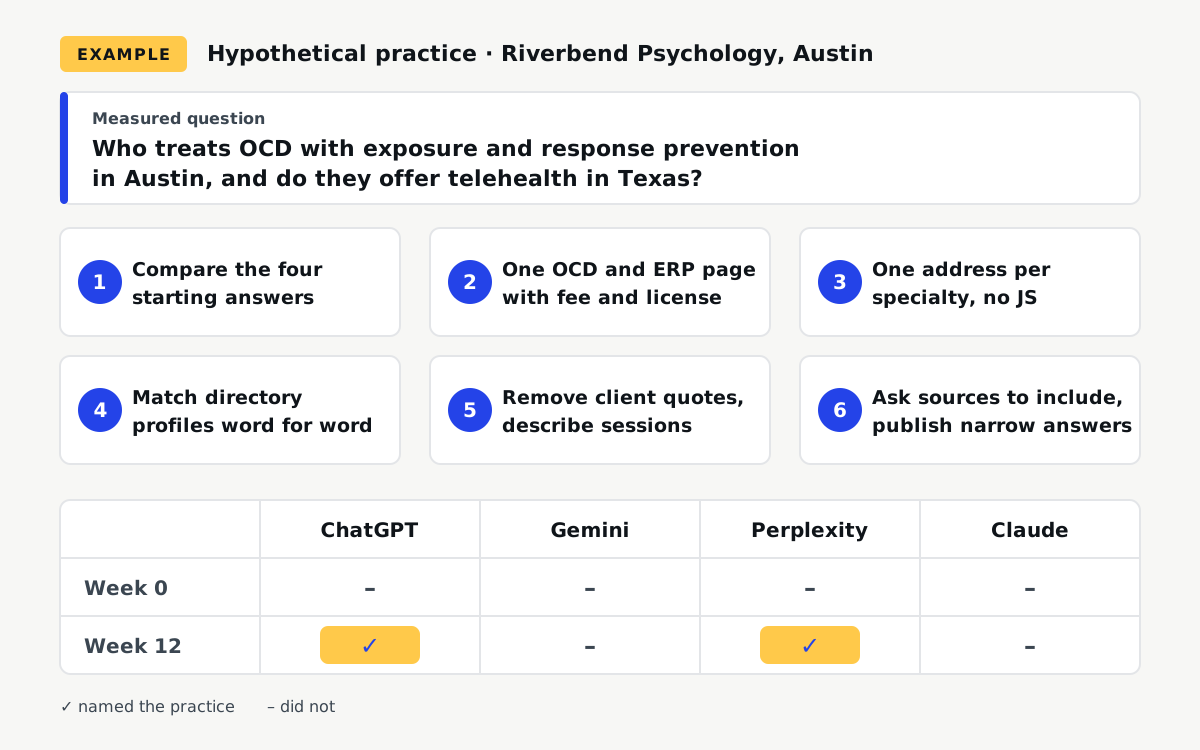
Example (hypothetical): Riverbend Psychology in Austin, Texas, two licensed psychologists and a postdoctoral fellow, nine years old, self-pay at $180 per 50-minute session, 14 unsolicited Google reviews, one psychologist with specialized ERP training. The measured question: “Who treats OCD with exposure and response prevention in Austin, and do they offer telehealth in Texas?” At week 0, 0 of 4 assistants named it; they cited the OCD foundation’s directory, Psychology Today and two group practices whose pages stated ERP, session length and Texas telehealth. Riverbend listed OCD as one of 14 concerns in a JavaScript carousel, beside three client quotes.
- We compared the four starting answers: every cited practice named the method in a heading, the city, telehealth limited to Texas, and a fee or insurance status.
- We wrote one OCD and ERP page: adults and teens from 13, what an exposure hierarchy is, a course commonly of 12 to 20 weekly sessions with no promised outcome, the $180 fee, and license numbers linked to the board lookup.
- We gave each specialty its own address, readable without JavaScript and in the sitemap, so the OCD passage could be retrieved alone.
- We made the foundation’s directory entry and the Psychology Today profile match the page word for word: name, address, method, telehealth.
- We removed the client quotes, which ethics codes discourage and no assistant can verify, and described the first three sessions instead.
- We asked for the practice’s inclusion where there was a path, such as the foundation’s provider listing and a local news feature on OCD, and published pieces on narrow questions, such as what happens in a first ERP session, each linking to the specialty page.
In week 5 Perplexity named Riverbend, citing the new page. In week 9 ChatGPT named it, citing the directory entry that now matched the site. By week 12 Gemini and Claude still had not. A second question, “psychologist for anxiety in Austin”, stayed at 0 of 4: platforms dominate it, and wellness posts aimed at it changed nothing.
Results vary with city, specialty and how many practices already describe themselves well; a broad question in a large market may never move.
What to publish
Good titles answer a question a client already asks: “ERP for OCD in Austin: what treatment involves and how long it takes”; “Telehealth therapy in Texas: who can see you”; “Out-of-network therapy: how superbills work”. An excerpt as it would appear on the site: “ERP sessions at Riverbend last 50 minutes, usually weekly. In the first two we map the obsessions and the rituals that follow them and rank situations from least to most distressing. Exposures start near the bottom of that list and are always agreed in advance.”
A page is citable when it holds facts an assistant can check: clinician and license, states served, which presentations and ages are treated and which referred, the method and structure of a course, fees, how to book. Claims of effectiveness, before-and-after stories and anything resembling a case history, even disguised, do not belong.
When it is not worth it
If your caseload is full and the waiting list runs to months, being named only adds inquiries you must decline. The same holds when nearly all clients arrive through an insurer’s directory or a physician’s referral, or when you prefer not to state a specialty publicly.
Nor is it worth competing for crisis questions: the right answer to an emergency is a crisis line, not a private practice. In these cases, simply keep the license lookup, directory profiles and Google Business Profile accurate, which stops wrong information spreading.
How the work runs, within your board’s rules
It starts with the free test: one question, four assistants, full answers saved as your starting point. With the service we measure up to 10 questions weekly in the four assistants, fix the site’s base so each specialty can be read and understood, find out where the AI gets the answer to your questions and ask for your inclusion wherever there is a path: Psychology Today, the International OCD Foundation’s listing, networks such as Headway and Alma. Some of those sources are editorial or paid, so we promise the request, not the listing, and you see what was asked and what got in. We also publish informative content for the measured questions, on a subdomain via DNS or delivered for you to publish. Onboarding is online. The fee is $299/month with no lock-in, plus a one-time $599 bonus charged only when an assistant starts naming the practice for a measured question, confirmed by a person, or Google Analytics shows a visit from an AI. Nobody can guarantee what an assistant answers.
Everything we write is informative and follows the advertising rules of your state board of psychology and the profession’s ethics code: no testimonials, no promises of cure or outcome, no case material, no solicitation, and you review each piece first. Confidentiality is untouched: the questions are anonymous, and we never need client information.
Questions
Do reviews matter more than my site?
Less than in most sectors. Practices have few public reviews and should not solicit them, so the assistants rely more on directories and on how precisely your pages describe method, population and fees. When replying to a review, never confirm the person was a client.
Can I just pay for a better directory listing?
A paid Psychology Today profile is read by the assistants, but so are hundreds of others in your city. It helps when it repeats, in the same words, a specialty page that proves the details.
Is this allowed by my state board?
Informative content about methods, formats and fees is ordinary professional communication. Boards restrict testimonials, misleading claims, guarantees and solicitation, which our content avoids, and you approve every piece.
How long until anything changes?
On a narrow question, first movement often appears between week 4 and week 12, usually in Perplexity first. Broad questions in large cities may never move.
What if an AI says something wrong about my practice?
It is usually repeating a stale source, such as an old directory profile with a former address. We find the cited source, it gets corrected, and the weekly measurement shows when the assistants stop repeating it.