

The question sellers and buyers actually ask
Agents meet the problem sideways. One asked ChatGPT for the best agent in town and saw her own name; asked to answer as it would for a stranger, it dropped her, having named her only because she had asked about herself earlier in the chat. Another got three different lists from three private windows. The useful measure is the answer a stranger gets, every week.
People type a property, a place and a constraint, and the constraint decides who is named: “who should sell my 1920s bungalow in south Minneapolis”, won by an agent with a visible record in older homes; “agent experienced with probate sales in Hennepin County”, where one explicit page can decide; “what commission should I expect to pay in [city]”. Each shape pulls different sources, and the agent named for one can vanish from the next.
Where the AI’s answer about agents comes from
With web search on, each assistant runs a few searches and summarizes what the pages agree on. For agents they are predictable: Zillow, Realtor.com and Redfin profiles with sales counts and reviews; the Google Business Profile; “top agents in [city]” lists, many of them paid; city subreddits; the state license lookup; and the agent’s own pages. The AI trusts a fact confirmed twice: 41 sales in a ZIP code on Zillow, matched by the agent’s own page.
Three things differ here. The AI answers about a person, but Zillow and Google often carry different names, so one agent becomes two weak entities, or the brokerage gets the credit. Sales volume is public, so broad questions favor high-volume teams, and specialty questions are where a smaller agent wins. Assistants also often name nobody, advising to interview three agents, and vary between runs, so one run proves nothing. Fame is not the criterion: the billboard team wins “best agent in [city]”; the probate question goes to whoever states plainly how often they handle probate.
The most common mistake: a website that is only a listings feed
Most agent sites are an IDX search box, the current listings, a “Top 1%” badge and a template neighborhood page. All of it exists elsewhere: the listings on Zillow, the template text on every site with the same theme, the badge nowhere checkable. The AI cites the original, and when a home sells its listing page disappears, and with it the agent’s record on that street.
So the agent is invisible exactly where strongest: what was sold, where, for how much and how fast. The fix is a page per specialty built on closed sales: homes sold in a defined area and type, median days on market against the area’s, list-to-sale ratio, what went wrong and how it was solved. Neighborhood pages describe housing stock, prices and transit, never who lives there: under fair housing rules “family-friendly” or “safe” can read as steering.
A worked example, step by step
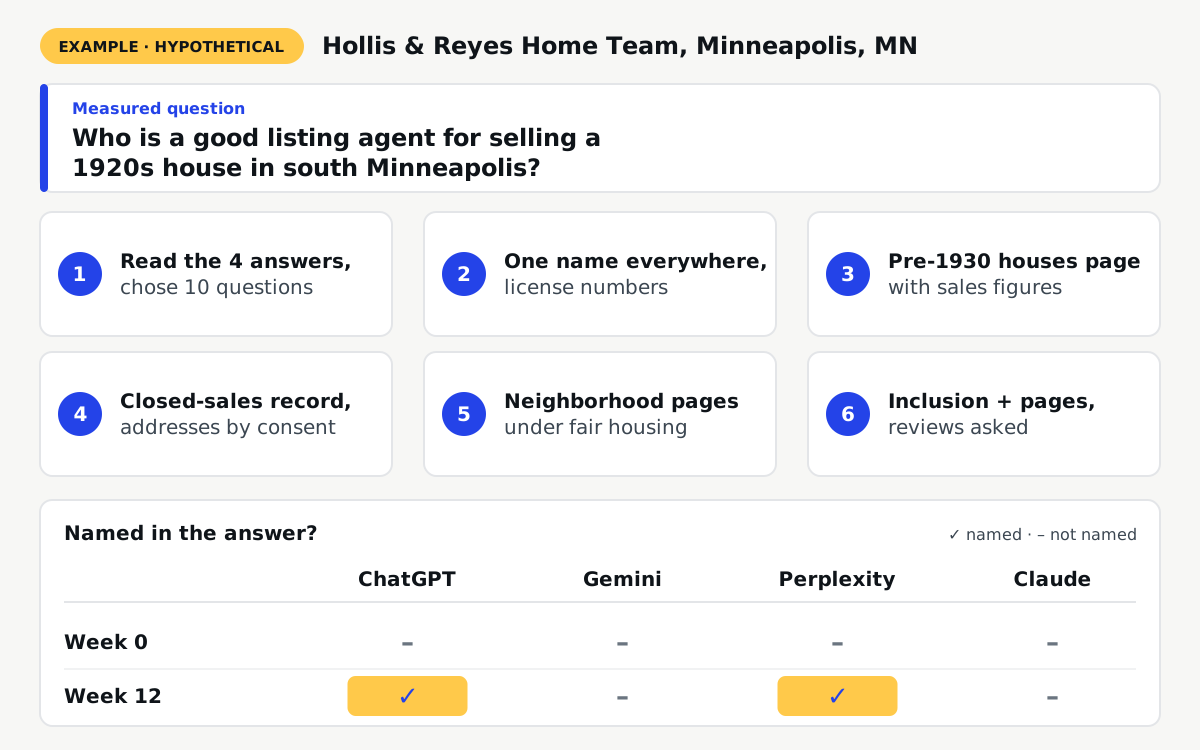
Example: a hypothetical team, not a sayurname client. Imagine the Hollis & Reyes Home Team in Minneapolis: two licensed agents, 14 years in business, 38 closed sales last year at a median price of $372,000, and 64 Zillow reviews averaging 4.9. In three years they had sold 23 houses built before 1930 in south Minneapolis. The site was an IDX feed; Zillow listed Dana Hollis alone, Google the team.
The measured question was “Who is a good listing agent for selling a 1920s house in south Minneapolis?”. At week 0 the team was named by 0 of 4: ChatGPT named two high-volume teams and suggested Redfin, Gemini the most-reviewed teams, Perplexity an old Reddit thread, and Claude advised interviewing three agents naming none.
- Read the four answers and their sources with both agents, and chose ten questions, from older homes to commission.
- Fixed the base: one team name with the required brokerage disclosure on the site, Google, Zillow, Realtor.com and Redfin, and license numbers checkable on the Minnesota Department of Commerce lookup.
- Built a page on selling pre-1930 houses in south Minneapolis: 23 sales, a median of 9 days on market against 21 for the area, and why the team recommends a sewer scope before listing.
- Published the closed-sales record behind it: neighborhood, year built, list and sale price, days on market, obstacle solved, and addresses only with the seller’s written consent.
- Rewrote six neighborhood pages under fair housing rules: housing stock, lot sizes, price ranges from own sales, transit; “family-friendly” and “safe” removed.
- Asked a “top agents in Minneapolis” list to include the team, published one page per measured question, each checked by an agent, and asked past sellers for reviews, with no incentive or suggested wording.
Nothing moved for five weeks. In week 6 Perplexity named the team for the older-homes question, citing the new page and the matching Zillow profile; in week 9 ChatGPT followed. At week 12 Gemini still led with the two highest-volume teams, each with more than 300 Zillow reviews, and Claude named agents in one run of four, never this team.
What did not work: a paid “top agents” magazine feature changed no answer; a “#1 bungalow expert” headline could not be substantiated and came down; the broad “best agent in Minneapolis” question never moved, and arguably should not. Results vary by city, question and competition; another team might see none of this in twelve weeks.
What to publish
A citable page answers one question with facts a second source confirms. Titles: “Selling a pre-1930 house in south Minneapolis: what we sold and how fast”; “Probate sales in Hennepin County: steps, timeline, who signs”; “What selling a $370,000 house costs, line by line”.
From the first: “Since 2022 we have sold 23 houses built before 1930 in south Minneapolis, at a median of 9 days on market against 21 for the area. In 14 the inspection flagged a clay sewer line, so we recommend a sewer scope before listing.” Citable means named, licensed agents, a defined area and property type, figures from own sales, fees stated as negotiable, and nothing about who lives where.
When it is not worth it
If referrals already fill your calendar and you turn listings away, more inquiries add nothing. Nor does it pay for commercial brokers, whose deals come from relationships, or in small rural markets where everyone knows the two agents in town.
It also fails with nothing yet to show: an agent with three closed sales should earn the transactions first, publishing process pages meanwhile. And when the brokerage forbids personal sites or new pages, start with the profiles the agent does control, on Zillow, Realtor.com and Google.
How the work runs, within license and fair housing rules
It starts with the free test: one seller’s question sent to the four AIs, full answers saved as the starting point. Subscribed, we measure up to 10 questions every week in the four assistants, fix the site’s base, find out where the AI gets the answer to each question and ask for your inclusion wherever there is a path: Zillow, Realtor.com and Redfin profiles, the “top agents in [city]” lists. Many of those are editorial or paid, so we promise the request, not the listing; you see what was asked and what got in. We also publish content that answers the measured questions. We publish on a subdomain through DNS, or deliver and you publish.
It costs $299/month, with no lock-in. A one-time $599 bonus is charged only when an AI starts naming you for a measured question, checked by a person, or Google Analytics shows a visit from an AI. There is no guarantee of being recommended: nobody controls AI answers. The content is informative and follows your state real estate commission’s advertising rules and fair housing law: brokerage disclosed, no promised price or timeline, no unsubstantiated claim, testimonials only as your state allows, no solicitation of another agent’s exclusive listings. An agent approves every piece.
Questions
Do Zillow reviews matter more than my website?
Reviews tell the AI you are real and well regarded; your pages tell it what you sell. In the example, 64 reviews were not enough without the older-homes page.
Can I pay to be named, via Premier Agent or a “top agents” list?
Premier Agent buys leads on Zillow; a paid list buys a spot on that list. Neither buys a place in an AI answer; in the example, the paid feature changed nothing.
Does this fit license rules and fair housing law?
Informative content about sales, areas and credentials is generally allowed, with the brokerage disclosed and every claim substantiated. Fair housing is the stricter limit: describe properties and places, never people. An agent approves each piece.
How long until anything changes?
In the example, the first assistant named the team in week 6; two had not by week 12. Broad questions dominated by high-volume teams may never move.
The AI names my brokerage instead of me. Why?
Usually your name differs between site, Google and portals, so the AI cannot join them. Use one name everywhere, brokerage beside it, and update the old profiles.