

The question a homeowner actually asks
Roofers usually meet this as a ladder against the gutter, not as a lost job. They ask an assistant about their own company and it praises the trucks, because the question already contained the name. A stranger then asks the way a person asks after a hailstorm: what the roof is made of, and which warranty is whose. The crew is gone. The only reading that matters is that stranger’s question, asked the same way every week.
Almost nobody types “best roofer near me” and stops. They add the line that decides the bid. Asphalt, not metal. A tear-off, not a second layer. The shingle maker’s limited warranty, which is not the crew’s promise to come back. “We do every roof” is not the criterion. The assistant cannot verify every. It can verify a material, a size, and two different warranties.
Where the answer about a roofer comes from
With web search on, each assistant runs a few searches and summarizes what the pages agree on. For this trade the sources are Google, the state contractor lookup, the shingle maker’s warranty page, reviews that name a leak, and the roofer’s site. A storm chaser ranks for a broad question because many ads repeat “free inspection” the week after hail. A local crew ranks for the asphalt question only if a page names the material, the size, and which warranty belongs to whom.
The mechanism is a split a stranger can hold the crew to. A photo of a truck does not say whether the ten-year callback is the crew’s or the mill’s. The four assistants disagree because each searches a different index, and the same one changes between runs, so one screenshot proves little. Fame is not the criterion: the advertiser with the loudest storm ad wins “roofer in [city]”, and the warranty question goes to whoever separates the two promises.
The most common mistake: one promise that covers every roof
Almost every roofer’s site says they do every roof and offers a free storm inspection. The material, the tear-off, and the difference between the manufacturer’s limited warranty and the crew’s workmanship sit in a contract the buyer sees on the tailgate. It happens because the free visit wins the call, and “every roof” feels like it loses no job. To an assistant, every roof is the same claim as the next truck’s every roof.
The cost is concrete. The homeowner takes the crew that printed “asphalt tear-off, maker’s warranty theirs, our workmanship ten years” next to a range. The local crew may be the one that will actually come back, and it never enters the answer. The remedy is a page for one roof: asphalt shingle, tear-off, a size, a band, and the two warranties named apart. The trade-off is that you turn away the metal job and the flat roof. Those were never this page. A free visit is a sales call, not a covered repair.
A worked example, step by step
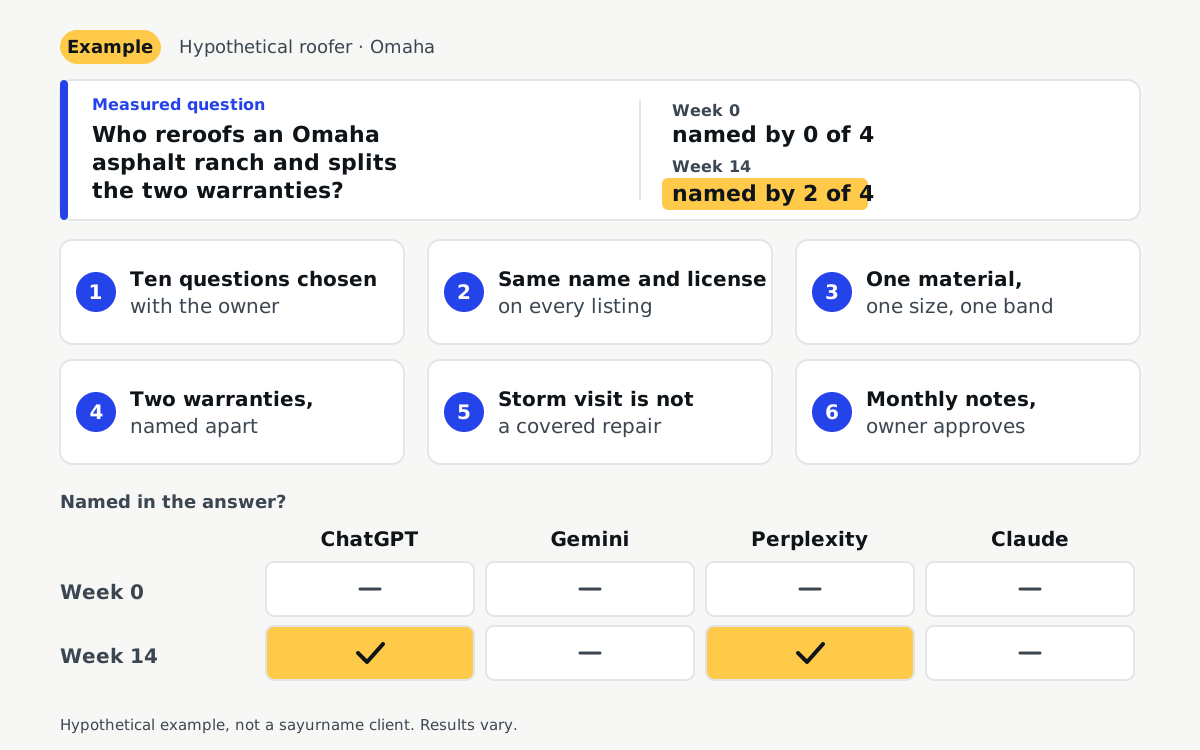
Example: a hypothetical crew, not a sayurname client. Imagine Benson Roofing in Omaha, Nebraska: the owner and eleven people, fifteen years, 140 Google reviews averaging 4.7. A typical asphalt tear-off on an 1,800-square-foot ranch is $9,400 to $13,200, including the tear-off and architectural shingles. The shingle maker’s limited warranty is the mill’s, not the crew’s, and it is not a promise that the crew returns for free. The crew’s own workmanship is ten years. Metal and flat roofs are a different page and a different price. The old site said “we do every roof” and “free storm inspections”.
The measured question was “Who reroofs an asphalt-shingle ranch in Omaha and separates the shingle maker’s warranty from the crew’s workmanship?”. At week 0 the company was named by 0 of 4. ChatGPT named two storm advertisers and their free inspections. Gemini listed the most-reviewed roofers on Maps. Perplexity cited a forum thread about a leak after hail. Claude explained warranties in general and named nobody.
- Read the four answers with the owner and chose ten questions buyers had asked that year: asphalt, a tear-off, the maker’s warranty, the crew’s callback, a small ranch, and what metal is not.
- Fixed the base: the same legal name, address and contractor registration on the site and on Google, matching the state lookup.
- Replaced “every roof” with one scope page: asphalt tear-off, about 1,800 square feet, band of $9,400 to $13,200.
- Split the warranties in two sentences: the shingle maker’s limited warranty is theirs; the crew’s workmanship is ten years and is not the mill’s.
- Wrote that a free storm visit is a look at the roof, not a covered repair, and removed “Omaha’s most trusted roofer”.
- Kept a monthly run of job notes, each read by the owner, and asked owners for a review that named which warranty was whose, with no discount and no suggested wording.
Nothing moved for six weeks. In week 8 Perplexity named the company and quoted the two warranties as separate sentences. In week 14 ChatGPT followed, after two reviews said the crew came back for a flashing leak and did not point at the mill. At week 14 Gemini still led with storm ads, and Claude named the company in one run of four, which does not count.
What did not work: a paid hail-season ad brought calls and no change in any answer. The metal-roof question never moved, because the company does not sell that page and two firms publish standing-seam prices in detail. Results depend on the city, the question and the competition. Another crew might see none of this in fourteen weeks.
What to publish
A citable roof page answers one material with lines a stranger could compare. Titles that work: “An asphalt tear-off on an 1,800-square-foot ranch in Omaha”; “Two warranties: the mill’s, and ours”; “A free storm visit is not a covered repair”.
An excerpt: “For an asphalt tear-off on a ranch of about 1,800 square feet, the band is $9,400 to $13,200. The shingle maker’s limited warranty is the mill’s, not ours. Our workmanship is ten years. Metal and flat roofs are not this price. A free look after a storm is a visit, not a repair we have already promised.” What makes it citable: a material, a size, two named promises, and a line for what the visit is not.
When it is not worth it
If the crew is booked through the next hail season, more inspections only lengthen a wait. Hire or raise the price first. A crew that only patches for one property manager, and never sells a full tear-off to a homeowner comparing two bids, will not be chosen by this question.
Nor does it pay when the registration does not match the name on the truck, or the ten-year line is a warranty the crew does not actually give. Start there, and come back when the two sentences on the page are promises you will sign.
How the work runs
It starts with the free test: one homeowner’s question sent to the four AIs, with the full answers saved as the starting point. Once subscribed, we measure up to 10 questions every week in ChatGPT, Gemini, Perplexity and Claude, fix the site’s base so the assistants can read the scope pages, and publish as much as we judge necessary for AI to cite your business in the answers you want. Volume and format follow what each question needs, and that part is our call. We also ask for inclusion in the sites the assistants use to answer each question. What we promise is the request, not the listing: many sources are editorial or paid and do not accept one, and you see what was requested and what got in. Publishing happens on a subdomain connected by DNS, or we deliver the pieces and you publish them. Onboarding is online, with no call.
It costs $299/month, with no lock-in. A one-time $599 bonus is charged only when an AI starts naming your company for a measured question, checked by a person on our team, or Google Analytics shows a visit coming from an AI. Nobody controls AI answers, so there is no guarantee of being recommended. The content states only scopes and warranties you will sign, and the owner approves every piece. It promises no roof.
Questions
Won’t naming only asphalt lose the metal jobs?
Those jobs need their own page. In the example, the assistants named the crew that split one material and two warranties, not the truck that claimed every roof.
Should the mill’s warranty be described as ours?
No. A homeowner who is told the crew “guarantees the shingle for 50 years” meets the mill’s exclusions later. Two sentences stop that.
Can a storm advertiser be the better answer?
Yes, when the question is only a free inspection this week. The local crew wins the question that asks which warranty is whose.
How long until anything changes?
In the example, the first assistant named the company in week 8 and the second in week 14; two had not by then. Some questions never move.
Does a hail-season ad buy the answer?
It can buy calls. In the example it changed no assistant. The answer is written from two warranties, not from an ad.