
The question homeowners actually ask
Installers find the problem by accident: one sees the business named by ChatGPT, asks again as a stranger in a fresh session, and the name is gone, because the first answer leaned on the earlier conversation. Three private windows give three different lists. One answer is a sample; what counts is the same question measured over weeks.
Homeowners add a constraint, and the constraint decides who gets named: who does the work (“solar company in [city] with its own crews, not subcontractors”), the roof (“installer who works on tile without voiding the roof warranty”), the utility rules (“is a battery worth it under PG&E’s net billing tariff”) or a problem left behind (“who services panels from a company that went out of business”). That last shape grew as installers closed, and there a small local company often beats national brands that avoid the work.
Where the AI’s answer about solar installers comes from
With web search on, the assistants run a few searches and summarize what the pages found agree on. In solar those pages are predictable: Google Business Profile and Maps, EnergySage and SolarReviews, Yelp and the BBB, the state license lookup (in California, the CSLB), the NABCEP directory of certified professionals, r/solar threads, local news about installers that closed, and the installer’s own pages.
Two traits shape the answer. Many firms that sell solar do not install it, so reviews and complaints split between seller and subcontractor, and the AI cannot tell who did the work unless a page says so. And incentives change while old pages stay up: assistants still find pages promising the 30% federal credit that, as of November 2026, ended for home systems installed after 31 December 2025. The four disagree because each searches a different index and varies between runs. Fame is not the criterion: the constrained question goes to whoever states the fact plainly, with license and reviews confirming it elsewhere.
The most common mistake: selling a savings number
The typical solar site is a lead funnel: a banner promising to “cut your electric bill by up to 90%”, a calculator asking for a bill and a phone number, a short page about “premium panels”. An assistant testing the company against “own crews” or “services orphaned systems” finds a form, not a sentence, and moves on.
The number also backfires. The AI cannot verify it, and when an assistant repeats a figure the customer never sees, the complaint lands on review sites the assistant reads. Savings depend on consumption, orientation, tariff and future rates. Replace each claim with something checkable: license number and classification, who holds NABCEP certification, systems installed last year, what is subcontracted, and dated incentive notes.
A worked example, step by step
Example: a hypothetical installer, not a sayurname client. Imagine Tower District Solar & Electric in Fresno, California: 14 people in two crews, nine years in business, a C-10 electrical license, two NABCEP PV Installation Professionals, about 170 home systems a year, 104 Google reviews averaging 4.9. A typical 7 kW system cost $2.90 to $3.40 per watt, $20,300 to $23,800 before incentives. The site was a calculator and a 120-word “Residential” page.
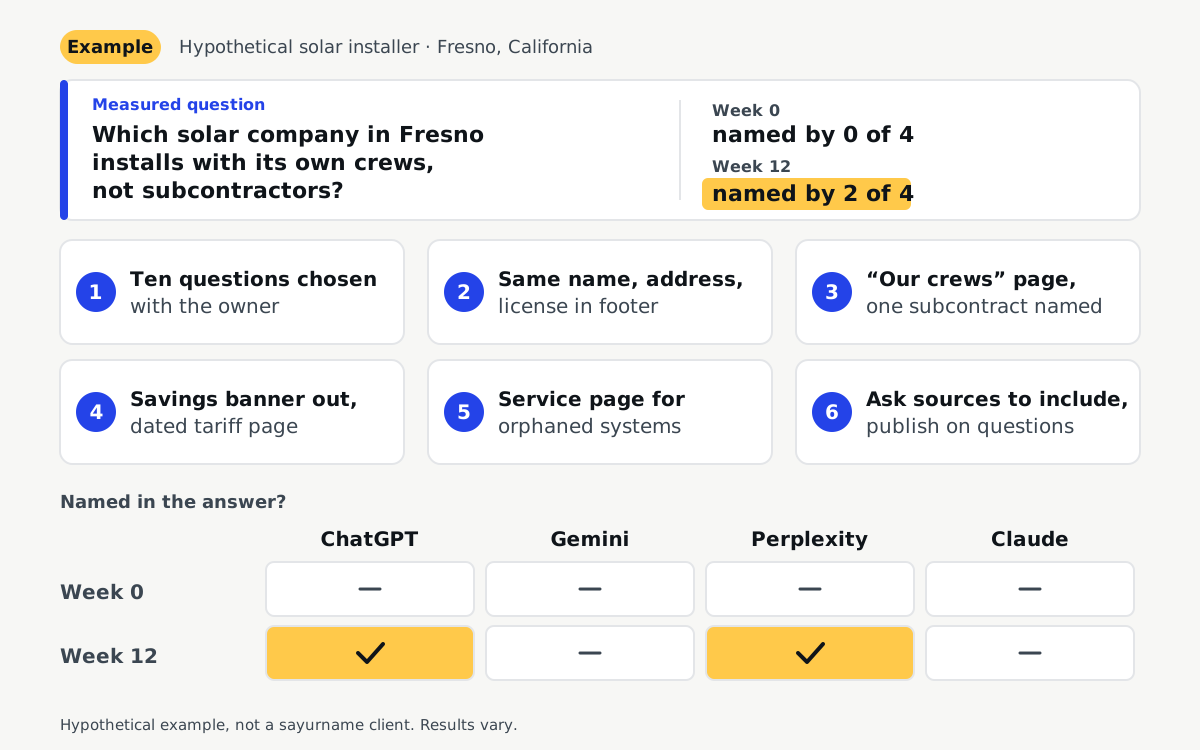
The measured question: “Which solar company in Fresno installs with its own crews, not subcontractors?”. At week 0 it was named by 0 of 4 assistants: ChatGPT named national brands and a marketplace, Gemini the most-reviewed locals, Perplexity a Reddit thread, Claude nobody.
- Chose ten questions with the owner: own crews, tile roofs, batteries under net billing, servicing systems from closed companies, price per watt and five more.
- Fixed the base: one name, address and phone everywhere, the CSLB license number in the footer, and the Google category changed from “Electrician” to the solar one.
- Wrote an “Our crews” page naming both crew leads and their NABCEP certifications, and the one thing subcontracted: re-roofing old tile, by a roofer named in the contract.
- Replaced the “up to 90%” banner with a dated page on bills under PG&E’s net billing tariff, saying savings depend on usage and future rates.
- Published a page on servicing systems left by closed installers: what the crew repairs, which inverters it supports, and a flat $250 diagnostic visit.
- Requested listings on EnergySage and SolarReviews, published one page for each measured question, each checked by the licensed owner, and asked every customer for a review after permission to operate, with no incentive.
The orphaned-systems question moved first: Perplexity named the company in week 4, citing the service page. In week 7 Perplexity named it for the own-crews question too, citing the crews page. In week 11 ChatGPT named it in three of four runs, which we count. Gemini kept naming companies with 400 to 700 Maps reviews; Claude gave general advice.
What did not work: a “Best Solar Company in Fresno” badge bought from an awards site moved nothing; more marketplace spend brought quotes but no change in answers; the battery question never moved, probably because two competitors have years of battery pages. Results vary by city, question and competition.
What to publish
A citable solar page answers one homeowner question with checkable facts. Titles that work: “Solar in Fresno with our own crews: who is on your roof and what we subcontract”; “Servicing systems from installers that closed: what we fix and what it costs”; “Batteries under PG&E net billing, as of November 2026: when one pays off”.
An excerpt from the first: “Our crews are led by Marco Ruiz and Dana Lee, both NABCEP PV Installation Professionals, and install about 170 home systems a year under our C-10 license. We do the electrical work, racking and PG&E interconnection ourselves; we subcontract only re-roofing old tile, and name that roofer before you sign.” What makes it citable: credentials a directory confirms, a license the state confirms, the in-house line, yearly volume, dated incentives, savings only as estimates.
When it is not worth it
If the company installs mostly as a subcontractor for sales firms, the homeowner never chooses it; the AI work belongs to whoever sells. If crews are booked four months ahead, spend on another crew instead. Where few homeowners shop for solar, the monthly cost will not pay back.
It also does not pay when the company will not put checkable facts in writing, or when its sales model depends on the savings promise this page advises removing. Then start smaller: complete the Google Business Profile, correct license and marketplace listings, delete expired incentive copy, and return when there is something concrete to publish.
How the work runs, within licensing and advertising rules
It starts with the free test: one homeowner question sent to the four AIs with full answers saved as the starting point. Subscribed, we measure up to 10 questions weekly in the four assistants, fix the site’s base so the AI can read the service pages, find out where the AI gets the answer to each question and ask for the installer’s inclusion wherever there is a path: EnergySage, SolarReviews, the NABCEP directory, the BBB. Some of those are paid or curated, so we promise the request, not the listing; you see what was asked and what got in. We also publish content that answers the measured questions.
It costs $299/month, with no lock-in. A one-time $599 bonus is charged only when an AI starts naming the company for a measured question, checked by a person on our team, or Google Analytics shows a visit from an AI. Nobody controls AI answers, so there is no guarantee. Content is informative and follows consumer-protection law and your state licensing board’s rules: no guaranteed savings or payback, every incentive dated, licenses only as official lookups show them, and the licensed owner approves every piece.
Questions
Do reviews matter more than my website?
Reviews tell the AI the company is real and liked; service pages tell it what the company does. In the example, 104 reviews were not enough until a page said who installs, and Gemini, leaning on Maps, still favored companies with far more reviews.
Should I just pay a lead marketplace to list me higher?
A marketplace can bring quote requests, and a complete profile there is a source the AI reads. Paying for leads does not buy a place in an answer written from several sources.
Can I say how much a customer will save?
Publish estimates labeled as estimates, with assumptions: consumption, orientation, tariff and the rate date. A savings figure or payback period presented as a promise draws complaints and gets repeated by AI as fact.
How long until anything changes?
In the example, the first assistant named the company in week 4, and two had not by week 12. Broad questions can take months.
What if the AI says something wrong about my company?
A closed company with a similar name, an expired incentive: the AI repeats what it read. Correct the source, usually a directory or an old page, and state the right fact, dated, on your site.