
The question pet owners actually ask
Clinic owners meet the problem sideways. One had ChatGPT rewrite the homepage “for AI” and saw no result, because smoother prose says nothing new. Another heard a client say she found the clinic through Perplexity, while Google Analytics logged direct traffic. What matters is the AI’s answer, asked the same way every week.
Owners rarely type “vet in [city]”. They type an animal, a place and a constraint, and the constraint decides who is named. Species: “vet in [city] who sees rabbits”, where most clinics say nothing and one page can decide it. Urgency: “vet open now in [neighborhood], my dog ate chocolate”, where hours and the word “emergency” are read literally. Procedure and price: “cost of a cat dental under anesthesia in [city]”. Each shape draws on different sources, so a clinic named for one can be absent from the next.
Where the AI’s answer about vets comes from
With web search on, each assistant runs a few searches and summarizes what the pages agree on. For vets they are predictable: the Google Business Profile and Maps (categories, hours, review wording), Yelp and Nextdoor, city subreddits where owners recommend vets who “actually know rabbits”, AAHA’s accredited-hospital locator and the Cat Friendly Practice and Fear Free listings, the state board’s license lookup, and the clinic’s own service pages.
Two features set this sector apart. Urgent questions are answered against stated hours, so a hospital whose page says “open 24/7” beats a better-loved clinic whose hours sit in an image. Species questions need explicit statements: the AI will not infer rabbits from a photo. The four disagree because each searches a different index and varies between runs. Fame is not the criterion: the most-reviewed clinic wins “vet in [city]”, but the rabbit question goes to whoever states it plainly, with an independent source agreeing.
The most common mistake: “emergencies welcome”
Almost every general practice site says “emergencies welcome”, meaning a dog limping on a Tuesday afternoon gets fitted in. An AI reads it literally. Asked at 11 p.m. for an emergency vet, it may name the clinic, or weigh the claim against Google hours that say closed and treat the clinic as unreliable for every urgent question, including daytime ones it could answer well.
The owner who drives to a dark building then writes the review that hurts most (“listed for emergencies, was closed”), which the AI reads too. Describe instead of claiming: what the clinic handles the same day, when the last urgent case is accepted, and the name, address and hours of the 24-hour hospitals it refers to after closing. A clinic that says plainly when it is not the answer becomes more credible where it is.
A worked example, step by step
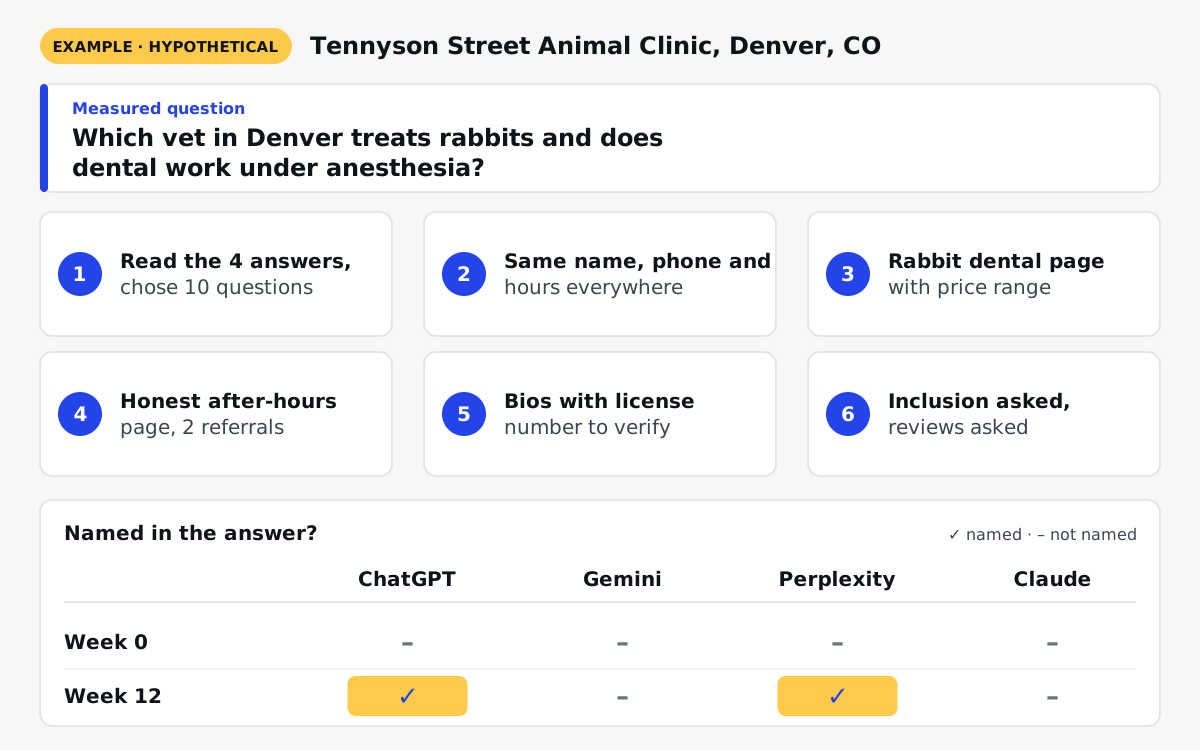
Example: a hypothetical clinic, not a sayurname client. Imagine Tennyson Street Animal Clinic in Denver: three vets, five technicians, 11 years open, 340 Google reviews averaging 4.7. One vet sees about 600 exotic patients a year; a rabbit dental under anesthesia costs $450 to $900. The site said “we treat dogs, cats and exotics” in one line, and Google still showed Sunday hours dropped two years earlier.
The measured question was “Which vet in Denver treats rabbits and does dental work under anesthesia?”. At week 0 the clinic was named by 0 of 4: ChatGPT named an exotic hospital and two 24-hour hospitals, Gemini the most-reviewed clinics, Perplexity a Reddit thread, Claude nobody.
- Read the four answers and their sources with the vets, and chose ten questions, from rabbit dentals to the last urgent slot.
- Fixed the base: identical name, address, phone and hours on the site, Google, Yelp and Nextdoor, Sunday removed, rabbits listed as a service.
- Replaced the one-line mention with a rabbit dental page: who treats them, how many a year, anesthesia and monitoring, price range, and which cases are referred.
- Rewrote the after-hours page: closes at 7 p.m., urgent cases until 5 p.m., nights referred to two named 24-hour hospitals.
- Rewrote the bios with school, year of licensure, exotics training and Colorado license number, checkable on the board’s lookup.
- Published one page per measured question, each approved by a vet, asked the Cat Friendly Practice listing to include the clinic, and asked rabbit owners for reviews with no incentive or suggested wording.
The after-hours question moved first: by week 4, Perplexity and ChatGPT stopped offering the clinic for nights and named its two referral hospitals, which is correct. In week 5 Perplexity named the clinic for the rabbit question, citing the new page; in week 10 ChatGPT followed, after reviews mentioned rabbit dentals. At week 12 Gemini still led with the exotic hospital and its 900 Maps reviews; one Claude run in four named the clinic, which does not count.
What did not work: a “Denver’s exotic pet experts” banner moved nothing, strained the board’s rules on claimed expertise, and came down; a paid directory listing changed no answer; the bird question never moved, since the clinic sees about 40 birds a year and the avian hospital is the better answer. Results vary by city, question and competition; another clinic might see none of this in twelve weeks.
What to publish
A citable veterinary page answers one owner’s question with checkable facts. Titles that work: “Rabbit dental care in Denver: who treats it, what anesthesia involves and what it costs”; “After 7 p.m.: where to take your pet tonight”; “Cat-only appointments: how we handle anxious cats”.
An excerpt from the first: “Dr. Lena Ortiz has treated rabbits here since 2016 and sees about 600 exotic patients a year. Overgrown molars are trimmed under gas anesthesia after skull radiographs, with a technician monitoring heart rate, oxygen and temperature. A dental costs $450 to $900 depending on extractions; jaw surgery is referred to a specialty exotic hospital.” Citable means a named vet with a verifiable license, species and procedure, the line between treated and referred, a price range where rules allow, and no case story identifying a client.
When it is not worth it
If new clients already wait three weeks for a wellness visit, more demand only lengthens the queue; hire first. A referral-only specialty hospital is chosen by referring vets, not by owners asking an AI, and a rural large-animal practice by farmers who already know it.
Nor does it pay when the clinic cannot change its own website, as in groups where head office controls every page, or when nobody will commit to specifics: no named vets, no species list, no urgent-case hours. Then start smaller: correct the Google profile and hours everywhere, and return with something concrete to publish.
How the work runs, within your state board’s rules
It starts with the free test: one owner’s question sent to the four AIs, full answers saved as the starting point. Subscribed, we measure up to 10 questions every week in the four assistants, fix the site’s base so the AI can read the service pages, find out where the AI gets the answer to each question and ask for the clinic’s inclusion wherever there is a path: AAHA’s locator, the Cat Friendly Practice and Fear Free listings, Yelp. Some of those are paid or require accreditation, so we promise the request, not the listing; you see what was asked and what got in. We also publish content that answers the measured questions.
It costs $299/month, with no lock-in. A one-time $599 bonus is charged only when an AI starts naming the clinic for a measured question, checked by a person on our team, or Google Analytics shows a visit from an AI. Nobody controls AI answers, so there is no guarantee of being recommended. The content is informative and follows your state veterinary board’s advertising rules: no promised outcomes, no testimonials where restricted, no “specialist” without board certification, no solicitation, no client or patient records; a veterinarian approves every piece.
Questions
Do reviews matter more than my website?
Reviews tell the AI the clinic is real and well regarded; the service page tells it what the clinic does, for which animals. In the example, 340 reviews were not enough without the rabbit page.
Can I pay a directory to be listed first?
A featured listing can bring calls from that directory, but not a place in an AI answer, which is written from what several independent sources say.
Is this allowed by my state veterinary board?
Informative content about services, species, credentials and hours is generally what veterinary advertising rules allow; they restrict misleading claims, unearned titles and solicitation. A veterinarian approves each piece, under your board’s rules.
How long until anything changes?
In the example, the first assistant named the clinic in week 5; two had not by week 12. Some questions never move, because another clinic is the better answer.
What if the AI says we are open 24 hours?
Usually an old listing or a vague sentence on your site said so. The AI repeats what it read: correct the source, state the real hours on your site, and watch the weekly measurement.