The question your customers actually ask
Owners find the problem by accident. One asks ChatGPT about window companies in town, sees the business named, then asks again as a stranger in a fresh chat and it is gone: the first answer leaned on the earlier conversation. Another has the AI rewrite the website and sees nothing change: it polished sentences without adding a fact. The useful measure is the same question, asked the same way, every week.
Homeowners rarely type “window installer near me”. They type the house, the place and the constraint: the building (“who replaces windows in a historic rowhouse in [city] and gets the commission approval”), the risk (“lead-safe window replacement for a 1950s house with children”), or the money (“are there still tax credits for new windows in [state]”). Each shape pulls different sources; the last is often answered with expired incentives copied from installers’ own pages.
How AI answers about window companies, and from what
With web search on, the assistants run a few searches and summarize what the pages agree on. For windows the sources are predictable: the Google Business Profile, with its categories and the words customers use in reviews; Yelp, Angi, Houzz and the BBB; Nextdoor and Reddit threads; dealer locators from manufacturers such as Andersen, Pella and Marvin; state license lookups; the EPA’s search for lead-safe certified firms; and the company’s own service pages.
The company’s pages matter most, because only they carry what a constrained question needs: lead-safe work on pre-1978 houses, applications filed with the city’s historical commission, how long approvals took. “Quality windows since 2008” gives an assistant nothing to match. The four assistants disagree because each searches a different index, and each varies between runs. Size is not the criterion: national brands win the generic question, while the historic one goes to whoever states the fact plainly, with independent sources agreeing.
The most common mistake: publishing the manufacturer’s brochure
Most window company sites come from the manufacturer’s dealer kit: product-line pages, energy claims, the same bay-window photo. The copy is accurate and identical to what forty other local dealers publish, so an assistant comparing candidates for “historic rowhouse in Philadelphia” finds no sentence that belongs to any of them.
The duplicated text also carries stale promises: many sites still advertise a 30% federal tax credit for windows, although the federal energy-efficient home improvement credit ended for windows installed after December 31, 2025. An assistant that quotes your banner repeats an error with your name next to it. Put the effort into pages only you could write: house types, neighborhoods, approvals, prices, dated wherever a rule or incentive is involved.
A worked example, step by step
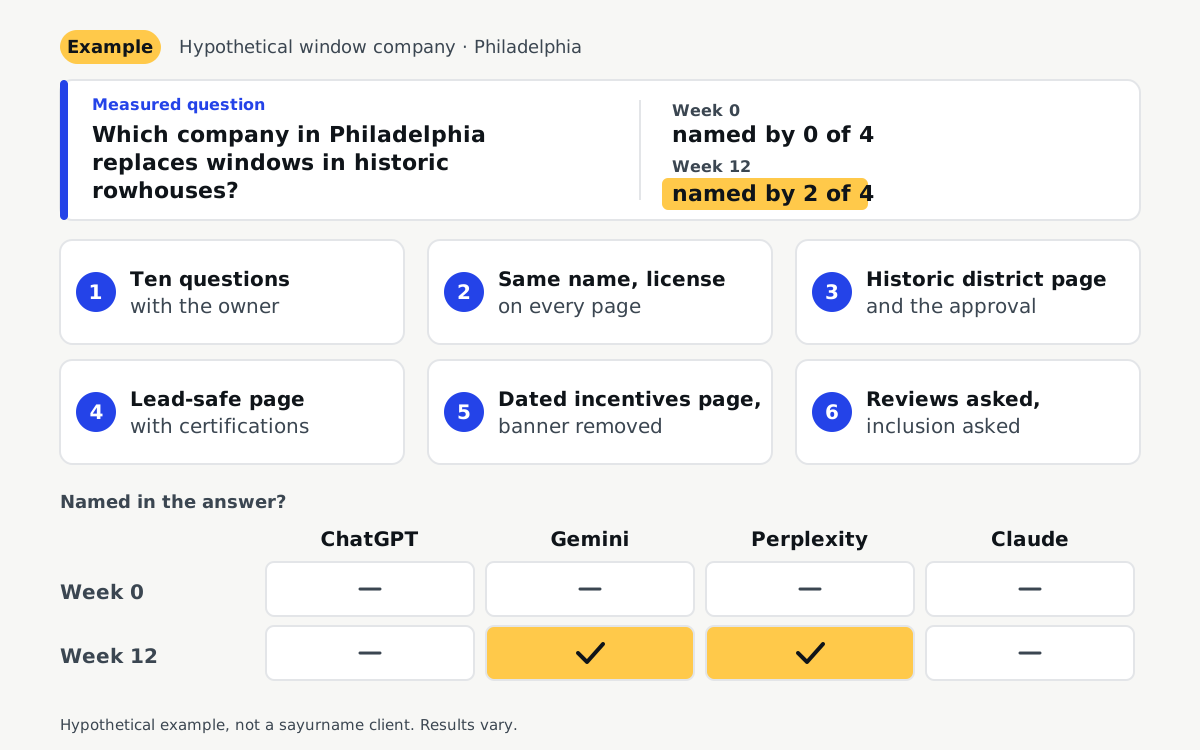
Example: a hypothetical company, not a sayurname client. Imagine Fairmount Window Works in Philadelphia: 11 people, 17 years in business, 318 Google reviews averaging 4.7, mostly working in rowhouses built before 1940. A vinyl double-hung replacement costs $850 to $1,400 installed; a wood window matching a historic profile, $1,900 to $3,400. The site was a dealer template with one 120-word windows page.
The measured question was “Which window company in Philadelphia replaces windows in historic rowhouses and handles the Historical Commission approval?”. At week 0 it was named by 0 of 4 assistants: ChatGPT named two national brands, Gemini the most-reviewed installers, Perplexity a Houzz list, and Claude gave general advice.
- Chose ten questions with the owner, among them historic districts, lead-safe work, noise near I-95 and cost per window.
- Fixed the base: the same name, address and phone everywhere; the Pennsylvania home improvement contractor number and city license in every footer; the EPA lead-safe listing corrected from an old company name.
- Replaced the 120-word page with one on historic districts: what the commission usually approves, how the application is prepared, and a median of five weeks to approval across the last 40 jobs.
- Wrote a lead-safe page: the firm and renovator certifications, how each opening is contained and cleaned, and why the rule covers houses built before 1978.
- Removed the “30% tax credit” banner and published an incentives page dated in its title.
- Asked for reviews after the final walkthrough, with no incentive or suggested wording, asked Houzz and the manufacturer’s dealer locator to list the company, and published owner-approved pages for the measured questions, such as job write-ups with the street, house age and approval timeline.
The lead-safe question moved first: Perplexity named the company in week 5, citing the new page and the EPA listing. In week 8 Perplexity named it for the historic question; in week 11 Gemini followed, after a Houzz project and several reviews mentioned the commission. At week 12 ChatGPT named it in one run of four, which does not count; Claude never did.
What did not work: a “most trusted window company” headline moved nothing; paid Angi leads brought jobs but no change in answers; the noise question never moved, probably because the company had no measured figures, only “quieter rooms”. Do not copy this without real historic or lead-safe jobs: the first review would contradict the page. Results vary by city, question and competition.
What to publish
A citable window page answers one homeowner question with facts others can check. Titles that work: “Replacing windows in a Philadelphia historic district: what the Historical Commission approves and how long it takes”; “Lead-safe window replacement in houses built before 1978: how we contain the work”; “Window incentives in Pennsylvania, as of November 2026”.
From the first: “Since 2019 we have filed 40 window applications with the Philadelphia Historical Commission, mostly in Fairmount, Spring Garden and Queen Village. Street-facing windows were approved in wood or composite profiles matching the original muntins; vinyl was refused. The median wait was five weeks, and we do not order windows before approval.” What makes it citable: a named place and house type, a count of real jobs, the line between approved and refused, a timeline, and a date on anything that depends on a rule.
When it is not worth it
If installation is booked four months ahead, more demand adds nothing; hire crews instead. A company installing mostly for builders or a big-box retailer’s program is chosen by those buyers, not by homeowners asking an AI. In a town with two installers, a complete Google profile already makes you the answer.
It also does not pay when the company will say nothing specific: no price ranges, no license number, no neighborhoods. Nor should you chase questions you cannot serve: a dealer that has never filed a historic-district application should not publish a page implying it has. Start with what your real jobs answer and correct the directory listings first.
How the work runs
It starts with the free test: one homeowner question, four AIs, full answers saved as the starting point. Subscribed, we measure up to 10 questions every week in the four assistants, fix the base of the site so the AI can read the service pages, find out where the AI gets the answer to each question, and ask for the company’s inclusion wherever there is a path: the Andersen, Pella or Marvin dealer locator, Houzz, Angi. Some of those are curated or paid, so we promise the request, not the listing; you see what was asked and what got in. We also publish content that answers the measured questions.
It costs $299/month, with no lock-in. A one-time $599 bonus is charged only when an AI starts naming the company for a measured question, checked by a person on our team, or Google Analytics shows a visit from an AI. Nobody controls AI answers, so there is no guarantee of being recommended. Pages state your contractor registration and EPA lead-safe certification where they apply, and date every incentive.
Questions
Do reviews matter more than my website?
Reviews show the company is real and liked; the service page says what it does. In the example, 318 reviews were not enough until a page stated the historic-district work, and reviews mentioning the commission helped Gemini connect the two.
I am a certified dealer for a big brand. Isn’t the manufacturer’s locator enough?
It helps. But it lists every dealer the same way, so it cannot answer a constrained question alone. Your pages have to say what you do that the other dealers on that list do not.
Should I mention tax credits and rebates?
Only with a date and a source. As of November 2026, the federal energy-efficient home improvement credit no longer covers windows installed after 2025, and utility programs change yearly; an undated banner becomes an error under your name.
How long until anything changes?
In the example, the first assistant named the company in week 5 for a narrow question and in week 8 for the main one; two had not by week 12. Some questions never move.
What if the AI says something wrong about my company?
It happens: an old company name, a closed showroom, an expired credit. Correct the source, usually a directory or an old page, and state the right fact, dated, on your own site.