
Published November 19, 2026
AI still recommends a lawyer who left your firm: how to clean it up
List every place that ties the lawyer’s name to the firm, then fix the ones the firm controls first: redirect the profile page to the team page with one dated sentence, re-sign her guides only after a current lawyer has reviewed them, and correct the directory entries. Ask the lawyer to update the profiles only she can edit. Assistants read pages without a date, so an old line is as true to them as a new one. Re-read frozen questions after a few weeks and promise no result. This is general information, not legal advice.
Why the name outlives the job
A lawyer leaves in March. By June, a prospective client asks an assistant for a good employment lawyer and is told to call her at your firm. The receptionist explains that she has gone, the caller is annoyed, and the firm has spent a phone call to look out of date. Nothing is broken in the assistant. It read a profile page, a directory entry and a news article, and all three said she works at the firm.
The reason is how assistants read. A page rarely says when a sentence was true. “Dana Whitcombe is a partner at Brennan Hale” looks the same in a 2023 article and in a 2026 profile, so the assistant treats it as a present fact. The more places repeat it, the more settled it looks. A departed lawyer who published a lot is the hardest case, because her name sits in many sources that the firm does not own.
There is also a professional side. Many regulators expect a firm not to present a lawyer as available when she is no longer there, and clients may rely on what they read. Check your own rules on this and on how to tell clients about the change. This page covers only the part that sits on pages and in profiles.
Find every place that links the name to the firm
Start with a search, not with your website. Search the lawyer’s full name together with the firm’s name on a search engine and on each of the four assistants, and read the complete answers. Then open the sources they cite. Write each place on a list with three columns: where it is, who can edit it, and what it says.
Group the places by who controls them. The firm controls its own site: the profile page, the bylines on guides and articles, the team page, the contact page, the structured data that names the person as working for the firm, and the firm’s social bios. The firm can usually claim and edit directory entries and its listing at the local bar or law society. Only the lawyer can edit her personal profile on a professional network and, often, her own entry in a legal directory. Nobody at the firm can change a news article, a conference page or someone else’s blog.
Do not try to fix everything. Rank the places by how likely an assistant is to read them: the firm’s own pages first, then the directories and bar listings the assistants cite for lawyers in your country, then everything else. A press article from two years ago is rarely worth a correction request.
What to change, in the order that matters
Own site first. Do not delete the lawyer’s profile page: a deleted page returns an error, and the old address stays in other sources pointing at nothing. Redirect it to the team page of her practice area, and on that page add one plain sentence with a month: “Dana Whitcombe left the firm in March 2026. Questions about her matters go to Adrian Brennan.” Say only what the firm is entitled to say and what the lawyer agreed to. Where the departure is sensitive, keep to the neutral version.
Bylines are the trap. A guide that carries the departed lawyer’s name and her sign-off keeps the connection alive on exactly the kind of page an assistant likes to quote. Do not simply swap in another name. Have a current lawyer read the guide, correct what has changed since, and then sign it. If nobody can stand behind it, take the guide down or fold it into a page that someone can.
Then the directories and the structured data. Edit the entries the firm controls so that she no longer appears in the list of lawyers, and remove her link to the firm from the page’s structured data. Ask her, kindly and in writing, to update her own profiles with her new firm in the same words. A profile she updates and the firm does not, or the other way round, leaves two versions for the assistant to choose from.
Last, say it once where an assistant will find it: a short dated note on the team page is enough. Do not publish a press release to announce a departure, and do not write about the lawyer in a way that could read as criticism.
A worked example, step by step
Example: a hypothetical firm, not a sayurname client. Brennan Hale is an invented six-lawyer employment-law firm in Leeds. Dana Whitcombe, a partner who wrote most of its guides on unfair dismissal, left in March. Four months later the receptionist logs five calls in one month from people asking to speak to her.
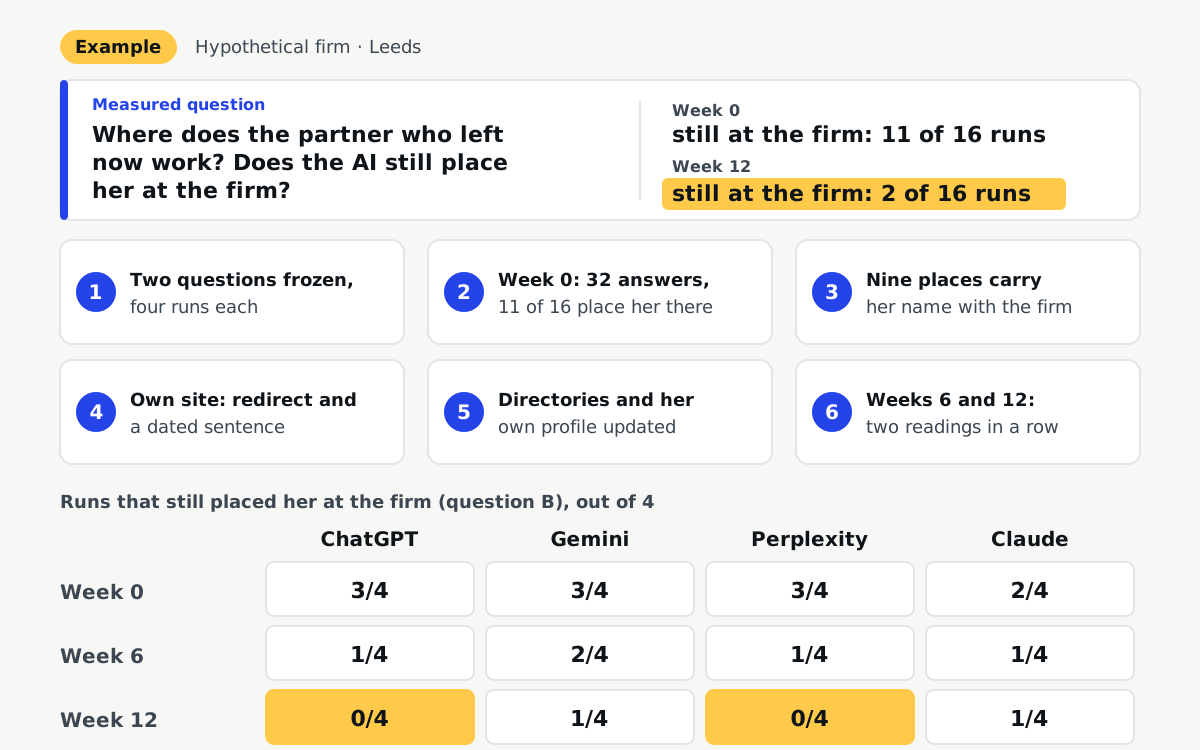
The firm froze two questions and asked each one four times on each of the four assistants, which makes 32 answers at every reading. Question A is what a buyer asks: “who is a good employment solicitor for unfair dismissal in Leeds?” Question B asks about the person: “Dana Whitcombe employment solicitor Leeds: where does she work?” For A, the firm counts the runs that name Dana as working at Brennan Hale. For B, it counts the runs that say she is still there.
- Froze the two questions and saved every full answer with its date.
- Week 0: read the 32 answers. Question A named Dana at Brennan Hale in 4 of 16 runs. Question B said she is still at the firm in 11 of 16.
- Searched her name with the firm’s name and found nine places: three on the firm’s site (her profile page and two guides carrying her byline), three directory entries, two press articles and her own professional-network profile.
- On the firm’s site: redirected her profile to the employment team page, added the dated sentence, and had a current partner review both guides, correct two paragraphs on notice periods that had changed, and sign them.
- Edited the two directory entries the firm controls, and asked Dana to update the third and her own profile. She did both within a week. The two press articles were left alone.
- Weeks 6 and 12: asked the same questions again. A change counted only when two readings in a row were lower than week 0.
Question B went from 11 of 16 runs at week 0 to 5 at week 6 and 2 at week 12. All four assistants gave a lower count at both later readings, so the change counted on each. ChatGPT and Perplexity reached 0 of 4, while Gemini and Claude stayed at 1 of 4. Question A named Dana at the firm in 4 of 16 runs at week 0 and in 1 of 16 at week 12. The two press articles still carry her name beside the firm’s, and the answers that still place her there cite them.
The reception log is the measure the firm trusts: calls asking for Dana fell from five in the month to one. Another firm might see little change in the assistants after twelve weeks and still have stopped the wrong calls.
When it is not worth the effort, and what not to do
If the lawyer left years ago and no assistant names her at the firm, there is nothing to fix. Run the two questions once and keep the answers. Do the work only when an answer places her at the firm, or when calls and emails show people still looking for her.
If the departure is contested or involves a dispute, leave the wording to the partner responsible and, where one exists, to the firm’s adviser on professional conduct. The cleanup is quiet and factual. Never remove a lawyer’s past work from the record to hide that she was there: a dated sentence is true, and an erased page is not.
Do not ask assistants to forget a name, and do not request the removal of every old article. The lasting fix is on the pages the assistants read. And never edit or impersonate a profile that is not the firm’s: only she can change hers.
How the work runs
It starts with the free test. Once subscribed, we measure up to 10 questions every week and publish as much as we judge necessary for AI to cite your firm in the answers you want. Volume and format follow what each question needs, and that part is our call. We also ask for inclusion in the sites the assistants use. What we promise is the request, not the listing.
It costs $299 a month, with no lock-in. A one-time $599 bonus is charged only when an AI starts naming your firm for a measured question, checked by a person on our team, or Google Analytics shows a visit coming from an AI. Your firm stays responsible for validating the legal content of what is published, and each piece comes with one revision. It is not legal advice, and it promises no client.
Questions
How long until assistants stop naming her at the firm?
It depends on how many sources repeat the old line. After the firm’s own pages and directories are fixed, expect weeks rather than days, and read the same questions again at about six and twelve weeks. Old press articles can keep the name alive longer.
Should we delete the lawyer’s profile page?
No. Redirect it to the team page for her practice area and add one dated sentence. A deleted page leaves old links pointing at an error.
Can I ask the lawyer to change her own profiles?
Yes, politely and in writing, with the exact wording you want. Only she can edit most of them, and two different versions give the assistant a choice.
What if a guide she wrote is still good?
Keep it only if a current lawyer reviews it, corrects what has changed and signs it. If nobody can stand behind it, take it down.
Is this a legal obligation?
Rules on how a firm presents its lawyers and informs clients differ by country and regulator, so check yours. This page covers pages and profiles, and it is not legal advice.