
Published November 2, 2026
What to do when ChatGPT says something wrong about your business
When an assistant gives a wrong price, service or location, save the complete answer and verify the fact with the business. Inspect your own pages, controlled profiles and any cited sources; correct what you control and request corrections elsewhere. Repeat a comparable question over time. The cited source is a lead, not proof of the assistant’s entire reasoning, and no correction guarantees a future answer.
Confirm it before you fix anything
Ask the question on each assistant, in a new conversation, in the words a customer would use. Save the full answer with its date and the assistant that wrote it. Answers change from one day to the next, so ask more than once. A fact that is wrong once may be noise; a fact that is wrong every time is worth fixing.
Keep the exact question, language, date, assistant and search setting where shown. A different location or a leading question can produce a different answer. Separate a wrong fact from an unavailable response; neither should be silently dropped from the record. The goal is to establish what was actually said, not to construct the most favorable score.
Where a wrong fact usually comes from
Look for the source before you look for the culprit. An old page of your own that still shows a past price or service, a directory or profile that was never updated, an article written years ago, or another company with a similar name. If the assistant is describing a different company altogether, that is a different problem, and our guide on brands mixed up by AI covers it.
A link in the answer is a place to investigate, not a complete audit trail. Open the actual page and note whether the wrong fact is present, its date and who controls it. If no source is shown, search for the exact wording but label the result as a possible lead. The model may rely on information that is not visible in the answer.
Fix the sources, in this order
Correct the facts on the pages and profiles you control, keeping the effective date and preserving genuinely historical information where appropriate. Then request corrections from independent site owners and record the request and outcome. Clear consistent information is useful to customers and can make a better source available; it does not force an assistant to retrieve or repeat it.
What not to count on
Most assistants offer a way to report a wrong answer. Use it if you like, but we know of no promise that it changes what the assistant tells other people, so treat it as a note and not as the fix. Nobody can promise how fast an assistant will pick up a correction, and nobody should promise that it will.
A report submitted through an assistant’s interface and a correction request to a directory are separate actions with separate outcomes. Keep a record of the request and whether the owner accepted it. A report may be worth sending, especially for a harmful error, but do not promise that it changes other people’s answers or a specific deadline.
How to check that the fix held
Keep the same frozen question, ask it on each assistant every week and save every full answer. Compare the answers over several weeks. If the right fact now appears most of the time, the correction is working; if the old fact keeps coming back, look for another page still saying it.
Review each assistant’s results separately and keep both correct and incorrect responses. A series can describe the observations you collected; it cannot establish the probability for every user or prove which edit caused a change. If the same error continues, investigate other current sources, a name collision and changed settings before deciding what to do next.
Worked example: an old service area
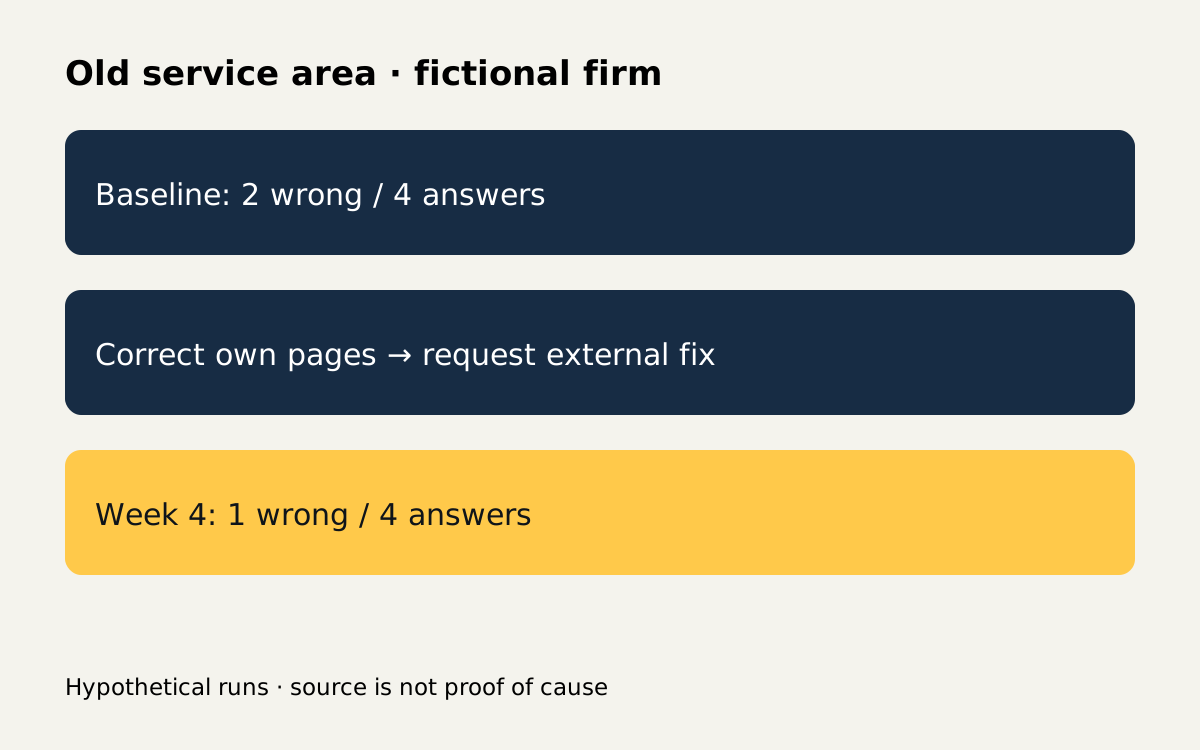
This is a hypothetical example, not a sayurname client. Riverbend Appliance Repair has five technicians and repairs washing machines within 20 miles of Denver. It used to serve a neighboring town but stopped on January 1. The owner wants to know whether an assistant still tells people the business covers that town. The business can verify its current service area; the date and company are invented for this illustration.
At the first measurement, two of four available answers incorrectly include the old town, one gives the correct area and one says it cannot determine the boundary. One incorrect answer links to an old directory page. Save all four full answers. The directory link is a useful place to inspect; its presence does not prove it was the only source of the answer. A vague answer is not the same thing as a verified wrong statement.
- Write the precise question, intended city and language. Save each answer with date, assistant and visible search setting. Keep a copy of the evidence before editing any page, and repeat the same question rather than adding a new clue to the later wording.
- Ask the business owner to confirm the current boundary and the effective date. Search the business’s own pages for the old town. In the example, an old service page still promises coverage and a profile repeats it; a historical announcement correctly says the area was served before the change.
- Update the active service page and controlled profile to state the current boundary and date. Label the historical announcement as historical rather than falsifying it. Keep the old version and change date so a reviewer can see exactly what changed and can reverse an error.
- Open the cited directory page, confirm that it actually contains the outdated area, and use its published correction channel. Save the URL, request and reply. Do not mark it corrected until the page changes; the directory may decline or take time to respond.
- Repeat the unchanged question weekly in fresh conversations. In the hypothetical fourth week, one answer still includes the old town, two give the correct boundary and one remains uncertain. Save all answers and note a changed model or search setting if visible.
- Review the remaining error and the outstanding request. The improvement from two wrong answers to one is an observation in two runs, not proof that the edit caused it or that a customer will never see the old claim again. If the incorrect answer could lead to safety, legal or financial harm, correct customer-facing channels promptly and escalate it to the responsible person rather than waiting for the next weekly check.
A third-party page may be accurate for its date, may decline a request or may be inaccessible. In each case record what is known and keep the current information easy to verify. An assistant can still use other information, so a corrected page is not a warranty about its output.
Do not manufacture reviews, claim ownership of someone else’s listing or rewrite a historical price as if it had always been current. If the business cannot agree on the correct fact, resolve that internally first; repeating contradictory statements on more pages will not resolve the underlying uncertainty.
Where sayurname fits
The free test saves the full answers to one question from ChatGPT, Gemini, Perplexity and Claude. After subscribing, the service works on the questions, requests inclusion where sources offer a route, and measures weekly. It costs $299 a month without lock-in, plus a one-time $599 bonus when a new positive name in a measured answer where the business was absent at baseline or an AI-referred visit recorded by connected Google Analytics occurs during the service. A team member checks the evidence; neither result is guaranteed.
Questions
Can I ask ChatGPT to change what it says about my business?
You can report an answer or correct a conversation, but neither guarantees what other people will see. Correct verifiable sources you control, request external corrections and check future answers separately.
How long until the answer is corrected?
Nobody can say. It depends on which sources the assistant reads, so keep asking the same question every week and judge by the pattern.
What if the wrong fact is on a site I do not control?
Ask the owner to correct it, and make sure your own pages state the right fact clearly so that the assistant has a better source to read.
Should I report the wrong answer inside the assistant?
You can, but treat it as a note. We know of no commitment that it fixes what other people are told, so the sources are where the work is.