Published October 23, 2026
When AI mixes your brand up with something else, and how to fix it
A shared name can lead an AI assistant to describe a different business, a product or an ordinary word. Save the full answers first, identify the conflicting facts and compare the business information you can verify. Correct your own pages and request corrections elsewhere; repeat the same questions over time without assuming any edit controls an assistant.
First, confirm it with the same question
Ask each assistant about your brand the way a customer would, for example "what is [your brand]?" and "is [your brand] good for [what you sell]?". Save the full answers with the date and the assistant that wrote them. One odd answer can be a one-off; the same mix-up in several answers is a pattern worth fixing.
Use both a named diagnostic question and a separate unbranded customer question. The first checks what the assistant says about an identity; the second tests whether a prospective customer encounters the business. They answer different questions and should not be combined into one score. If an assistant does not answer, record that separately.
Why it happens
The usual causes are a name shared with another company, a product or an everyday word, a name that is spelled in more than one way, and a brand that is described differently in different places. When the pieces an assistant finds do not agree, or are too thin to place you, it fills the gap with something that sounds close.
A cited source can suggest a place to inspect, but it does not reveal the full cause of an answer. Search the exact wrong address or description and check page dates, domains and ownership. An old article can be accurate for its publication date even if it is no longer current. Do not assume the cited page is the only information the assistant used.
Say who you are, the same way everywhere
Open your home page and your about page with one plain sentence: the name, what you offer, to whom and where. Use the same spelling and the same description on your other profiles, directories and listings. Consistency is what lets a machine connect the pages to one brand.
Treat legal name, public trading name, domain, location and service description as individual fields. Check that changes do not erase a real historical name or misrepresent another company. A directory you do not control may require a request; record the request and outcome instead of claiming that the listing has already changed.
Make the difference explicit
A distinct description can identify the business without making claims about the unrelated organization. Put the official name, service, place and links to profiles you control together on an appropriate page. Structured organization data can repeat those verified facts for software, but it does not force a model to use them. Do not add another business’s details to your own structured data merely because the names are similar.
Worked example: two businesses called Northstar
This is a hypothetical example, not a sayurname client. Northstar Dental is a two-dentist clinic in Austin. An unrelated Northstar Dental laboratory operates in another state. A customer asks, “Does Northstar Dental in Austin provide children’s checkups?” The clinic treats children but does not make dental appliances. The owner has three hours to review facts and has access to the clinic’s own website and business profiles.
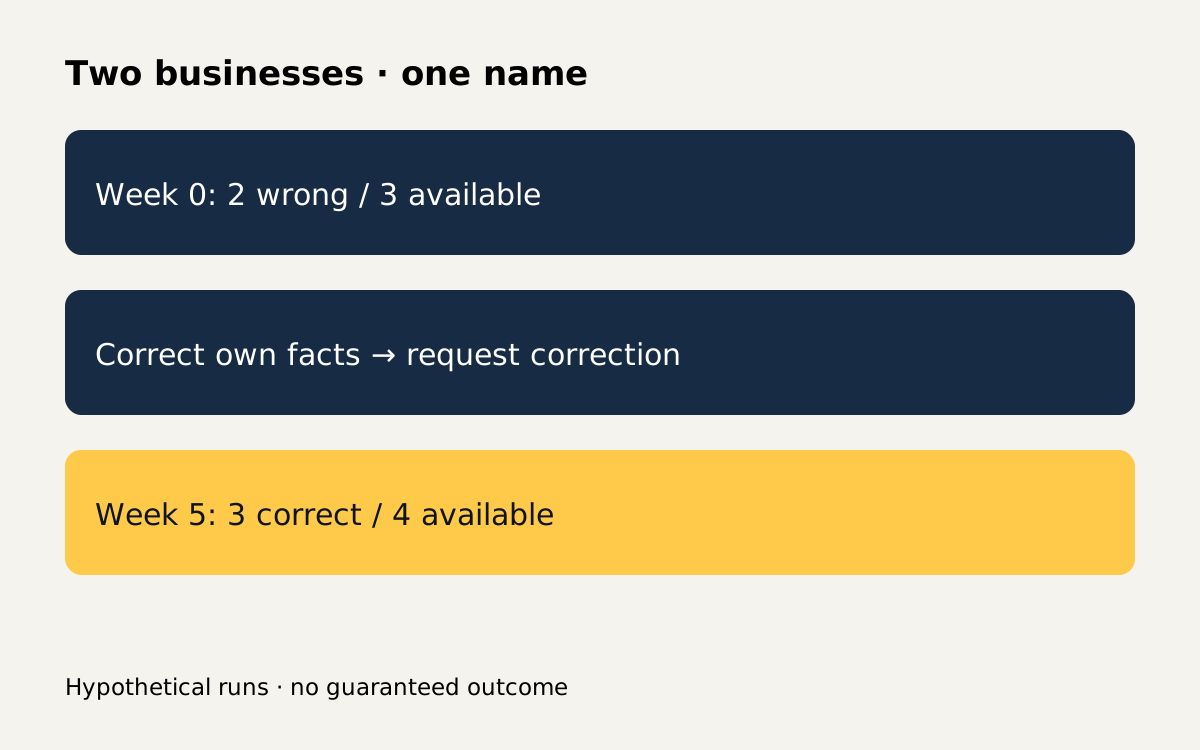
At week zero, the owner asks the named question in four assistants in new conversations. In this invented run, two answers describe the laboratory, one describes the clinic correctly and one does not answer. One of the wrong answers links to a third-party listing with an obsolete description. The owner saves all four results. Two wrong answers out of three available do not establish what every future visitor will see, and the source link does not establish that it caused the mistake.
- Record the exact named question, location, date, assistant, visible search setting and full response. Keep a separate unbranded question about children’s checkups as another series; do not use the diagnostic question to infer new customer discovery.
- Verify the correct business facts with the dentists: official name, address, services and the domain they control. The laboratory’s name is similar, but its address, work and website belong to a different organization. Do not edit or claim that organization’s identity.
- On the clinic site, add a plain description on the home and about pages, link to its own booking page and profiles, and correct an outdated service description. Update structured organization data only with facts belonging to the clinic. Save the prior page and the date of the change.
- Review the third-party listing and send its owner a correction request through the published channel. Record the URL, request date and response. A request may be refused, ignored or accepted later; do not mark the listing corrected until its owner actually changes it.
- Repeat the unchanged named question weekly in fresh conversations. At a fictional week five, three of four available answers describe the clinic correctly and one still describes the laboratory. Save every full answer, not just the good ones. Check whether the assistant or search setting changed.
- Ask the clinic to review the remaining error and any unresolved listing. A better week does not prove which change caused it or guarantee the next answer. If an assistant includes the clinic only as a source, that is different from naming it in the response. If the issue returns, recheck the saved sources and facts before making a new change.
The example shows an operational record, not a prediction of five-week recovery. Pages and external sources can change independently, assistants can vary between runs, and a listing may remain incorrect despite a request. Keep the correct facts verifiable and the outstanding requests visible.
Do not try to fix a confusion by inventing details about the other organization, copying its site or repeatedly telling a model a fact in the same conversation. If your own name or service has genuinely changed, keep a clear dated explanation of the former name instead of rewriting history.
Then measure again, every week
Repeat the same question in fresh conversations, save each full response with date and visible settings, and mark unavailable answers separately. Compare the pattern by assistant rather than treating one favorable answer as proof. Changes in a question or settings limit the comparison.
The free test saves the full answers to one question from ChatGPT, Gemini, Perplexity and Claude. After subscribing, the service works on the questions, requests inclusion where sources offer a route, and measures weekly. It costs $299 a month without lock-in, plus a one-time $599 bonus when a new positive name in a measured answer where the business was absent at baseline or an AI-referred visit recorded by connected Google Analytics occurs during the service. A team member checks the evidence; neither result is guaranteed.
Questions
Can I ask the assistant to correct itself?
You can report or correct a conversation, but that does not guarantee a change for other users. Correct the sources you control and check future answers separately.
My name is a common word. Should I rename the brand?
Not necessarily. Pairing the name with what you do, every time it appears, usually separates it from the common word.
How do I know it is fixed?
Repeated correct answers are encouraging observations for those runs, not proof that the confusion can never recur. Keep the full answers and dates.
Does a source link prove why the assistant confused the names?
No. It is a lead to inspect, not a complete record of the assistant’s decision. Save the answer and check the page itself.