
Published October 20, 2026
How to know if AI assistants recommend your business
Ask the AI assistants the questions your customers ask, write those questions down so the wording never changes, save each full answer with its date, and repeat every week. Counting how many answers name your business, and whether that count moves, is the reliable way to know. One lucky answer is not.
Pick the questions
Choose a short list of questions your customers ask before they buy, like “What's the best [your category] in [your city]?”. Use the words customers use, not the words you use internally.
Avoid questions containing your brand: they test recognition after you have supplied the answer, not whether a buyer who has never heard of you will discover it. Pick a category, a specific need and a geography where you really serve customers. Record the full question, the intended customer and why the question matters. A vague question may elicit an explanation rather than a list; that is a result worth keeping, not a failed test.
Freeze the wording
Write each question down exactly and never edit it. If you change the wording, you are measuring a different question, and this week's result can't be compared with last week's.
Keep the language, location and customer constraint alongside the question. Changing a city, adding a price ceiling or switching languages can legitimately change the list, even when the topic sounds the same. Start a separate series for the revised version and retain its first measurement. Do not splice the new answers into the old trend: you cannot tell whether a change came from your work or the changed question.
Ask every assistant
Ask ChatGPT, Gemini, Perplexity and Claude. Each can answer the same question differently, so each needs its own result. Note how you asked, including whether web search was on, so the next run is comparable.
Use a fresh conversation for each question and assistant. Record the date, model and whether search is enabled when the interface exposes them. The providers can change their systems without notice; a setting change is a break in comparability, so mark it on the record. Do not assume an assistant actually searched just because a search control exists. Save what the interface shows and identify unavailable answers rather than counting them as absences.
Save the full answer, with the date
Keep the complete text of each answer, not only the line where you appear. The full answer shows who else was recommended and which sources were cited, which is what you will want to read when the result changes.
Count a positive mention when the answer names your business. Record a link to your site separately: a source link without the business name in the answer is not a mention. A negative mention does not count as a positive recommendation.
A name in the prose, a link in the sources, and a negative description are three different observations. Keep them in separate fields, with an excerpt and the complete answer available for review. A source-only link is valuable for understanding discovery, but it does not prove the assistant named your business. A negative mention is not a positive recommendation. This distinction prevents a favorable number from hiding an answer that warns customers away.
Repeat every week and read the pattern
Answers vary from one run to the next, so one run proves little. Run the same questions weekly and look at the count over several weeks. A rise, a drop or a flat line each tells you something about whether the work is moving the answers.
Read a series by question and by assistant instead of averaging unlike questions into one score. For a single question asked of four assistants, two positive names out of four means two of the four available answers in that run, not a probability of fifty percent for every future user. If an assistant fails, report two of three available answers and note the missing response. Compare like with like and investigate an abrupt shift before claiming a cause.
A worked example: what a clinic can learn in four weeks
This example is hypothetical, not a sayurname client or a forecast. Cedar Lane Physio is a small clinic in Austin with two physiotherapists. Its owner wants to know whether people seeking help after a running injury can find it through AI. The clinic can take new patients, but it does not offer surgery. The owner chooses one question: “Which Austin physiotherapy clinic helps runners return after an injury?” The name of the clinic is deliberately absent.
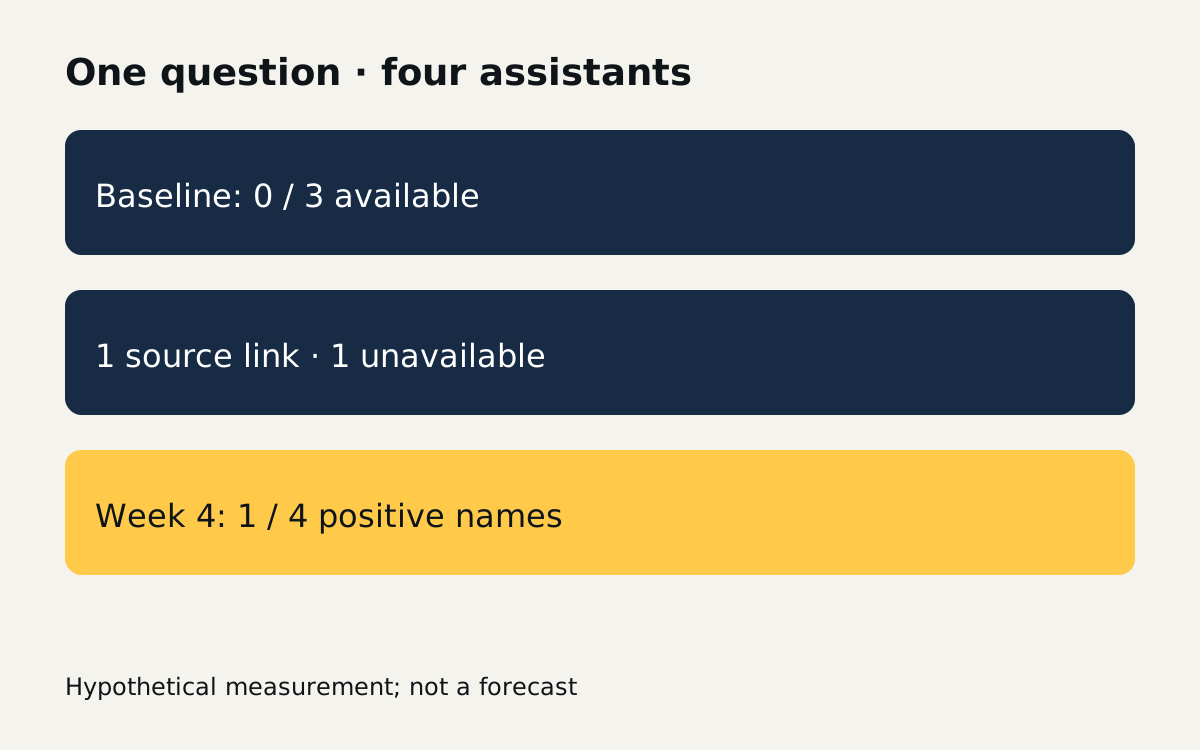
At the starting point, four assistants answer. In this illustration, none names Cedar Lane in the prose. One links to its website among the sources; another names a different clinic; a third gives general advice; and the fourth does not return an answer. The correct record is zero positive names in three available answers, one source-only link and one unavailable response. Calling that one recommendation out of four would misstate both the numerator and the denominator.
- Record the exact English question, the date, Austin as the intended location, the assistant and the search setting shown in each interface. Save a separate copy of every complete answer, including the one that links to the clinic.
- Mark the positive name, source-only link and unavailable answer in separate columns. Ask a colleague to read ambiguous language. A negative statement or a name appearing only in the source list is not a positive name in the answer.
- Check the sources the assistants actually show. The clinic finds that its public page describes general rehabilitation but does not explain its running assessment, who it serves or how to book. It corrects the page using facts the clinicians can verify; it does not claim that a particular edit will control an assistant.
- Repeat the unchanged question weekly in fresh conversations. Record model or search changes and keep any unavailable response visible. If the question is later changed to include a price, start a second series instead of replacing the first.
- In a hypothetical week four, one of four available answers names Cedar Lane positively. Save the full answer and compare it with the baseline. The finding is one positive answer in that run, not proof that the page caused it or that the clinic will appear next week.
The owner can now inspect both what changed and what did not. A source link appeared before a name, but that sequence alone does not establish causation. Another assistant may use different sources or give no names at all. The same discipline is useful when a result falls: check the stored question, available answers and settings before deciding the work has failed.
Do not use this procedure to infer market share, actual referrals or revenue. The question set is a sample chosen by the business, and answers vary. When the practical question is whether AI sent visitors, inspect a connected analytics report separately; a visit and a positive name are distinct signals. If capacity is already full or the business cannot serve the chosen question honestly, address that constraint before investing in visibility.
The shortcut
The free test asks one of your questions to ChatGPT, Gemini, Perplexity and Claude and saves the complete answers as its starting point. The service measures questions weekly. It costs $299 a month without lock-in, with a one-time $599 bonus subject to the conditions below.
You can run this in a spreadsheet without buying a tool. The cost is the time to repeat the questions and review full answers; automation helps only if it preserves the question, settings and evidence. The free test is a starting point for one question, not a forecast of the next answer. Other questions start with their own first measurement. A team member checks a qualifying result before a bonus is charged.
A qualifying positive name in an answer on a measured question where the business was absent at baseline, or an AI-referred visit recorded by connected Google Analytics during the service, can trigger the bonus. A team member checks the evidence first. The bonus is charged once per customer; neither result is guaranteed.
Questions
How often should I check?
Weekly is a good rhythm: often enough to see a change, spaced enough that one odd answer doesn't dominate the picture.
Why isn't a one-time check enough?
Because answers vary between runs. A single check can show you in a good answer or a bad one by chance. A series of checks shows the pattern.
Can I do this by hand?
Yes. A spreadsheet with the question, the assistant, the date, the full answer and a yes-or-no for “named” is enough. It takes time, which is why many people automate it.
What counts as being recommended?
For a positive mention, the answer must name your business. A link to your site among the sources is useful evidence, but it does not count as a mention on its own; a negative mention is not a recommendation.