Published October 20, 2026
Why ChatGPT doesn’t mention your company
ChatGPT skips a company when the name on the door, the name on the site, and the name on the public record are three different strings. It cannot tell they are one shop, so it names a shop whose pages agree, or it describes the bread and names nobody. Aligning the three names is the fix. Nobody can promise that aligning them will put the shop in the answer.
A name the pages can agree on
An assistant does not resolve nicknames the way a neighbor does. “Bend’s best bread”, “Cascade Crumb LLC”, and “Riverside Bakery” are three queries. If each page uses a different one, none of the pages confirm the others.
The criterion is the string, not the reputation. A shop everyone in town knows can be absent from the answer because no two sources spell it the same way.
Where the silence comes from
With web search on, each assistant searches the words in the question and summarizes pages that repeat one name. A map listing under a slogan, a site under a legal name, and a review under the sign do not repeat one name. The assistant reports the name that does get repeated, which is often a competitor who picked one and kept it.
The four assistants can be silent for different reasons. One may lack the page. Another may have the page and distrust it because the record disagrees. One screenshot of a blank answer does not say which.
The most common mistake: a slogan as the name
Almost every shop puts the legal name in the footer, the slogan on Google, and the sign in the photos. It happens because each was chosen for a different audience. To an assistant they are three businesses.
The cost is concrete. The person who asks for the Saturday loaf takes the bakery whose site, map, and record all say the same name and the same cutoff. The remedy is one name, used on the sign, the site, the map, and the public record you can change. The trade-off is retiring a slogan people liked. The slogan was not a name the pages could confirm.
A worked example, step by step
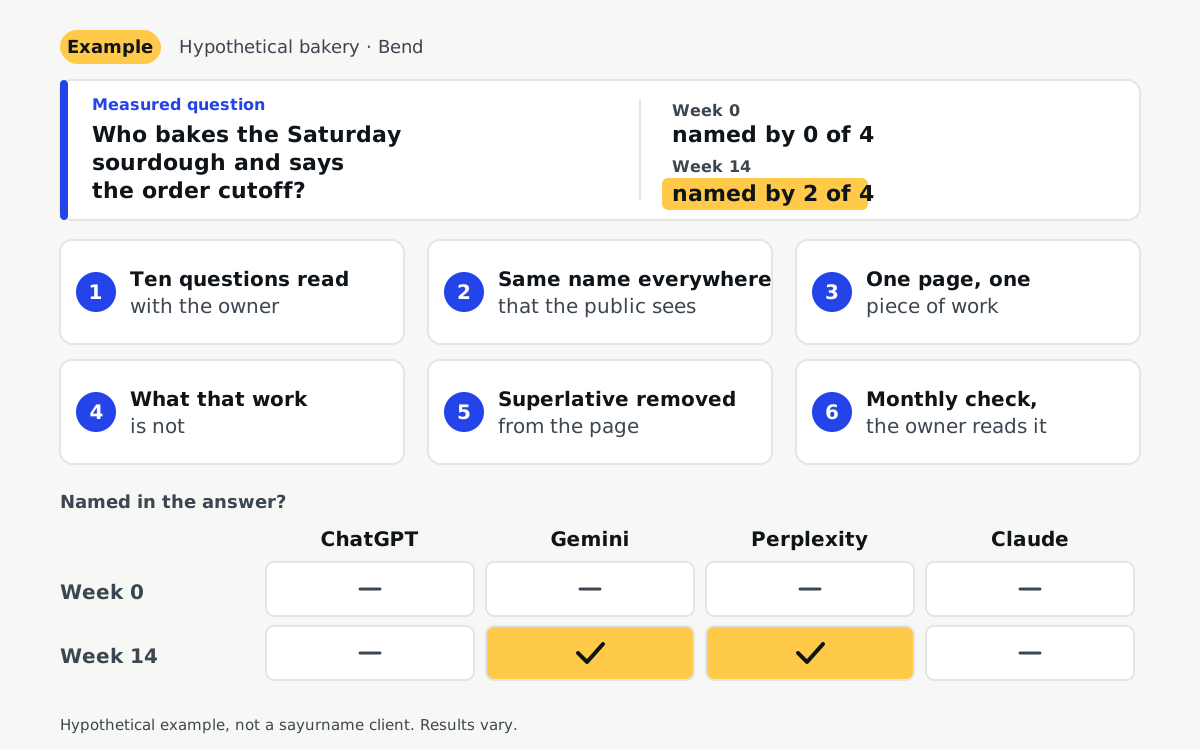
Example: a hypothetical bakery, not a sayurname client. Imagine a shop in Bend, Oregon. The sign said Riverside Bakery. The site said Cascade Crumb LLC. Google said “Bend’s best bread”. One baker, six years, 90 reviews averaging 4.8, split across the three names. The Saturday sourdough is ordered by Tuesday at 16:00. A loaf is $8. The old test was asking ChatGPT “do you know Cascade Crumb?”, which praised the description because the question contained the name.
The measured question was “Who in Bend bakes a Saturday sourdough and says the order cutoff?”. At week 0 the shop was named by 0 of 4 under any of the three names.
- Listed every public place the shop appeared and wrote the exact string each one used.
- Picked one name, Riverside Bakery, the one on the sign, and changed the site, the map, and the state record that could be changed to that string.
- Published one page: Saturday sourdough, order by Tuesday at 16:00, loaf $8, not a wedding cake.
- Asked two review sites that still said “Bend’s best bread” to show Riverside Bakery. The requests were logged. The changes were not assumed.
- Stopped testing with “do you know Cascade Crumb?”. That question already contained a name.
- Kept a monthly check that the four places still used Riverside Bakery, read by the baker.
Nothing moved for six weeks. In week 8 Gemini named Riverside Bakery and quoted Tuesday at 16:00. In week 14 Perplexity followed. ChatGPT still described sourdough in Bend and named a bakery whose three pages had always matched, and Claude named Riverside in one run of four, which does not count.
What did not work: a new logo. It changed the picture and not the string. The wedding-cake question never moved, because the page says they do not bake one. Another shop might align the names and still see the Saturday question stay at zero.
When it is not worth it
If the legal name cannot be changed and the sign cannot match it, put the legal name on the sign and the site rather than inventing a fourth string. A fourth name makes the split worse.
Nor does it pay when the pages agree and the shop is absent because a competitor states the cutoff and you do not. That is a different problem. Aligning the name will not write the cutoff for you.
How the work runs
It starts with the free test. Once subscribed, we measure up to 10 questions every week and publish as much as we judge necessary for AI to cite your business in the answers you want. Volume and format follow what each question needs, and that part is our call. We also ask for inclusion in the sites the assistants use. What we promise is the request, not the listing.
It costs $299 a month, with no lock-in. A one-time $599 bonus is charged only when an AI starts naming your business for a measured question, checked by a person on our team, or Google Analytics shows a visit coming from an AI. Each piece includes one revision. It promises no customer.
Questions
If I ask ChatGPT whether it knows my legal name, and it says yes, am I being recommended?
That question already contained the name. In the example it praised the shop and the stranger’s question still named nobody.
Which name should we keep?
The one a stranger can see on the door, copied onto the site, the map, and the record you can change. The example kept the sign.
Will matching the names put us in the answer?
Not by itself. In the example two assistants named the shop after the names matched and the cutoff was a sentence. Two had not by week 14.
Does a new logo fix a missing name?
No. The logo changed the picture. The string is what the search repeats.
What if a review site will not change the old name?
Log the request and leave it. The example did not wait for every site. The site, the map, and the record were the three that had to match.