
Published October 22, 2026
Why AI cites a competitor's page instead of yours, and what to fix
When an assistant cites a competitor, save the complete answer and inspect the linked page against the exact customer question. Compare what each page actually says, what you can verify, and whether your own site is accessible. A visible citation is a lead, not a full explanation of the model’s choice. Correct a concrete gap, request external corrections where appropriate, and remeasure without promising the answer will change.
Start from what was cited
Ask the question the way your customer does, in the assistant that cites the competitor, and save the full answer with its links. The page it cited is your reference. You are not copying it, you are finding out what it does that yours does not.
Keep the exact wording, date, assistant and full response, including which page was linked and whether the competitor was actually named in the answer. A source link and a positive recommendation are different observations. An assistant may provide no sources or a link that fails; mark the limitation instead of inventing a reason.
Does it answer the question first?
Check whether the linked page actually addresses the customer’s specific question and whether your own relevant page makes the same facts easy to find. An answer-first opening can help a reader find the point, but a first paragraph does not guarantee citation. Compare service, location, limitations and evidence, not just page length or the position of one sentence.
Is it clear who it is for?
Check whether each page identifies the customer, service and place. A repairer who serves one city and a manufacturer selling nationally may both mention the same product but answer different needs. Verify your own offer with the business before filling a gap; an unsupported claim copied from a competitor is worse than an omission.
Record the differences and verify them with the business before making any claim.
Do others say the same about them?
Look at the sources shown in the answer and any profiles you can independently verify. A directory can contain stale information, and the assistant may use information that is not displayed. Record what you found and who controls each page. Ask for a correction or inclusion where an editorial process exists; never equate a submitted request with acceptance.
The linked page is a starting point for inspection, not proof of the assistant’s selection rule. Record factual differences you can verify, make only changes your business can substantiate, and keep requests and their outcomes separate.
Worked example: comparing two repair pages
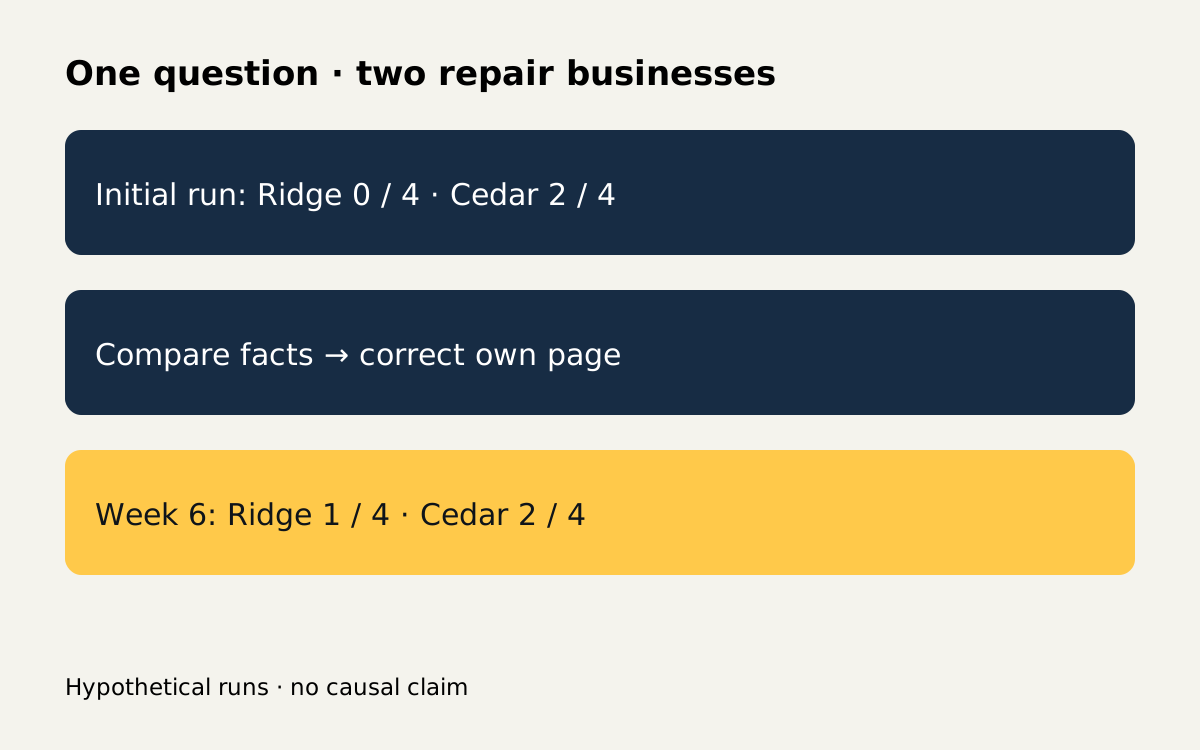
This example is hypothetical; neither business is a sayurname client. Ridge Window Repair is a four-person local business in Portland that repairs leaking windows but does not replace roofs. A fictional competitor, Cedar Repairs, is named in an assistant’s answer to “Who repairs a leaking window in Portland?” The response links to a Cedar page. The owner has two hours to approve changes and wants to learn what is missing from Ridge’s own information.
In the initial illustrative run, two of four available assistants name Cedar, none names Ridge, and one of the two provides a link to Cedar’s window-repair page. The other answers may have no links. Store the entire response and date for each assistant. The linked page is evidence of what was shown in that run, not evidence that its first paragraph caused the selection.
- Freeze the unbranded question, city, language and visible search setting. Save each assistant’s complete response and separate named businesses from linked source domains. If an assistant is unavailable, show the denominator of available responses.
- Open the cited page and record its actual claims: it describes a window leak assessment, a service area and how to request an appointment. Do not copy its wording or infer its private ranking strategy. Check the date and confirm the linked page is still available.
- Inspect Ridge’s page using the same questions. The fictional page describes general construction but does not state whether a leaking window is repaired. Confirm the real service, city and exclusions with the owner before proposing changes. A business must not claim an offering it cannot deliver.
- Add a clear description of the verified repair service, the area served, how the first visit works and what is excluded. Retain the earlier version and date. If a directory lists the old service, ask its owner to correct it and keep the request and response; acceptance is outside Ridge’s control.
- Repeat the unchanged question weekly. In a hypothetical week six, one assistant names Ridge, two still name Cedar and one gives general advice. Save all four answers. The name in the prose and a source-only link remain separate; a negative description is not a positive recommendation.
- At review, compare the initial and later full answers, the changed page and outstanding requests. The owner can decide whether further work is useful. One new name in this example does not prove which change caused it, guarantee the next result or show a sale.
The competitor’s page may have many differences, and the assistant may have used sources that were not shown. The example does not claim that a specific layout, word count or sentence placement determined the response. Treat the comparison as a way to find verifiable gaps, not as a recipe for copying a competitor or manipulating an answer.
Do not spend on visibility for a service you cannot perform or when the business has no capacity to take the work. Fix an inaccessible page or incorrect service statement first. If the cited page is about a different city, customer or service, it may not be a meaningful comparator; select another question or record that limitation.
Then fix one thing and measure again
Repeat the same question in fresh conversations, save each full response with date and visible settings, and mark unavailable answers separately. Compare the pattern by assistant rather than treating one favorable answer as proof. Changes in a question or settings limit the comparison.
The free test saves the full answers to one question from ChatGPT, Gemini, Perplexity and Claude. After subscribing, the service works on the questions, requests inclusion where sources offer a route, and measures weekly. It costs $299 a month without lock-in, plus a one-time $599 bonus when a new positive name in a measured answer where the business was absent at baseline or an AI-referred visit recorded by connected Google Analytics occurs during the service. A team member checks the evidence; neither result is guaranteed.
Questions
Does the competitor's page have to be better than mine?
No. The linked page shows a visible source in that response. Its selection does not prove it is better or that any specific feature caused the assistant’s choice.
Can I ask the assistant why it chose them?
You can, but its explanation is not a reliable record of how it chose. The cited page and the saved answers are better evidence.
Should I copy the competitor's page?
No. Use it to see what the question needs, then answer it in your own words and with what only you know about your business.
Does a cited page reveal the full selection process?
No. It shows a source visible in that response; it does not show all information or prove why the assistant selected it.