
Published October 22, 2026
How AI assistants choose which brands to mention
An assistant may draw on its model, available search results and conversation context when answering a buyer’s question. Providers do not expose one universal formula for choosing brands, and the same question can produce different answers. Check whether the business is accurately described on accessible pages and relevant independent sources, then save repeated responses to the same unbranded question. A source link, a brand mention and a positive recommendation are different outcomes.
There is no single published ranking formula
A buyer may ask for a local service, compare software or seek a shortlist for a specific budget. The words, location, language and context of that request change what a useful answer looks like. Some assistants can search the web, while others may respond from their existing model or ask for more details. A product’s available tools and settings matter; do not assume every answer searched the web.
A recommendation is generated for a particular request, not selected from a public, fixed league table. Providers do not disclose every signal behind each answer, and an answer does not reveal all the information considered. A confident explanation such as “the assistant picked you because of this page” is a hypothesis unless there is evidence that separates that page from other changes.
Make the business easy to understand
Start with facts a buyer needs: the service, audience, geographic coverage, conditions and a working next step. Put them on a page a person can access and maintain. Explain meaningful exclusions too. A company that repairs residential windows but not car glass should say so; an ambiguous description can attract the wrong request even if the site gets traffic.
Check the same facts in profiles and independent references. Where an outside listing is wrong, request a correction through its stated process and record the request. An editor may decline or take time; asking for inclusion does not purchase a mention. Credible detail helps a human assess the business, but no page or directory can force an assistant to choose it.
Separate retrieval from the answer
For search-enabled products, a page must be reachable through the relevant discovery path to be a candidate for that path. OpenAI documents OAI-SearchBot for its search features separately from GPTBot, which has a different purpose. Google describes crawling and indexing for Google Search. These are product-specific explanations, not evidence that every assistant uses the same index.
Even a page that is accessible or appears as a linked source may not lead to a brand name in the text of an answer. The answer may name a competitor, ask a clarifying question, include no companies, or mention the business negatively. Record what the assistant actually wrote and whether it provided a link, rather than converting every source into a recommendation.
Worked example: choose a test before changing pages
Consider Harbor Window Repair, a fictional four-person repair business serving one city. This is an invented example, not a sayurname customer or an actual test. Its owner wants to know whether people asking for window leak repairs can find the business, and has four hours to address inaccurate public information.
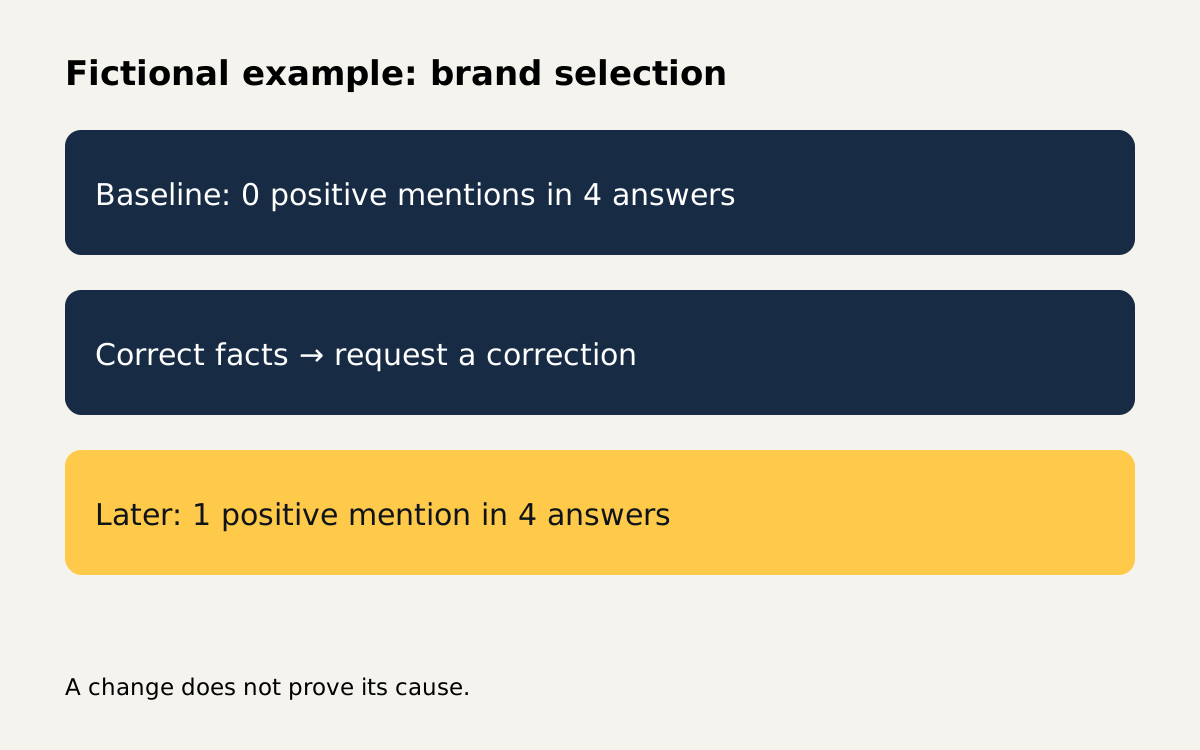
The owner writes one unbranded question: “Who repairs leaking residential windows in my city?” In a hypothetical baseline, four available assistants answer. None names Harbor; one links to its service page as a source and two name other businesses. The source-only link is useful evidence of a path, not a positive brand mention.
- Save the exact question, date, location, language, available search setting and complete response for each assistant. Record an unavailable answer separately; it is not an absence.
- Read the service page as a customer. Replace a vague “home services” label with an accurate description of leak diagnosis, the area served and what the team does not repair. Confirm every claim with the owner.
- Check three controlled profiles and two relevant independent listings. Correct an outdated telephone number where the owner has access, and request a correction from the independent listing without asserting that it has already been made.
- Repeat the same question weekly with comparable settings. Suppose a later run returns one positive Harbor mention in four available answers. Save that answer, any source links and the remaining non-mentions; do not drop inconvenient results.
- Compare the observations with the dated changes. A new mention can coincide with several edits or external changes, so this small before-and-after check does not establish which action caused it. If the answer describes the wrong service, correct the underlying claim and measure again.
The difference between zero and one is useful for a next investigation, but four answers do not establish a stable market share. A question naming Harbor could help detect incorrect facts; it is a separate accuracy check and should not replace the unbranded buyer question.
When to do something else first
Do not pay for a claim that a fixed number of pages guarantees placement. If the service is not available in the requested area, revise the target question instead of implying coverage. If the booking page is broken, repair the journey first; a mention that sends people to a dead end cannot solve that problem.
Avoid manufactured reviews, invented customer cases or repeated copy on unrelated pages. They make the evidence less trustworthy and can mislead buyers. A responsible test keeps negative and unavailable results, protects personal data and uses each provider’s permitted access methods. Start with accurate information and a buyer question that the business can honestly satisfy.
Sources and limits
Google explains how its search engine discovers and indexes pages at https://developers.google.com/search/docs/fundamentals/how-search-works and discusses its generative search features at https://developers.google.com/search/docs/fundamentals/ai-optimization-guide. OpenAI describes different user agents for search and training at https://developers.openai.com/api/docs/bots. These sources document specific products, not a universal recipe for every assistant.
A search-enabled answer can vary with the question, language, location, account context and available search settings. Save these alongside the complete answer and date. One result is an observation, not a ranking or a reliable probability. You cannot see all of the information an assistant considered, and a link in the sources is not proof that the business was positively named in the answer.
How sayurname works
The free test sends one question to ChatGPT, Gemini, Perplexity and Claude and saves the available answers. After subscription, sayurname works on the questions, requests inclusion where sources offer a route and measures weekly. The monthly service is $299 without lock-in. A one-time $599 bonus can be charged for a new positive mention in an answer to a measured question where the business was absent at baseline, or an AI-referred visit recorded by connected Google Analytics during the service. A team member checks the evidence first. Neither outcome is guaranteed.
Questions
Does a link in the sources count as a recommendation?
No. A linked page, a business named in the answer and a positive recommendation are distinct observations. Save each separately, together with the complete answer and the question.
Can I guarantee that an assistant will name my business?
No. You can improve accurate public information, request corrections and repeat a consistent measurement, but an independent assistant controls its own answers.
Should I include my business name in the test question?
Use a separate unbranded question to test whether the assistant can identify the business for a buyer’s need. A branded question is useful for checking factual accuracy, but it answers a different question.
How often should I repeat the check?
Use a consistent schedule that you can maintain, such as weekly. Record dates, exact questions and settings. A single change or result does not prove a cause.