
Published October 22, 2026
Why ChatGPT, Gemini, Perplexity and Claude recommend different brands
The four assistants can name different businesses because the question, language, location, available search tools, retrieved sources and response generation can differ. A single answer is not a stable ranking or a representative market share. Record the exact prompt and each product’s settings, save the full responses and repeat the test. Count a business named positively in the answer separately from a link listed only as a source.
Start with the question, not a winner
A person looking for a local repair service has a different task from someone comparing software for a global team. The assistant may consider constraints such as location, language, budget and product availability, but it may ask for missing details or respond without naming a company. A different answer is not automatically a mistake: check whether each response actually addressed the same buying need.
Changing the prompt from “a repair shop” to “a repair shop open on Sunday near me” changes the candidates that might fit. A prior conversation, enabled tools and account preferences can also affect an answer. Do not call one provider better from one sample or infer that a business not named in that sample is invisible to every customer. Save the entire response before assigning a category.
Understand the limits of the systems
ChatGPT can use web search when available; OpenAI separately documents OAI-SearchBot for its search features and GPTBot for content that may be used in training. Search access and training preferences are distinct. The provider explains these controls at https://developers.openai.com/api/docs/bots. A crawl request is not a recommendation, and allowing a crawler does not guarantee that a name will appear.
Google describes Google Search’s generative features as using its search index and ranking systems: https://developers.google.com/search/docs/fundamentals/ai-optimization-guide. That document concerns AI features in Google Search; do not treat it as a complete description of every Gemini product. Product surfaces and access to search can differ. Check the actual Gemini experience and settings you are testing rather than assuming it always produces a Google Search result.
Source links and answers are separate observations
Perplexity describes answering questions with sources and provides links a reader can inspect: https://www.perplexity.ai/help-center/en/articles/10352903-what-is-pro-search. Anthropic documents that Claude’s web search can use live web content and return citations: https://platform.claude.com/docs/en/agents-and-tools/tool-use/web-search-tool. Availability, integrations and product behavior depend on the plan and settings. These descriptions do not expose each provider’s complete ranking formula or establish that every answer uses search.
A source linked under an answer is evidence that the link was presented as a source, not that the assistant positively named the company. A name in an answer can be positive, neutral or negative. Classify the actual wording and retain it; do not turn a negative mention or a source-only link into a positive recommendation. A visit from an identifiable AI referrer is a separate analytics signal and may miss other influenced journeys.
Worked example: a fictional comparison
Harbor Window Repair is a fictional local business, not a sayurname customer. Its owner wants to know whether people asking about a leaking window might see the name. The team picks a specific city, confirms that the business serves it and starts with four available assistants. The numbers below are invented to demonstrate how to retain the denominator and interpret a small test.
- Write an unbranded buyer question: “Which companies repair a leaking residential window in Riverside?” Record the date, language, location, account context, model when visible and whether web search is enabled. Use the same wording and record any unavailable product.
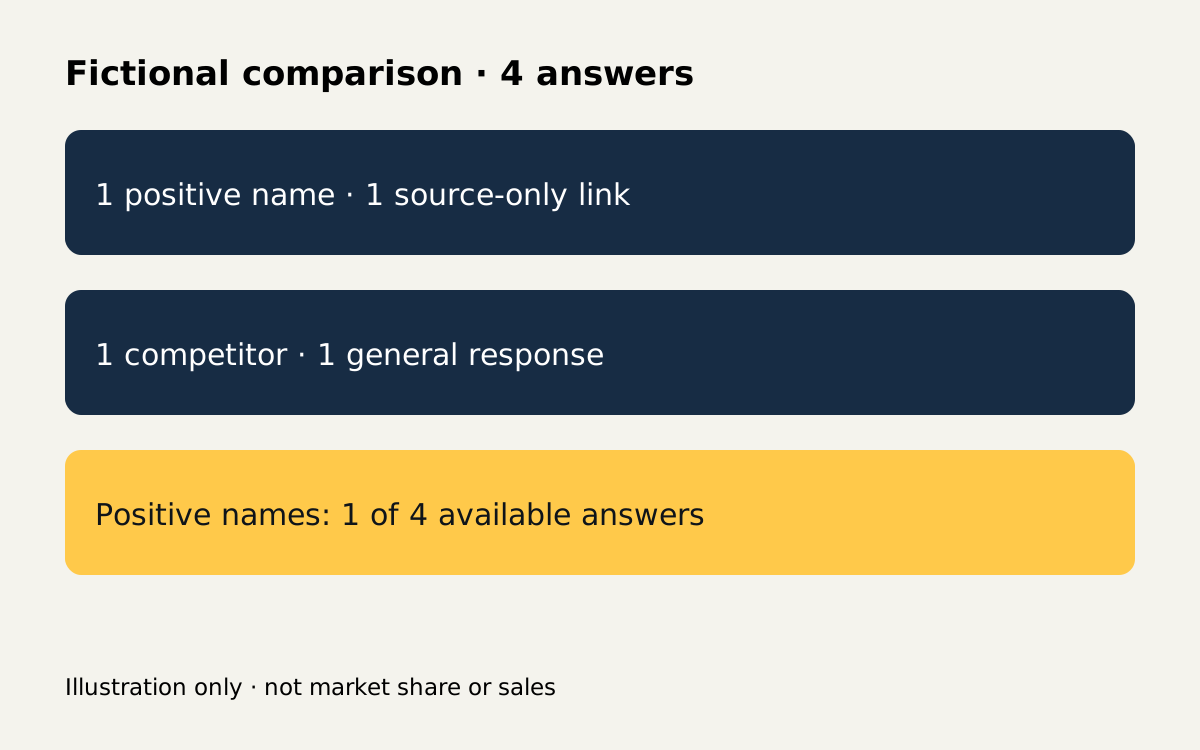
- Save all four complete answers and their links. In this hypothetical round, one assistant names Harbor positively, one links to a Harbor page without naming it, one mentions a competitor, and one provides generic advice. The positive-name count is one out of four available answers, not two.
- Open the linked pages and compare the claimed services, location and contact information with what Harbor actually offers. If a source incorrectly lists another city or an outdated phone number, document the URL and ask the owner or source operator to correct it. Do not assume a correction guarantees the assistant will select it.
- Improve the company’s service page with the repair scope, area served and contact route. Ask relevant sources for inclusion or correction where they provide a route. Record what was requested and what was actually changed; a request is not an accepted listing.
- Repeat the unchanged question on a weekly schedule and save every answer, including absences and failures. If two of four assistants name Harbor in one later round, record two of four; do not call that change proof the page edit caused it. Source indexes, product settings and responses can change independently.
The example compares four saved outputs under a described setup. It does not establish that 25% or 50% of all buyers saw Harbor, that any person visited the site, or that a sale occurred. To learn whether the result is repeatable, expand the question set to reflect real customer needs and preserve the number of available answers in each round.
When a comparison is misleading
Do not compare outputs from different dates, languages or locations and call the gap a provider effect without recording those differences. A brand may operate in one market but not another. Some products might use web search while others cannot in the tested account. If a response is blocked, unavailable or incomplete, retain it as unavailable rather than treating it as an absence or omitting it from the report.
Avoid declaring a universal winner from a small set of prompts or buying repeated tests solely to obtain a flattering result. If a customer cannot buy the advertised service, correct the offer first. If the question is too broad for any business to serve, choose a realistic customer question; do not rewrite it after seeing the answer just to make your own brand appear.
Turn the comparison into a next action
Group the evidence by question, assistant, date and outcome: positive name, other or negative mention, source-only link, no name, and unavailable. Preserve the answer because a label cannot show the context. Review discrepancies between public sources and the service page, then prioritize corrections where a real buyer could be misled. Track requests for inclusion separately from accepted updates.
Use the same question set and configuration for subsequent checks where possible. If a model or search setting changes, note the version and avoid presenting the two rounds as perfectly comparable. Investigate site visits and confirmed leads through their own measurement systems. A good comparison reveals where to investigate next; it is not a promise that any provider will recommend a brand.
How sayurname works
The free test sends one question to ChatGPT, Gemini, Perplexity and Claude and saves the available answers. After subscription, sayurname works on the questions, requests inclusion where sources offer a route and measures weekly. The monthly service is $299 without lock-in. A one-time $599 bonus can be charged for a new positive name in a measured answer where the business was absent at baseline, or an AI-referred visit recorded by connected Google Analytics during the service. A team member checks the evidence first. Neither outcome is guaranteed.
Questions
Which assistant is best for recommending my business?
There is no universal winner in one response. Compare the assistants your buyers use with relevant questions, saved outputs and repeatable settings.
Does a source link count as a positive brand mention?
No. A source-only link and a positive name in the answer are separate observations. Save both the response and its sources.
Does Google’s AI Search guidance describe all Gemini products?
No. It describes Google Search features. Check the actual Gemini product and settings used in your test.
Does one changed answer prove an edit worked?
No. Other inputs, sources or settings may change. Repeat the same test and report limitations rather than assigning causality to a small sample.
Can Analytics show every buyer influenced by an assistant?
No. Some visitors arrive through a later direct visit or another channel. A recorded AI referral is useful but incomplete.