
Published November 20, 2026
How a law firm chooses the questions to track in AI assistants
Choose up to ten questions, each written as a person with the problem would type it, without the firm’s name and in one language per question. Cover four kinds: the problem in plain words, the problem with a place, the choice question (“who can help me with…”) and the matter next door that the firm does not want. Add one control question the firm should not win, take the wording from real enquiries, freeze it, and keep it unchanged for a full series. This is general information, not legal advice, and no list can promise a recommendation.
Why the list decides what you learn
A firm that tracks AI answers learns only about the questions it asked. If the list says “best law firm in London”, the firm learns how an assistant answers a question almost nobody phrases that way. If it says “my employer dismissed me after a medical leave, what can I do”, it learns about a question that a real client types the night before she calls. The measurement can be perfectly run and still useless if the questions are the wrong ones.
The list also has to be small enough to act on. Fifty questions produce two hundred answers a week that nobody reads, while ten produce forty answers that a partner can read in half an hour and compare with the previous week. The point of choosing is to decide, in advance, which answers would change what the firm does.
Four kinds of question, and how many of each
Start with three questions that state the problem in plain words, with no place: “I was dismissed after a medical leave, what can I do”. They show whether the firm appears when the person does not yet know whom to ask. Add three that carry a place or a jurisdiction: “who can help with a dismissal after medical leave in Toronto”. These are closest to the decision, and the place changes which firms and sources an assistant uses.
Then two choice questions, the way a person compares: “how do I choose a lawyer for an employment dispute”, “what should I ask before hiring an employment lawyer”. Add one question from the matter next door, one the firm does not want, so you can see whether assistants send the wrong enquiries to it. The tenth is a control question the firm should not win, such as a patent question for an employment firm. If the firm is named there, the reading method is broken, not the firm’s luck.
Where the wording comes from
The words come from clients, not from the firm’s own site. Read the last forty enquiries, the notes reception wrote and the contact-form messages, and underline how people describe the problem before any legal term appears. “Constructive dismissal” may be the correct term, but the client wrote “they made my job impossible so I left”. Use the client’s phrase for the problem questions and the legal term only for the choice questions, where a person has already learnt it.
Do not copy any real person’s facts into a question, and do not use details that could identify someone. Strip the case down to the general problem. Do not put the firm’s name or a lawyer’s name in the list: a question with the name will almost always name the firm and tells you nothing about the people who do not know it. Write each question in one language, the language a client would use, and keep the language with the question.
Freezing the list
Write the final wording in a sheet with an identifier, the kind, the language and the date. Ask each question in the same assistants with the same settings every time and save the complete answer, not a summary or a screenshot of the first lines. Once the list is frozen, change nothing for a full series, which means at least four weeks and two readings in a row. If you edit a word, you have a new question and a new series.
A question that clearly fails (nobody types it, or every assistant answers it with the same two directories) can be replaced between series, with the reason written next to it. A question you dislike because the firm never appears is not a reason to drop it: it is the most useful line on the list. Keep the replaced question and its history so the firm can compare like with like later.
A worked example, step by step
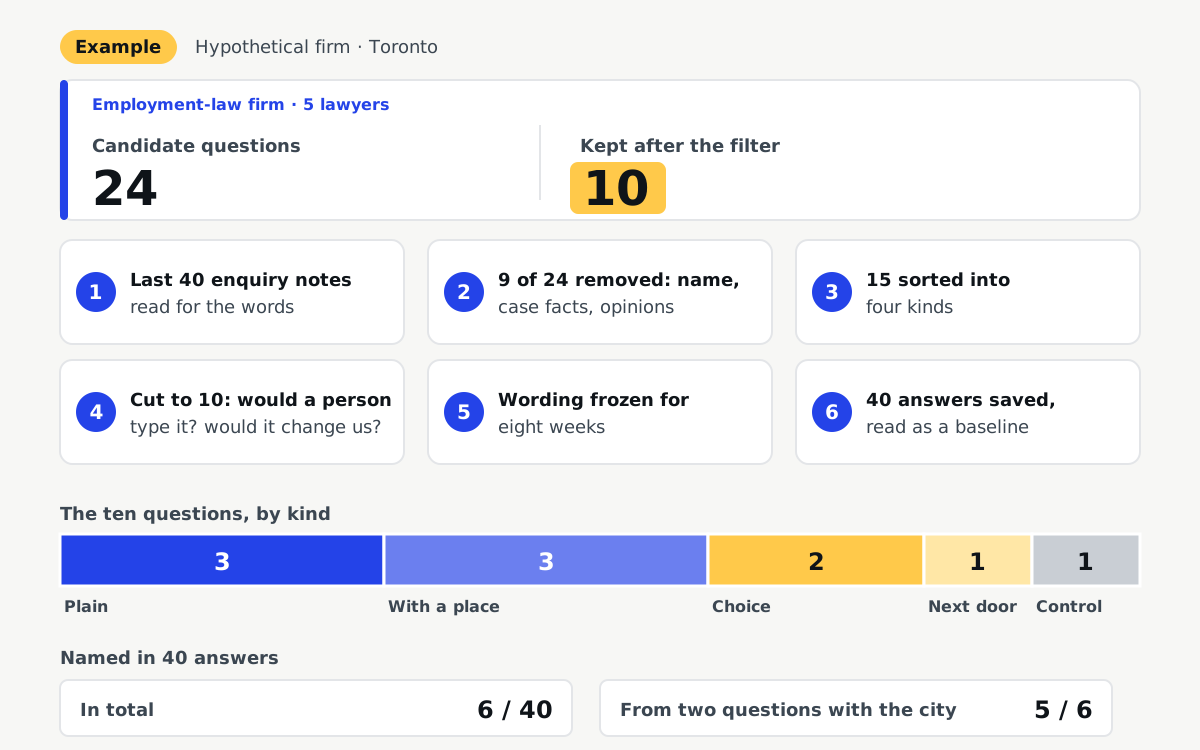
Example: a hypothetical firm, not a sayurname client. Calder & Voss is an invented five-lawyer employment-law firm in Toronto. It handles about thirty new enquiries a month and wants to track AI answers, but the first draft of its list has twenty-four questions.
The managing partner reduces the list in one afternoon, with three rules: the words come from clients, there is no name and no case fact in any question, and every question must be able to change a decision.
- Read the last 40 enquiry notes and underlined how people describe the problem, in their own words, before any legal term.
- Listed 24 candidate questions and removed 9: 4 contained the firm’s name, 3 carried facts from a real enquiry and 2 asked for a legal opinion rather than a lawyer.
- Sorted the remaining 15 into four kinds: problem in plain words, problem with a place, choice question and matter next door.
- Cut to 10 by asking of each: would a person with this problem really type it, and would a different answer change what we do. Kept 3 plain, 3 with a place, 2 choice, 1 next door and added 1 control question about a patent dispute.
- Wrote the final wording in a sheet with an identifier, kind, language and date, and froze it for eight weeks.
- Ran the ten questions in four assistants, 40 answers, and saved each in full. Read the result as a baseline, not as a score.
In the first reading the firm was named in 6 of the 40 answers, and 5 of those came from two questions, both with “Toronto” and the word “dismissed”. The plain questions without a place named it in none, and the control question named it in none either, which is what it should do.
The partner learnt two things she could act on: the firm is visible only when the person already names the city, and no assistant sends people to it when they describe the problem without a place. She did not conclude that the firm is invisible. She wrote down the baseline and the date of the second reading.
When it is not worth the effort, and what not to do
If the firm has no capacity to take new matters, a question list will only show demand it cannot serve. Fix the capacity first, or choose questions in the one practice area where it does have room. If the firm serves a very narrow set of clients who come only through referrals, three questions and a quarterly reading may be enough.
Do not build the list from the questions the firm already wins, because it will always look healthy. Do not use the firm’s name in any question, do not copy a client’s facts into the list, and do not describe the firm’s rate of success in any page you publish from the results. Check your own rules on advertising and on the use of client information before you start, because they differ by country and regulator.
How the work runs
It starts with the free test. Once subscribed, we measure up to 10 questions every week and publish as much as we judge necessary for AI to cite your firm in the answers you want. Volume and format follow what each question needs, and that part is our call. We also ask for inclusion in the sites the assistants use. What we promise is the request, not the listing.
It costs $299 a month, with no lock-in. A one-time $599 bonus is charged only when an AI starts naming your firm for a measured question, checked by a person on our team, or Google Analytics shows a visit coming from an AI. Your firm stays responsible for validating the legal content of what is published, and each piece comes with one revision. It is not legal advice, and it promises no client.
Questions
How many questions should a law firm track?
Up to ten is enough to cover the problem, the place, the choice and the control. More than that produces answers nobody reads, and the point is to decide what to do next.
Should the list include the firm’s name?
No. A question with the firm’s name almost always names the firm and does not show whether strangers who have the problem are sent to it.
Why add a question the firm should not win?
It is a control. If the firm is named for a matter it does not handle, the way you read the answers is wrong, and you learn that before drawing conclusions.
Can I change a question when the result is bad?
Not in the middle of a series. A changed word makes a new question. Replace a question between series, with the reason, and keep its history.
Can this guarantee that AI will recommend my firm?
No. It shows where the firm stands and which answers would change what it does. It is general information, not legal advice, and it promises no recommendation and no client.