
Published November 6, 2026
Why an AI recommends a different lawyer for each legal problem
An assistant does not keep one list of “the lawyers in this city” and reuse it. It answers the question it was asked. A construction defect after a renovation and a divorce are different questions, so they draw different pages. A firm that publishes one page for both gives the assistant nothing it can attach to either. The firm that states one matter is named on that question and stays off the other. Nobody can promise either list. This is general information, not legal advice.
The list is per question, not per city
Partners often ask “who does the assistant recommend in our city?” and treat the answer as the firm’s rank. That question is not the one a client asks. The client names the problem. Change the problem and the sources change, even in the same city on the same day.
The criterion is whether a page states that problem and a boundary. Fame in the city is not the criterion. The firm everyone knows for one matter can be absent from the next matter, including a matter it also does, if no page states the second one.
Why the four assistants still disagree
Each assistant searches a different index, and the same one changes between runs. So two assistants can name different firms for the same construction question, and the same assistant can change next week. One screenshot of “best lawyer” proves little about either matter.
What does not change is the mechanism. The page that says “a homeowner’s claim about defective renovation work, not a divorce” can be quoted on the first question and correctly ignored on the second.
The most common mistake: one page for both matters
Almost every small firm puts every matter it has ever touched on one page, so it will not miss a call. It happens because turning a matter away in public feels like losing it. To an assistant, a page that says both “renovation defects” and “divorce” states neither, because it does not say which client and which first piece of work.
The homeowner takes the firm that printed the renovation claim and said it is not a divorce. The divorce question keeps naming firms that publish divorce. The remedy is one page per matter you will actually take. The trade-off is that the other question names someone else. That is the point of the question, not a failure of the page.
A worked example, step by step
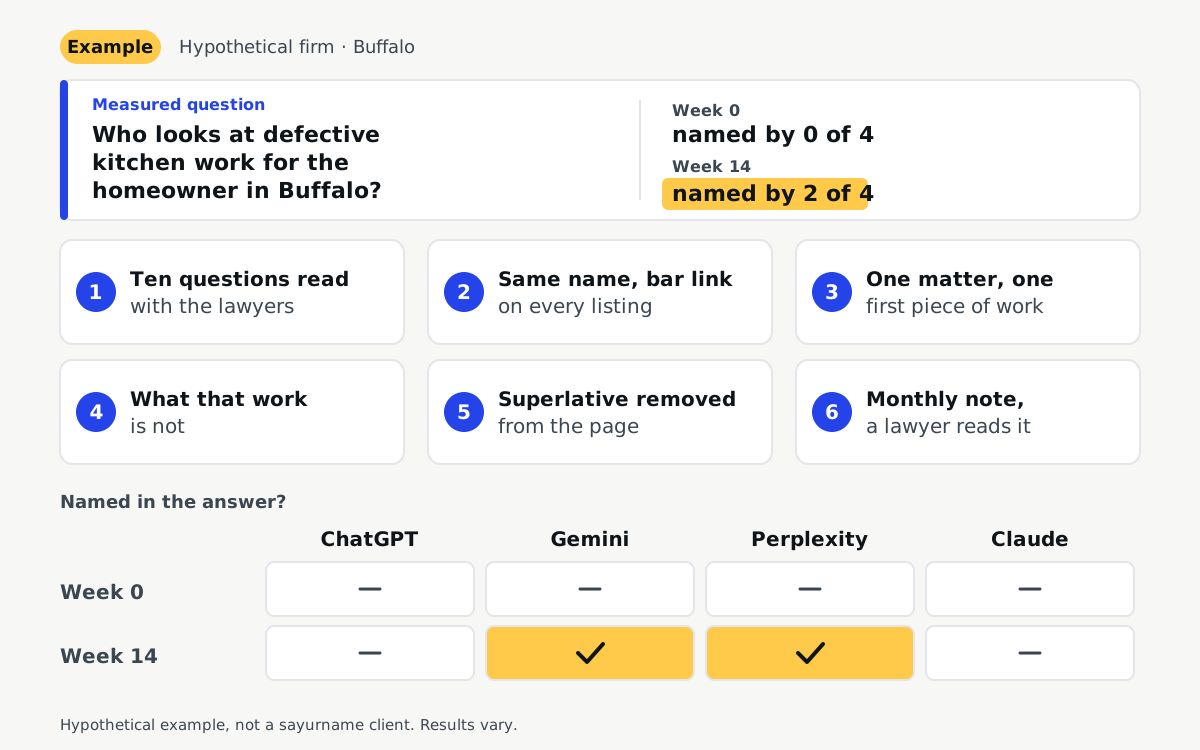
Example: a hypothetical firm, not a sayurname client. Imagine Elmwood Counsel in Buffalo, New York: two lawyers, twelve years, 90 Google reviews averaging 4.6. They act for a homeowner about defective work after a kitchen renovation. A first written look at the contract and the photos is $500 to $800. They do not do divorce. The site links to the New York bar lookup. The old site said “Buffalo lawyers for your family and your home” and a form.
Two questions were measured. “Who in Buffalo looks at defective work after a kitchen renovation for the homeowner?” And “Who in Buffalo handles a divorce?” At week 0 the firm was named by 0 of 4 on both.
- Read both sets of answers and kept them separate. The renovation question and the divorce question were not averaged into one rank.
- Fixed the base: the same legal name and address, with a link to the bar lookup.
- Replaced the combined page with one page: a homeowner’s first look at defective kitchen work, $500 to $800, not a divorce.
- Wrote that the firm does not do divorce, in a sentence, so the divorce question had nothing false to quote.
- Removed “Buffalo’s lawyers for every family problem”.
- Kept a monthly note on the renovation page, read by a lawyer. The divorce question stayed on the list only as a check that the firm was still absent, which was the intended result.
On the renovation question, nothing moved for six weeks. In week 8 Gemini named the firm and quoted the first look. In week 14 Perplexity followed. ChatGPT still named a firm that listed every home repair, and Claude named the firm in one run of four, which does not count.
On the divorce question the firm was still named by 0 of 4 at week 14. That was the result they wanted. A page that tried to cover both would have given the divorce answer a sentence the firm did not mean. Another firm might see neither question move.
When it is not worth it
If the firm truly wants both matters, each needs its own page, its own first piece of work, and its own check. One page with two headings is the combined page again. If the lawyers will not say which matter they decline, the assistant will keep guessing.
Nor does it pay when the bar record does not match the name, or the page promises a result on the renovation. Fix that before you measure two questions.
How the work runs
It starts with the free test. Once subscribed, we measure up to 10 questions every week and publish as much as we judge necessary for AI to cite your firm in the answers you want. Volume and format follow what each question needs, and that part is our call. We also ask for inclusion in the sites the assistants use. What we promise is the request, not the listing.
It costs $299 a month, with no lock-in. A one-time $599 bonus is charged only when an AI starts naming your firm for a measured question, checked by a person on our team, or Google Analytics shows a visit coming from an AI. Your firm stays responsible for validating the legal content of what is published, and each piece comes with one revision. It is not legal advice, and it promises no client.
Questions
Should one firm try to be on every list in the city?
Only on the questions whose pages it will sign. In the example, being absent from the divorce answer was the correct result.
Does a high review count carry from one matter to the next?
Not by itself. The renovation question moved when a page stated that work. The same reviews did not put the firm on the divorce list.
Can two matters share a page if the headings are separate?
Separate headings on one page still read as one claim. Give each matter its own page and its own first piece of work.
How long until the chosen question changes?
In the example, the first assistant named the firm on the renovation question in week 8 and the second in week 14. The divorce question did not move, on purpose.
What if the firm later starts doing the second matter?
Then publish that page, with its own boundary, and start its measurement from zero. Do not add a line to the first page and expect the old answers to update.